what is
Hulusi: Free Reeds, Melody Pipes and Drone Versions
Understand hulusi through its free-reed mechanism, gourd chamber, melody and drone arrangements, source-specific names and three complete identification cases.
Hulusi is a free-reed instrument with a melody and drone system
Start with the sound mechanism
Hulusi, 葫芦丝, is a free-reed wind instrument. In the MTSU instrument gallery’s description, breath supplies a gourd wind chamber connected to a melody pipe and a drone pipe. Each pipe contains a reed. The melody changes while the drone provides a continuing pitch. A gourd shape is a useful visible clue, but the reed-and-pipe arrangement explains why this instrument makes sound. [1]
The gallery describes a typical two-pipe arrangement, then says most modern hulusi add a second drone pipe. A three-pipe instrument and a two-pipe written description are therefore not automatically a contradiction. Keep the source’s version beside the count instead of turning either example into a rule for every model.
This page answers the identification question first: what produces the sound, how the named parts relate, and what a written record establishes. It then gives a model-reading example and questions for an actual instrument. It does not provide a fingering chart, a measured acoustic profile, a first-lesson result or a condition assessment.
Connect each named part with its musical role
The gallery’s description allows bamboo or wooden pipes and gives bamboo, bronze or silver as possible reed materials. These are distinctions between named parts: the material of the pipe does not automatically identify the material of the reed inside it. A photograph of a gourd or bamboo tube may leave the vibrating part out of view. [1]
| Part or role | What the account says | Useful explanation | Ask about the actual model |
|---|---|---|---|
| Gourd wind chamber | Common chamber connected to the pipe assembly. | Breath supplies the connected sounding system. | Which connected pipes are present? |
| Melody pipe | One melodic pipe in the typical arrangement, containing a reed. | The changing musical line belongs to this named role. | What key, usable notes and fingering chart are documented? |
| First drone pipe | A reed-bearing drone, normally tuned to the fifth in this account. | A continuing pitch can accompany the changing melody. | What is its actual pitch and how is it used? |
| Additional modern drone | Most modern examples add a second drone, at another pitch or in unison. | A third pipe can have a stated accompaniment role. | Is it a functioning drone, and what pitch does its record give? |
“Normally tuned to the fifth” describes a relationship in the source account. It is not an absolute note-name guarantee for an unidentified item. Likewise, a unison second drone and a differently pitched second drone are two described possibilities; choose the actual model’s record before assigning either one.
Do not infer simultaneous sounding from a count alone. Three visible pipes do not tell you which pipes sounded in a particular phrase, what control was used, or what the recording contains. Those questions need a clear model description and matched performance evidence.
Read two complete fictional model records
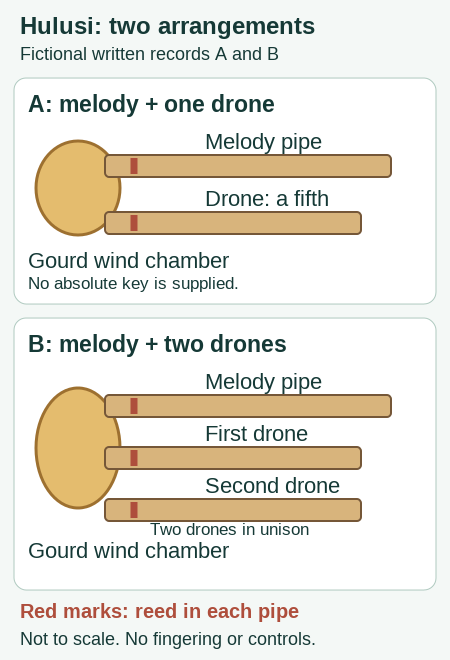
These are original teaching records based on the two arrangements described by MTSU. They are not museum objects, sale listings or an observed demonstration. Record A states: one gourd chamber, one melody pipe and one drone pipe; the drone is described as a fifth. Record B states: one gourd chamber, one melody pipe and two drone pipes; the two drones are in unison. Neither record supplies an absolute key, a fingering chart or a condition report.
| Record | Complete stated arrangement | Supported reading | Still unresolved |
|---|---|---|---|
| A | Gourd; one melody pipe; one drone described as a fifth. | Two pipes with different melody and accompaniment roles. | Absolute key, fingering, condition and actual control. |
| B | Gourd; one melody pipe; two drones in unison. | Three pipes; the accompaniment relationship is explicitly stated. | Absolute key, fingering, condition and which drones sound in a passage. |
| Unlabelled photograph | Three visible tubes and a gourd; no further record supplied. | A construction clue worth checking against an identified model. | Whether each tube functions, its pitch, reed and exact instrument identity. |
Record A does not become incorrect because Record B has an additional drone. Record B does not inherit an absolute pitch from Record A. The photograph supplies less than either complete written record. The appropriate output is a bounded description plus precise missing questions, rather than a manufactured tuning table.
Keep the instrument name beside its community and setting
MTSU places hulusi among minority ethnic groups in Yunnan, southwest China, and says different groups use different names. It gives a Dai example, bilangdao, explaining bilang as an end-blown pipe and dao as a gourd. Retain that attribution when reading the name. It is not a uniform vocabulary claim about every community in Yunnan or every instrument called hulusi. [1]
The entry describes soft, reedy tones and traditional use for dance accompaniment and personal entertainment. Those descriptions help interpret a named source; they do not identify the performer, place or occasion of an unrelated recording. A present concert programme or a particular player’s practice has its own evidence.
When a caption gives a performer’s own instrument name, community and occasion, preserve those details before replacing them with a broad label. When the caption gives only “Chinese flute,” the mechanism remains unresolved. Ask for an identified instrument or clearer record instead of deciding from a cultural mood word.
Compare sound production before comparing bamboo or tone words
Hulusi and lusheng both use free reeds and a common air-supply chamber in the gallery’s descriptions, but their pipe arrangements differ. The traditional lusheng account has six reed-bearing pipes and describes melody, chords and a drone; its named forms and community contexts remain separate. A common principle does not establish identical layout, tuning or fingering.
The described dizi is a transverse flute with a side mouth-hole and a dimo membrane over another hole. Its flute blowing interface differs from a hulusi’s reed system. Bamboo appears in both accounts, which is why material alone makes a poor identification rule. The membrane’s buzzing role also should not be confused with a hulusi reed hidden inside a pipe. [1]
Useful recognition begins with a matched label and visible mechanism. Sound adjectives such as soft or reedy can suggest a next listening question, but this revision did not audition an audio file. An uncredited short clip does not establish a model, drone arrangement, tuning or player identity.
Turn recognition into a specific model or first-lesson question
If you only need an identification, stop after explaining the free-reed mechanism and the supplied melody/drone arrangement. If you are preparing a lesson, ask the teacher which key and model the lesson uses and obtain its actual fingering chart. A broad gallery entry does not tell you where to place every finger.
For an item being considered for use, ask which pipes are functional, what the key and drone pitches are, and what the maker or teacher says about their controls. Request a model-specific condition or setup assessment when playability is the question. A visible gourd and a familiar name do not establish that the reeds or tuning are suitable for your intended lesson.
For a cultural or recording question, keep the source identity, performer description and occasion together. Use the existing sound, learning and comparison pages for their separate questions. The next step should resolve the actual missing fact, rather than add another broad definition.
Try three complete identification decisions
The following original fictional cases use the complete facts supplied in each question. Open an explanation after deciding what the evidence permits.
Case 1: a two-pipe description and a three-pipe model
A classroom note describes a typical hulusi with one melody pipe and one drone. A second identified model record describes one melody pipe and two drones in unison. A reader says one record must be wrongly labelled because the counts differ. Is that established?
Show answer 1
No. The described versions can legitimately differ. MTSU gives the typical two-pipe arrangement and says most modern examples add a second drone. Keep each complete arrangement and source together. Neither count alone supplies an absolute key or demonstrates every available version.
Case 2: an unsupported pitch guarantee
The only supplied record says its drone is normally a fifth. It gives no key or absolute note. A reader labels the drone “G on every hulusi” and adds a fingering diagram. What is unsupported?
Show answer 2
The absolute G guarantee and invented fingering chart. A relative fifth description does not name the actual key or assign every model an absolute pitch. Use the particular model’s documented tuning and fingering. The gallery’s variation account also leaves the second drone’s relationship to its own model record.
Case 3: bamboo without a reed record
An unlabelled picture shows a bamboo tube. It does not show a gourd chamber, reed assembly or blowing interface. A reader identifies hulusi because the tube is bamboo. What is the better next step?
Show answer 3
Keep the identity unresolved and obtain the label and mechanism. Bamboo appears in different instruments. The source describes hulusi through a free-reed melody/drone assembly and dizi through a transverse flute interface. The supplied photograph lacks the facts needed to decide between those or other possibilities; do not add unseen parts.
Sources and scope
- MTSU Center for Chinese Music and Culture: Instrument Gallery
Written Hulusi entry: free reeds, gourd, typical and modern pipe arrangements, source-specific naming and described use; named dizi/lusheng mechanism comparisons only.
The model records, tables and cases are original fictional explanatory material. This revision uses the gallery’s written descriptions; its linked audio and video were not auditioned.
The header diagram is an original schematic of fictional Records A and B. It is not a scale drawing, fingering chart, control diagram or measured model. The earlier Wikimedia Commons object-photo source remains available as a separate source link; that photograph was not used to establish these records or their tuning.
