Practical guide
Erhu, Gaohu and Zhonghu: Register and Orchestra Roles
Erhu, gaohu and zhonghu belong to the huqin family of bowed string instruments. In modern Chinese orchestras, gaohu commonly supplies a higher register, erhu a central register and zhonghu a lower one. Their playable ranges overlap, and the score decides whether each carries a melody, a countermelody, harmonic support or rhythmic texture. Use the tuning, construction and passage together rather than assigning each instrument one permanent role.
Start with three related instruments
| Instrument | Register relationship in this comparison | Construction or playing clue | Do not infer |
|---|---|---|---|
| Erhu 二胡 | The central reference among these three. | Two strings, a small resonating body and a bow passing between the strings. | That every singing bowed line must be an erhu. |
| Gaohu 高胡 | Higher open-string tuning than the erhu in the chart below. | A generally smaller soundbox; Guangdong and orchestral holding arrangements can differ. | That holding between the thighs is compulsory for every orchestral gaohu. |
| Zhonghu 中胡 | Lower open-string tuning than the erhu in this chart. | A larger body and thicker strings in the TOR comparison. | That it can only accompany or cannot play a solo line. |
MTSU describes the erhu's two strings and bow placement. [1] The Timbre and Orchestration Resource (TOR) describes the related instruments and their construction variants. [2] HKCO's own bowed-string guide lists erhu, gaohu and zhonghu among its orchestral instruments, with additional huqin types depending on the repertoire. [3]
This is a comparison within one family. It does not replace the broader distinction between bowed strings, plucked strings, winds and percussion. The new question is which related bowed instrument you are hearing and what its line does in one passage.
Read the open-string map before discussing range
The following original diagram uses the open strings shown in HKCO's published instrumentation and range table: gaohu G4–D5, erhu D4–A4 and zhonghu G3–D4. C4 means middle C. The table describes HKCO's own Eco-Huqin configuration and says these instruments sound as written. Treat it as a clearly identified example, not the mandatory tuning of every regional or specially configured instrument. [4]
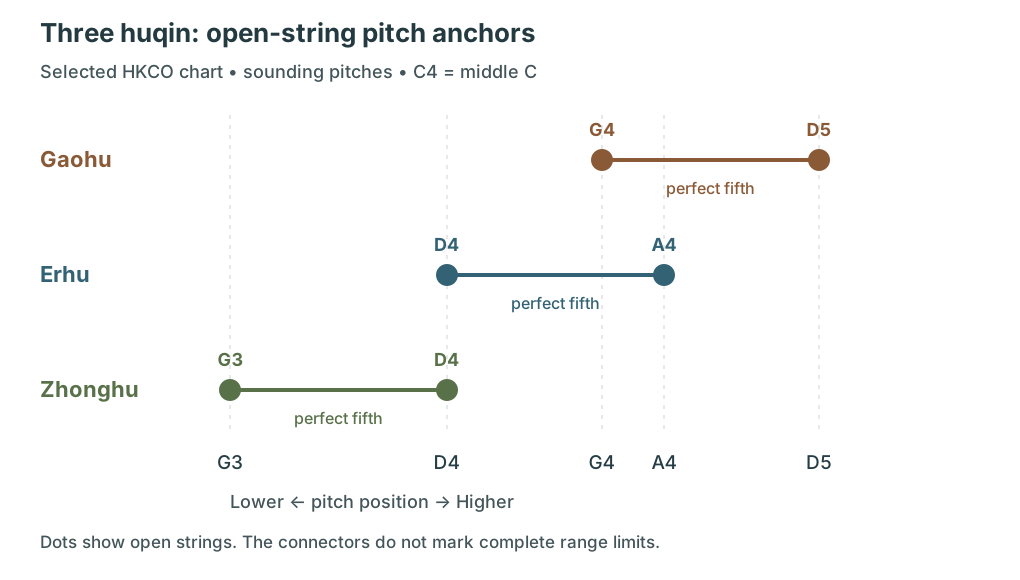
Each instrument's two open strings are a perfect fifth apart. Comparing corresponding strings between instruments is a separate operation: this gaohu pair is a perfect fourth above the erhu pair; this zhonghu pair is a perfect fifth below it. A fifth between an instrument's own strings does not mean every neighbouring huqin is tuned a fifth higher.
The TOR page's prose describes gaohu as a fifth higher than erhu, while its displayed open-string figures show the G4–D5 and D4–A4 pairs used here. We use HKCO's identified chart for the numerical tuning comparison and preserve that distinction rather than repeat the conflicting interval wording. [2] If another source gives different tuning, check which instrument variant and musical setting it describes.
Tuning, playable range and register answer different questions
Tuning names the open strings. Playable range includes notes obtained through fingering and relevant techniques. Register in a passage describes where the particular line sits—low, central or high in relation to the instrument or the surrounding music.
The right-hand dot in the diagram is therefore not the highest note the player can produce. The connectors join two open-string anchors; they are not bars enclosing a full playable range. HKCO's original chart shows ranges and extreme notes separately. For arranging, use the actual ensemble's current chart and a player's advice about practical passages rather than turn this introductory diagram into a scoring limit.
Overlap matters to listening. In the selected tuning, erhu's lower open D4 is also zhonghu's upper open D4. That shared pitch does not give the instruments identical timbre or make every D4 an open string in every performance. Players can produce a pitch in different positions, and the technique, dynamics and orchestration affect the sound.
Likewise, hearing a high note does not establish “gaohu.” An erhu player can move into a higher register. Compare a labelled performance, the visual evidence and the line's relationship to other parts. When the recording does not identify the instrument clearly, keep the name uncertain.
Use appearance and holding position as clues
Look for the family resemblance first: a long neck, small soundbox, two strings and a bow operating between them. MTSU describes those erhu features, while TOR explains the family construction, including a membrane soundboard and the absence of a fingerboard. [1] [2]
Then check the variant. TOR describes the Guangdong gaohu as held between the thighs, without the baseplate and cloth arrangement of the erhu. It also describes orchestral gaohu versions with a baseplate and cloth below the bridge, resting against the left thigh and body. A distant photograph of a player resting an instrument on the thigh does not therefore rule out gaohu.
A zhonghu's larger body and thicker strings can help when comparing clearly labelled objects at a similar scale. Camera angle, cropping and perspective make size unreliable across unrelated photos. Hexagonal versus cylindrical soundbox shape is also not a sufficient three-instrument identification key: TOR notes multiple shapes within the family.
Material clues need context too. A snakeskin surface is not an unconditional family requirement. HKCO's table explicitly identifies its instruments as the orchestra's own Eco-Huqins. A recording label or a player's instrument specification is stronger evidence than assuming that one visible material determines the name.
Two annotated examples show roles changing
Dance of Yao: melody and countermelody
TOR's annotated excerpt of Dance of Yao, by Liu Tieshan and Mao Yuan, arranged by Peng Xiuwen, identifies the erhu, zhonghu and cello as carrying the long melody, with gaohu on a countermelody. The source marks the example around 4:00 in its linked performance. [2]
Use that annotation as a focused listening task: follow the shared melodic phrase, then look for the different higher line. Zhonghu is participating in the melody here, not merely supplying a permanent background role. Register separation and timbre work together to make the parts distinguishable.
Unforgettable Water Festival: a shared melodic line
For Liu Wenjin's Unforgettable Water Festival, TOR describes gaohu and erhu taking the same melodic line and coordinating characteristic slides. Its annotated example begins around 1:15 in the linked recording. This is a different job from “gaohu always plays the countermelody.”
The examples above report the educational source's score and performance annotations; this site has not made an independent audio measurement or reproduced the recordings. Open the original source for its score images and linked performances. If you use another upload, timestamps and even the arrangement may differ, so check the passage rather than paste the old time into your notes.
A part can also sustain harmony, double another line, punctuate rhythm or change its job later in the piece. “Higher instrument” describes a useful register tendency; “melody” describes what the part is doing at that moment.
Four comparison cases
Try the reason before opening each explanation. These original cases use the specified chart and source annotations, not an automatic listening test.
Case 1
The selected chart gives erhu D4–A4 and gaohu G4–D5. Does “each instrument has strings a fifth apart” mean this gaohu is a fifth above this erhu?
Show answer and explanation for case 1
No. The interval within each pair is a fifth; comparing corresponding gaohu and erhu strings gives a fourth.
D4 to G4 and A4 to D5 are perfect fourths. Keep within-instrument tuning separate from the register relationship between instruments.
Case 2
In a modern orchestra video, a small huqin rests on the performer’s left thigh instead of being held between both thighs. Must it be an erhu?
Show answer and explanation for case 2
No. TOR describes orchestral gaohu versions that also rest against the left thigh and body.
The Guangdong holding convention does not identify every orchestral version. Use the recording label, instrument configuration and other visible evidence together.
Case 3
A low-register bowed instrument joins erhu and cello on the melody in TOR’s Dance of Yao example. Does that contradict its identification as zhonghu?
Show answer and explanation for case 3
No. Zhonghu can carry or double a melody; its lower register does not confine it to accompaniment.
The annotation identifies zhonghu in the shared melodic line. Register and passage role are related choices, not synonyms.
Case 4
A recording has a bright high bowed note, but the upload gives no instrument labels or clear view of the player. Is “definitely gaohu” a justified result?
Show answer and explanation for case 4
No. Record the audible clue and leave the identification uncertain until you can check it.
Ranges overlap, erhu can play high notes, and technique and recording affect timbre. One adjective or pitch is weaker evidence than an identified performance and visible instrument.
Fill a listening record for one short passage
Download the plain-text listening record (TXT). Choose a clearly labelled performance or teaching demonstration. You can begin with the annotated TOR examples or MTSU's erhu demonstration link. The blank record is an original note-taking aid, not a scored ear-training exam.
| Record | My note |
|---|---|
| Piece, arrangement and ensemble | ________________ |
| Original link and instrument labels | ________________ |
| Passage start/end time | ________________ |
| Instrument and evidence for its name | ________________ |
| Appearance/holding clue and variant | ________________ |
| Register relative to which other line? | ________________ |
| Attack, sustain or articulation noticed | ________________ |
| Role in this passage | ________________ |
| Another instrument sharing the line | ________________ |
| Uncertainty and how to check it | ________________ |
On a second pass, follow just one line instead of naming every instrument. On a third, compare its role with another passage. A useful result might be “labelled gaohu, higher counterline at this timestamp; later shares the melody.” That says more than “gaohu sounds happy” and keeps the observation tied to a particular piece.
Sources and further reading
- MTSU Center for Chinese Music and Culture: Instrument GalleryErhu construction, two strings, bow placement and a labelled demonstration link; no gaohu/zhonghu tuning facts attributed to this gallery.
- Timbre and Orchestration Resource: Erhu, Gaohu and ZhonghuConstruction and Guangdong/orchestral gaohu variants; annotated Dance of Yao and Unforgettable Water Festival examples. Conflicting gaohu interval prose is distinguished from the selected HKCO tuning chart.
- Hong Kong Chinese Orchestra: Bowed-string InstrumentsThe orchestra’s huqin configuration and repertoire-dependent additional instruments.
- HKCO: Instrumentation and Range Table (PDF, 2025 chart)Visually checked open-string rows for gaohu G4/D5, erhu D4/A4 and zhonghu G3/D4, plus the sounds-as-written and Eco-Huqin footnote. Original source includes practical and extreme ranges; this article’s diagram shows only open-string anchors.