Practical guide
Yangqin Strings, Courses and Bridges: How the Layout Works
Understand parallel strings and bridge-divided spans, then distinguish physical wires, strike positions and distinct pitches with a complete example.
A string, a course and a playing span are different
A yangqin has more physical strings than a simple one-string-per-note picture suggests. Parallel strings can serve the same note, while bridges divide a string into different playing spans. Counting every visible wire, support or strike location as an independent pitch mixes different parts of the layout.
Here, a course means a group of parallel strings intended to sound together for a note at a corresponding playing span. A span means the string length between support boundaries that a player can strike. The actual tuning decides whether two available spans produce different pitches or duplicate a pitch available elsewhere.
TOR’s construction account describes multiple strings for notes—two for lower notes and up to five for higher notes in its selected account—and strings divided by bridges. Use this as an explanation of the design idea, not a guarantee that every yangqin model uses identical counts.
On a narrow screen, swipe the table sideways or focus it and use the right-arrow key.
| Quantity | What you count | What that count alone cannot establish |
|---|---|---|
| Physical strings | Individual wires | Distinct pitches or the complete range |
| Course at a span | Parallel strings intended for a note | The note name without the tuning map |
| Playing spans | Lengths between support boundaries | A universal interval between them |
| Bridge rows | Rows of supporting structures | One note per bridge or one octave per row |
| Distinct pitches | Different tuned notes available | Their easiest fingering or practical speed |
Follow wires, supports and strike positions in that order
Start with a labeled diagram for the actual model, rather than trying to tune from a general photograph. Trace a physical string from its end supports and note where bridges divide its path. Then inspect which parallel wires form the corresponding group and which spans the note chart identifies.
A bridge is a support boundary, not a note label. One wire may offer more than one playing span, and different courses or positions can duplicate a pitch. The model’s chart tells you how those positions are named. A larger number of visible strings therefore does not automatically imply a proportionally larger musical range.
TOR describes tuning pegs on either side of the instrument and a wooden fan-shaped soundbox. Its introduction explains changes from earlier bridge arrangements to modern chromatic capabilities. Those details locate the design, but they are insufficient for giving a universal note-by-note tuning procedure.
This is an anatomy-reading task. It does not instruct you to move bridges, loosen strings or replace wire. For adjustments, obtain the actual maker’s directions and appropriate guidance; a schematic cannot substitute for the instrument’s setup information.
Work through a complete fictional course example
Suppose an original teaching model has three parallel wires, each with two indicated playing spans. Assume all three left spans are tuned to the same pitch A and all three right spans to another pitch B. A and B are placeholders, not note names from a real instrument.
The model contains 3 physical wires, 6 indicated strike positions and 2 distinct pitches. Three copies of A do not become three different pitches. Likewise, the two spans on each wire do not turn it into two physical wires.
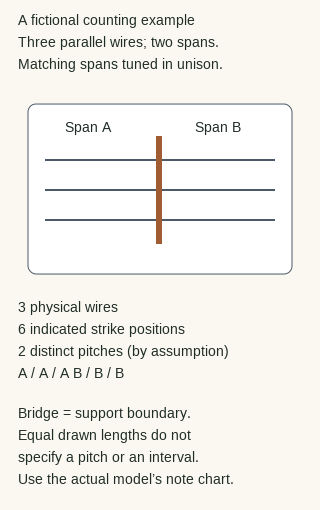
If B were instead tuned to A, this fictional model would offer one distinct pitch despite retaining six indicated positions. If the corresponding wires were not in unison, the assumption underlying the course example would fail. You would need the actual tuning information rather than retaining the result by force.
The drawing’s equal-looking lengths specify no acoustic interval. Real pitch depends on string and setup properties, and the actual bridge arrangement may be quite different. Do not infer an octave, frequency or maker’s note map from the cartoon.
On a narrow screen, swipe the table sideways or focus it and use the right-arrow key.
| Assumptions | Physical wires | Indicated positions | Distinct pitches |
|---|---|---|---|
| 3 wires × 2 spans; matched spans A/A/A and B/B/B, A≠B | 3 | 6 | 2 |
| Same wires and spans; every indicated position tuned to A | 3 | 6 | 1 |
How the mallets use the layout
The player normally strikes strings with thin bamboo mallets in the TOR description. An attack can involve the parallel strings at a playing location; the instrument is not organized like a keyboard with one visible key for every note. The written pitch still needs to be connected to an actual position on the player’s model.
For a first learning exercise, ask the teacher to point to one named note on the model’s map, show its corresponding span and demonstrate the strike. Then ask whether the same pitch is available at another position. That small comparison makes the layout understandable without guessing the entire instrument from string count.
TOR’s practicalities describes variations between models and qualifies the extreme registers. It discusses a movable bridge on a named 402 model. Keep that as a source-specific design description rather than an instruction to reposition your bridge. A 402 label alone does not supply a current maker’s exact revision or procedure.
The source’s broad chromatic description should also be read with the extreme-register qualifications. For an arrangement, ask the actual player about usable notes, passage layout and practical transitions. A general statement that modern yangqin can play chromatic music does not certify every extreme note on every model.
Three layout cases with complete answers
These fictional checks use explicit assumptions. They do not report a tested instrument.
Case 1
Three parallel wires each have two indicated spans. Corresponding left spans all sound A and right spans all sound B, with A different from B. How many wires, positions and distinct pitches are specified?
Show answer and explanation for case 1
3 physical wires, 6 indicated positions and 2 distinct pitches.
There are 3 × 2 = 6 positions, but the three copies of A and three copies of B collapse to two pitch identities. The model’s stated unison assumption supplies that result.
Case 2
A seller photographs many wires and four bridge rows but supplies no note chart. Can you calculate the exact number of different pitches from those counts?
Show answer and explanation for case 2
No. The counts do not specify the tuning or duplicated pitches.
Wires, bridge rows, playing spans and pitch identities are different quantities. Request the exact model/revision map rather than assume one pitch per wire or per bridge.
Case 3
A fictional model retains three wires and two positions per wire, but every indicated span is tuned to A. Does it still have two distinct pitches?
Show answer and explanation for case 3
No. It has one distinct pitch under the new assumption.
The physical and position counts remain 3 and 6. Distinct pitch count depends on the specified tuning; equal diagrams or different locations do not by themselves imply different notes.
The useful information to request next
For the instrument you will use, request the maker and model revision, a clearly oriented note chart, the stated tuning and the explanation of duplicated notes or special extreme-register positions. Ask a teacher or player to demonstrate the same short passage while pointing to the relevant positions.
For buying, keep condition and setup separate from a large string-count claim. For arranging, confirm the actual player’s layout and practical notes. For tuning or repair, use the maker’s procedure and the appropriate assistance. The basic yangqin guide provides the broader context; this page resolves the narrower anatomy and counting question.
If your question is why a hammered-string instrument is listed with plucked instruments, use the orchestral family guide. Section membership and the way a note starts remain two useful explanations of the same instrument.
Sources and further reading
- Timbre and Orchestration Resource: Plucked Strings — In-depthConstruction descriptions of sanxian membrane transfer, modern ruan body/frets, yangqin multiple strings and bridge divisions. Selected instruments; exact maker layouts are not specified.
- Timbre and Orchestration Resource: Plucked Strings — PracticalitiesSanxian fretless playing, pick/finger-plectrum options and yangqin mallet techniques. Model and extreme-register qualifications; linked recordings and score images are not reproduced.
- Timbre and Orchestration Resource: Plucked Strings — IntroductionSmall/large sanxian context and changes in modern orchestral instruments; no universal model specification or fixed ancient origin adopted.
- Hong Kong Chinese Orchestra: Plucked-string InstrumentsThis orchestra lists sanxian, ruan sizes and yangqin in its plucked section; mechanism and section membership remain separate questions.