Start with the verified clip
Use the licensed Erhu sample, then read the sound section before comparing a second instrument.
Open sound pathInstrument guide
Understand the erhu’s two strings, bow, bridge and resonator. Learn its huqin context, compare related instruments and use a setup checklist before a first lesson.
A credited erhu practice clip. Recording conditions do not measure your room’s practice volume; use the sound and construction guides for a focused comparison.
Erhu practice sample by irzirgpznj. Source, Creative Commons 0.
Identify the erhu, connect its parts to bowing and pitch control, and arrange a first lesson with a playable setup and one clear practice goal.
The erhu (二胡, èrhú) is a two-string Chinese bowed instrument in the huqin family
Sound routeUse the clip, then read the cueThe bow supplies energy while the string sounds
Learning routeChoose a realistic next stepBegin with a demonstrated seated position and instrument support
Use the licensed Erhu sample, then read the sound section before comparing a second instrument.
Open sound pathUse the roadmap to decide whether teacher access, room volume, setup work, and practice feedback match your situation.
Open learning pathTreat price as the last comparison after setup, accessories, return terms, first-lesson fit, and a nearby-instrument check.
Open decision pathStart with attack and sustain, then check construction or credits.
Use the sound guideCheck register relationships and source descriptions rather than mood labels.
Compare related huqinAsk for support, setup and feedback on one bowing action.
Plan a first taskUse the sound guide to separate Erhu attack, sustain, and ensemble role from nearby instruments.
02 / LearnCheck the first monthConfirm teacher access, practice volume, setup friction, and the first small win before committing.
03 / RepertoireListen with a score goalMove from naming the instrument to hearing what a piece asks the player to do.
04 / BuyAvoid the common bad purchaseUse setup, return terms, accessories, and inspection cues before comparing only price.
05 / CompareTest the neighboring choiceCompare the closest alternative so the final choice is about sound, space, and learning fit.
The erhu (二胡, èrhú) is a two-string Chinese bowed instrument in the huqin family
SoundHow bowing creates a flexible melodic lineThe bow supplies energy while the string sounds
BuildParts to understand before changing anythingThe bridge transfers string vibration to the membrane and resonator
HistoryHuqin ancestry and the modern erhuMTSU's instrument gallery places erhu within the huqin family and describes its movement from earlier vocal and small-ensemble s...
PiecesListen to solo and section roles separatelyA useful repertoire example gives you a listening job
LearnA small first-lesson sequenceBegin with a demonstrated seated position and instrument support
BuyingChoose a playable instrument, not a generic accessory bundleAsk what the seller includes for an erhu lesson: the instrument, an appropriate bow, strings and the practical items your teache...
NextChoose the comparison that answers your remaining questionUse the erhu sound guide if you are still identifying a recording
Identify the erhu, connect its parts to bowing and pitch control, and arrange a first lesson with a playable setup and one clear practice goal.
The erhu (二胡, èrhú) is a two-string Chinese bowed instrument in the huqin family. A standard acoustic instrument has a long neck, a small resonator and bow hair placed between its two strings. The right hand moves the bow; the left hand contacts the strings to control pitch.
It is useful to compare erhu with violin because both use bow-driven string vibration. The analogy has limits: the standard erhu is played upright, has two strings and has no fingerboard for the left hand to press against. Its posture, bow interface and pitch control need their own instruction.
Identify the actual instrument rather than its cover photograph. A clear performance video or collection label can connect construction with a name. A still image over an unrelated soundtrack cannot confirm which instrument produced the music.
Two strings and bow hair between them are strong visible clues.
A violin comparison helps with mechanism, not identical technique.
What Does an Erhu Sound Like? Listening Cues and Comparisons
Read this section alongside MTSU Center for Chinese Music and Culture Instrument Gallery. Two strings and bow hair between them are strong visible clues.
The bow supplies energy while the string sounds. A player can change speed, direction and force to shape the start and continuation of a note. The left hand can add pitch movement, vibrato and slides. These actions help explain why erhu is often described as singing or voice-like.
The instrument also plays short articulated notes, agile passages and ensemble textures. Timbre and Orchestration's examples show bowed strings carrying melody, supporting harmony, passing tremolo figures and adding rhythmic punctuation. One slow recording does not define all of that vocabulary.
For a first listening exercise, follow attack, sustain and pitch movement in separate passes. Use the credited practice clip on this page as one example, then compare a clearly credited ensemble passage. Recording level, microphone position and processing affect the apparent tone and loudness; they do not measure how your own instrument will sound in your room.
Listen for the bow’s effect throughout the note.
An online clip is not a practice-room volume measurement.
What Does an Erhu Sound Like? Listening Cues and Comparisons
Read this section alongside Timbre and Orchestration: Chinese Bowed Strings and Freesound: Erhu File and Uploader Description. Listen for the bow’s effect throughout the note.
Notice whether the start is connected or articulated.
Replay the same phrase before comparing a different recording.Listen for continued bow-driven energy or repeated attacks.
Use the sound guide to compare a pipa tremolo.Distinguish a slide from vibrato or a new note.
Leave the observation uncertain if processing or noise hides it.Separate melody, accompaniment and punctuation.
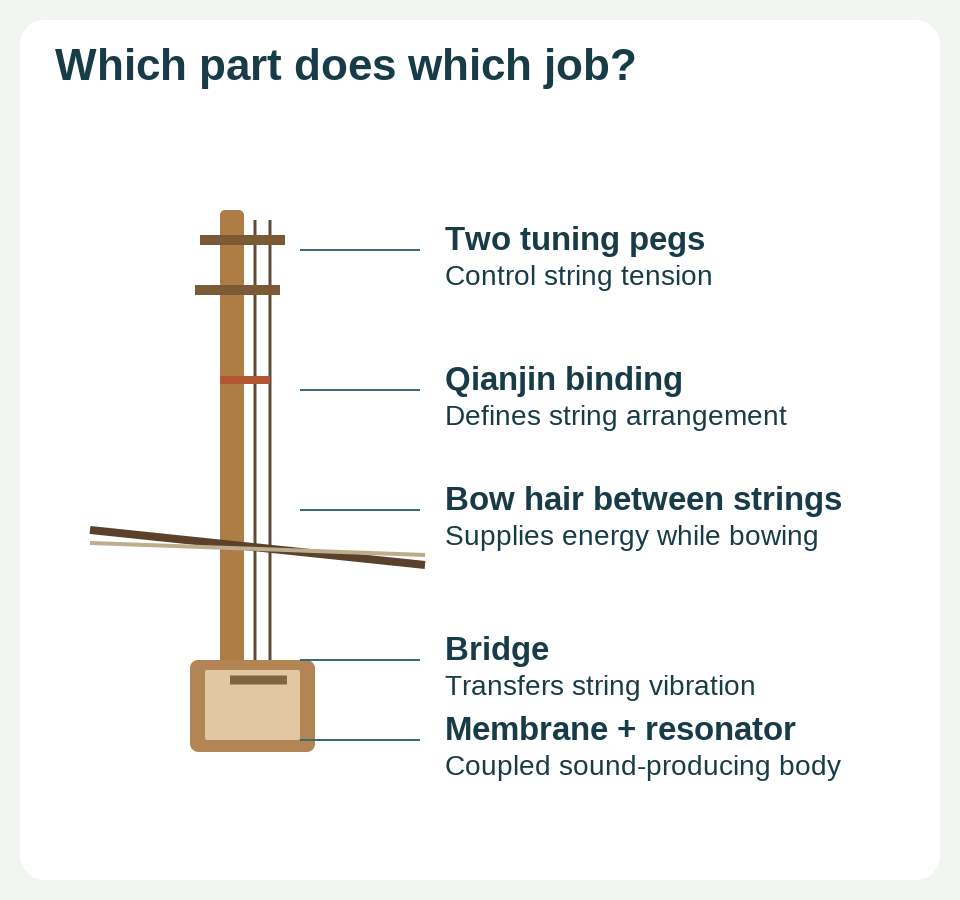
Check the program or source description for the instrument credit.The bridge transfers string vibration to the membrane and resonator. The qianjin is the binding that draws the strings toward the neck and helps define their working arrangement. Two tuning pegs control string tension. The neck gives the left hand a reference, while the strings are stopped without a fingerboard underneath them.
The bowed-string resource describes traditional skin membranes and the development of synthetic alternatives. Materials and construction can vary. A photograph may show the broad layout, but it cannot reliably prove membrane condition, bow playability, string stability or the absence of unwanted noise.
Ask a teacher or knowledgeable repairer to demonstrate the setup before moving the bridge or qianjin. A beginner who cannot yet separate a bowing issue from a setup issue can make the problem harder to diagnose by changing several things at once. Start by understanding each part's job, then make an agreed adjustment if one is needed.
| Part or condition | Useful question | Why it matters |
|---|---|---|
| Bow and bow hair | Can the intended bow action be demonstrated on this setup? | The bow is central to obtaining a controlled first tone |
| Strings and tuning pegs | Do the strings and pegs hold the tuning used for the lesson? | Unstable tuning makes pitch feedback harder |
| Bridge and qianjin | Has their setup been checked by someone familiar with erhu? | Their arrangement affects playing and sound |
| Membrane and resonator | Are condition and material described, with a setup assessment? | Appearance alone cannot settle acoustic condition |
| Support, posture and reach | Can a teacher see and correct the actual seated setup? | A playable instrument still needs a workable playing position |
| Transport and returns | What protection and return terms are provided? | A beginner needs a clear next step if the instrument arrives unplayable |
A bridge and qianjin have specific setup functions.
Ask for a demonstrated setup assessment before unfamiliar adjustments.
What Does an Erhu Sound Like? Listening Cues and Comparisons
Read this section alongside Timbre and Orchestration: Chinese Bowed Strings. A bridge and qianjin have specific setup functions.
MTSU's instrument gallery places erhu within the huqin family and describes its movement from earlier vocal and small-ensemble settings into modern concert and cross-genre use. A broad family history is not the same thing as a precise invention date for the modern instrument.
The orchestration resource describes erhu as important in traditional instrumental ensembles before the twentieth century and in the development of the modern Chinese orchestra. It also notes twentieth-century changes such as increasing use of metal strings and design changes intended to improve sound and projection.
Hong Kong Chinese Orchestra lists erhu alongside gaohu, zhonghu, gehu and bass gehu in its bowed-string configuration, with other huqin used according to repertoire. That describes one orchestra's choices. Different ensembles, regional traditions and programs can use different combinations.
Separate huqin family history from the current instrument’s form.
One orchestra’s configuration is not a universal seating rule.
Read this section alongside Timbre and Orchestration: Chinese Bowed Strings and Hong Kong Chinese Orchestra: Bowed Strings. Separate huqin family history from the current instrument’s form.
A useful repertoire example gives you a listening job. Timbre and Orchestration's First Erhu Rhapsody example, credited to Wang Jianmin, highlights a passage where tremolo figures pass through the bowed-string registers with dynamic changes. Follow which line changes rather than assuming every sound is one solo erhu.
Its Dance of Yao example, credited to Liu Tieshan and Mao Yuan and arranged by Peng Xiuwen, describes erhu, zhonghu and cello carrying a melodic theme while gaohu contributes a countermelody. Use that source-hosted example to hear a section's blend and division of roles. It is an orchestral example, not an isolated erhu demonstration.
The Freesound practice sample on this page has a different purpose. It is credited to uploader irzirgpznj, who identifies it as a practice excerpt; the file page displays a Creative Commons 0 license. Keep that credit and recording context with the clip. Move between examples because they answer different listening questions, rather than collecting a long list of titles.
Use a credited example and a specific listening task.
A named work and a translation of its title should not be counted as separate pieces.
Read this section alongside Timbre and Orchestration: Chinese Bowed Strings. Use a credited example and a specific listening task.
The source example describes tremolo figures passed across the section with dynamic changes.
Use the credited source-hosted score and example; do not identify every line as solo erhu.The source describes erhu, zhonghu and cello on the melody and gaohu on a countermelody.
Follow one role, then compare with the solo practice excerpt.Begin with a demonstrated seated position and instrument support. Ask the teacher to show how the right hand controls the bow and how to work on an open string before adding several left-hand demands. A first clear goal might be to reproduce one demonstrated bow action and describe where the tone changes.
When appropriate, add a short stopped-note exercise. Without frets or a fingerboard, the left hand needs feedback on placement and pitch. Repeating an uncertain pitch quickly does not solve that problem. Agree on a reference and a way to compare your result, such as the teacher's demonstration or the tuning approach used in the lesson.
For online learning, test the view of both hands and the instrument before relying on it. Keep the task short enough that a teacher can see the motion and hear the relevant sound. If a movement becomes uncomfortable, stop it and ask for a correction rather than forcing a posture or practice quota.
Download the blank worksheet (TXT)
Fill it with your own observations, source details and next question.
Start with support and one bowing action.
Test the actual camera and sound for online instruction.
Read this section alongside the reference list. Start with support and one bowing action.
Repeat the action agreed with a teacher on an open string.
You can describe one audible or visible point for correction.Use the teacher’s agreed reference and compare a small phrase.
You can connect left-hand placement with the pitch being checked.Add one musical demand at a time.
You can explain the written notes separately from bowing instructions.Compare credited examples with different textures.
You can distinguish what a solo clip and a section example each demonstrate.Ask what the seller includes for an erhu lesson: the instrument, an appropriate bow, strings and the practical items your teacher recommends, such as a suitable case, rosin or a tuning reference. Reeds and mallets are not erhu playing accessories. A dizi-style spare membrane sheet is not a universal maintenance item for an erhu resonator.
Ask about condition, setup assessment, transport protection, return terms and access to help after delivery. These questions matter at any price. A low price does not prove a fault, and an expensive listing does not prove a beginner-ready setup. Close photographs and a seller description should be followed by a competent playability check when you are choosing a lesson instrument.
If your main interest is listening, you can explore the music without purchasing. If you want to learn, ask about trial, rental or shared lesson-instrument options before committing. The scenarios below help choose the next action from the information that is actually missing.
These are illustrative examples for working through the decision.
A beginner finds a listing with attractive photographs but no playability check, bow description or return terms.
What should happen before purchase?
Ask for the missing information and arrange a teacher or setup assessment. A photograph identifies some visible parts but does not prove that the instrument can support the first lesson.
A new learner hears a squeak and wants to move the bridge, replace strings and change the bow at once.
What is the more useful next action?
Ask a teacher to check the demonstrated bow action and setup, and change one agreed factor at a time. Several simultaneous changes make it harder to distinguish technique from an instrument problem.
A violinist expects to press the erhu strings onto a fingerboard and use the same playing position.
Which differences need a demonstration?
The upright support, bow hair between the strings and left-hand stopping without a fingerboard. Musical experience helps, but those physical interfaces need their own instruction.
A learner hears an amplified or closely miked ensemble clip and assumes a home lesson instrument will have the same loudness.
What evidence would help more?
A practical demonstration with a comparable room, setup and playing level. Recording gain and ensemble texture do not provide a reliable measurement of apartment practice volume.
Use an erhu-specific accessory list agreed with the teacher.
A two-string instrument is not automatically easy; decorative appearance, a low price or a beautiful recording cannot establish playability for a first lesson.
What Does an Erhu Sound Like? Listening Cues and Comparisons
Read this section alongside Timbre and Orchestration: Chinese Bowed Strings. Use an erhu-specific accessory list agreed with the teacher.
Use the erhu sound guide if you are still identifying a recording. Use the erhu, gaohu and zhonghu resource if the question is which close huqin relative is playing. A violin comparison is useful for construction and playing position; a pipa comparison is useful when you are separating continuous bowing from repeated plucks.
For learning, write down the one missing check: feedback, setup, support, tuning or a demonstrated first task. Ask that question before adding repertoire or a purchase goal. For a classroom activity, let students connect visible parts with a sound-making action before asking them to memorize names.
You have a useful first understanding when you can explain what vibrates, how the bow supplies energy, how the left hand changes pitch and what evidence supports the instrument name. The next page should resolve whichever of those questions remains open.
String count does not remove the need for bow control, pitch placement and feedback. A first lesson can still begin with a small manageable action.
The standard acoustic erhu has neither frets nor a fingerboard for stopping the string. The left hand controls pitch through string contact and placement.
They are related huqin, but their usual tuning, size and roles differ. Check a credited instrument view or program when identifying them.
A trial or lesson-instrument option may help you assess the playing process and setup first. If you buy, arrange a competent check and confirm the seller’s condition and return information.
Choose a comparison from the actual uncertainty.
Explain sound-making actions before memorizing a label.
Read this section alongside the reference list. Choose a comparison from the actual uncertainty.