Practice worksheet
Dizi, Xiao and Xun: How They Produce Sound
Dizi, xiao and xun are flutes, but the player meets a different blowing interface on each. A dizi is held across the body and blown at a side hole; a xiao is held vertically and blown at its upper rim; a xun is a hollow vessel with a blowing opening on top. Common dizi types add a dimo membrane over a separate hole. Check the instrument variant and visible construction before relying on words such as bright, airy or mellow.
Start with the blowing interface
The quickest useful comparison is not “which sounds most Chinese?” It is where the player directs the air and what body resonates. This distinguishes a transverse tube, a vertical rim-blown tube and a vessel without turning one recording into a universal tone chart.
| Instrument | Body and playing interface | Useful visible clue | Important limit |
|---|---|---|---|
| Dizi 笛子 | Usually a bamboo transverse flute, blown across a side hole. | In common membrane types, a separate dimo hole sits along the tube. | Xindi has no membrane hole; a buzz is not compulsory for every dizi type. |
| Xiao 箫 / 簫 | A vertical tube flute, blown at its upper rim. | The mouth meets the upper end rather than a side hole. | Northern and southern forms differ; one photographed mouth end is not every variant. |
| Xun 埙 / 塤 | A hollow vessel flute, commonly clay, with a blowing hole above the cavity. | The body encloses a chamber rather than continuing as a long tube. | Shapes and finger-hole numbers vary. |
MTSU’s instrument gallery describes the dizi and xun construction. [1] The Timbre and Orchestration Resource (TOR) identifies xiao as a rim-blown vertical flute and distinguishes dizi types. [2] “Wind instrument” is the broad family; it does not mean that each instrument contains a reed.
Read the three structures in one diagram
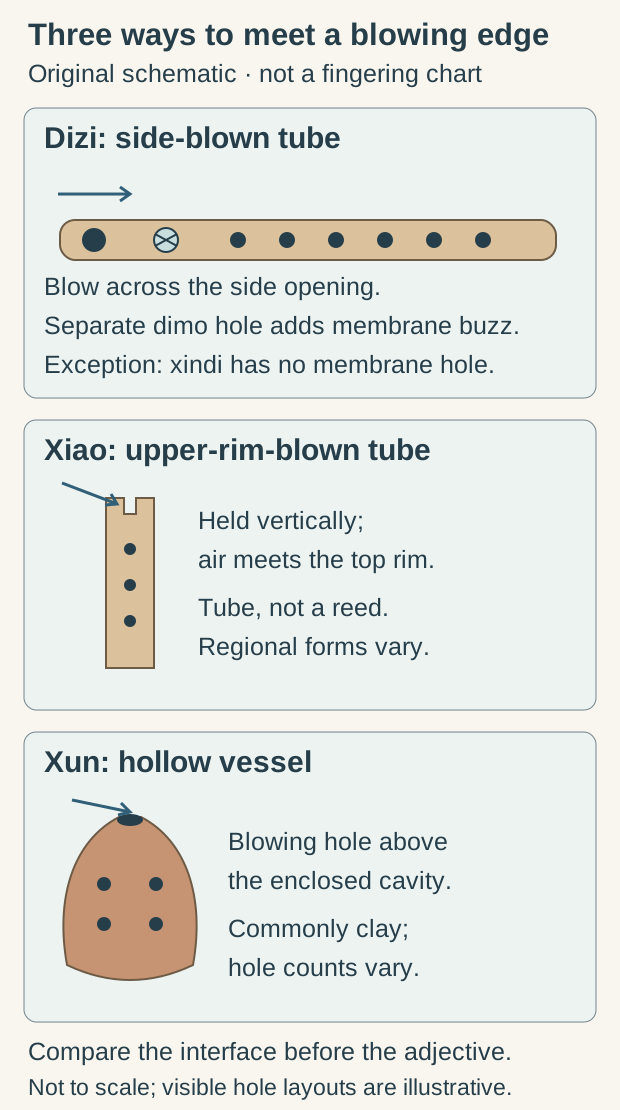
Download the original comparison diagram (SVG). Follow each air arrow to the blowing edge before looking at the finger holes. The arrows describe the interface; they do not prescribe a lip angle or a breathing technique.
The dizi’s membrane is shown separately from its blowing hole. The xiao panel shows a simplified upper rim; actual mouth-end construction varies. The xun panel shows a cavity, with an opening above it. None is a fingering chart, a maker’s plan or a complete list of holes on every instrument.
Dizi: separate the blowing hole from the dimo
MTSU describes a common dizi as a bamboo length with a mouth-hole, six finger holes and a separate hole covered by a thin bamboo or reed membrane, called dimo. That sheet vibrates and contributes the characteristic buzzing colour. “Reed membrane” names the material of a covering; it does not make the dizi a reed instrument. [1]
The blowing hole is where the player directs the air. The membrane hole has a different job. Finger holes control the played notes, while the membrane affects the sound colour. Seeing more openings than six therefore does not necessarily contradict “six finger holes”: you may be counting openings with different functions.
TOR distinguishes bangdi, qudi and xindi. It describes the smaller bangdi as bright, resonant and clear, and qudi as thicker and mellower. It explicitly says that xindi has no membrane hole and lacks that characteristic membrane buzz. [2] Use these as qualified descriptions of types, not a rule that every dizi is bright and every mellow flute is xiao.
When a demonstration does not show the membrane hole clearly, record “not visible.” That is different from proving it absent. A distant camera, the player’s hand or a cropped frame can conceal the relevant part.
Xiao: look at the upper end of the tube
The xiao’s useful distinction here is its rim-blown vertical interface. The player directs the air at the upper rim of the tube rather than a transverse side hole. TOR also uses the spelling siao and describes northern and southern versions. [2]
This is a construction comparison, not an instruction to seal the end and blow straight down as though it were a whistle. The blowing edge matters. A learner should use instruction for the actual instrument’s mouth end, since the simple label “vertical flute” does not supply a complete embouchure lesson.
A long tube held upright is a useful initial clue, but orientation alone does not identify xiao. Check whether the upper end is visible, how the player meets it and what the source calls the instrument. Do not substitute a guessed finger-hole count or a quiet passage for that evidence.
TOR says xiao is not a regular instrument in the Chinese orchestra it discusses; when present, it is usually the northern form. That helps explain why a broad orchestra chart may omit it. It does not mean that xiao is absent from Chinese music or cannot be used in a particular ensemble.
Xun: identify the vessel before counting holes
MTSU describes xun as a small vessel flute with a clay body, usually egg-shaped, a sound hole and varying numbers of finger holes. It also notes that earlier examples existed with and without finger holes and in different shapes. [1] The compact enclosed chamber is the useful distinction from the long dizi and xiao tubes.
The blowing opening is above the vessel. A standard xun does not have the built-in fipple mouthpiece of a familiar ocarina: the player supplies the air at the opening’s edge. The secondary overview of xun describes this mouthpiece distinction. [3] An egg-shaped object alone is therefore not enough to decide that it is xun rather than another vessel flute.
Do not turn the visible front holes into a universal specification. The back may be hidden, and instruments differ in hole count, shape and size. The four holes drawn in the schematic show the idea of a vessel with finger holes; they are not the required layout for a playable xun.
A museum object’s date also does not date the performance you hear. A modern xun can appear in a modern concert or film soundtrack. Historical shape, current construction and a recording’s musical use are three different questions.
Replace fixed tone labels with passage descriptions
Words such as bright, airy, mellow and hollow can help a listener explain an impression. They become less useful when used as exclusive identification tests or permanent emotional assignments. Describe the attack, sustained sound and musical setting of one labelled passage.
| Overconfident note | More useful wording | What to check |
|---|---|---|
| “All dizi sound sharp.” | “In this labelled bangdi excerpt, the sustained phrase has a bright, buzzing colour.” | Instrument type, visible membrane and the selected phrase. |
| “This quiet sound proves xiao.” | “The video identifies xiao; I hear air noise around the held notes in this excerpt.” | Upper-rim interface and source label; playback level is separate. |
| “Xun only plays sad ancient music.” | “This modern soundtrack uses a labelled xun in a slow, mournful passage.” | Recording date, arrangement and scene rather than an exclusive instrument role. |
For a fair comparison, avoid using the volume slider as an acoustic loudness measure. Microphone placement, recording gain, mixing, room sound and accompaniment can all alter what reaches your phone. A solo note and a flute inside a full ensemble also answer different listening questions.
Keep the adjectives attached to a source and passage. If the instrument is unlabelled and the view is unclear, describe what you hear and leave the name uncertain. That is a useful observation you can check later.
Make a short listening and object record
Download the editable observation record (TXT). Begin with an identified demonstration. MTSU’s gallery links demonstrations for dizi and xun; use the original source and its labels. This page does not reproduce those recordings or claim an independent listening test.
- Read the label. Copy the instrument name and any variant, then record the original link.
- Inspect the interface. Note tube or vessel, blowing-hole position and whether the relevant mouth end is visible.
- Choose a short passage. Record its start and end; describe one attack and one sustained sound.
- Keep uncertainty explicit. Separate what the video shows from what its sound merely suggests.
- Compare one feature. On a second labelled example, compare the same feature rather than rank the instruments as better or easier.
An original example note might read: “The source labels this as qudi. The camera shows a side blowing hole and a separate covered opening. I hear a buzzing layer on the sustained phrase; this excerpt does not establish its unamplified loudness.” This is a worked wording example, not a report of a performance measured by this site.
If your task is to start playing, take the actual instrument and its mouth-end construction to a suitable teacher. This introductory comparison does not decide which instrument will be easiest for your hands, breath control or practice setting.
Six construction and listening checks
Try each original case before opening its explanation. These check the limits of an identification claim, not your ability to recognise an unlabelled recording.
Case 1
A transverse bamboo flute has six finger holes and a thin sheet covering a separate opening. Is that sheet a reed the player blows through?
Show answer and explanation for case 1
No. It is the dimo membrane, separate from the blowing hole.
Air is directed across the side blowing hole. The common membrane dizi adds a vibrating sheet over another hole; do not classify it as a reed instrument because you hear a buzz.
Case 2
A source labels a membrane-free transverse flute xindi. Does the absence of a buzz prove that the label is wrong?
Show answer and explanation for case 2
No. Xindi is the exception described by TOR.
TOR places it among the dizi types and says that it has no membrane hole. The broader name does not require the common bangdi or qudi membrane construction in every variant.
Case 3
A cropped picture shows a performer holding something upright. Is that sufficient evidence for xiao?
Show answer and explanation for case 3
No. Look for the tube and the upper-rim blowing interface, and check its label.
An orientation alone does not reveal how sound starts. A vertical wind instrument could have a different interface; the photograph may also hide the mouth end or distort the apparent direction.
Case 4
You can see four holes on the front of a clay vessel. Must it be a different instrument because another xun picture shows six?
Show answer and explanation for case 4
No. Xun shapes and finger-hole counts vary.
MTSU describes varying numbers of finger holes. The back may also be hidden. Use the object label and blowing opening; do not transfer one photographed layout to every example.
Case 5
The xiao track is louder on your phone than the dizi track. Have you established that xiao is acoustically louder?
Show answer and explanation for case 5
No. You compared playback levels in two recordings.
Microphone position, gain, mixing, room sound and the arrangement can change the result. Keep the description tied to the excerpt rather than publish a loudness ranking.
Case 6
A film uses xun in a mournful scene. Does this prove that xun can only express sadness or that the recording is ancient?
Show answer and explanation for case 6
No. The scene supplies an association, not an exclusive musical function or a date.
A modern performance can use the instrument in many musical contexts. Describe the phrase and the film setting; use dated historical evidence for a historical claim.
Sources and further reading
- MTSU Center for Chinese Music and Culture: Instrument GalleryDizi blowing, finger and membrane holes; xun vessel shape and variable finger holes. Original demonstration links remain on the source page.
- Timbre and Orchestration Resource: Chinese Orchestra — Wind InstrumentsXiao rim-blown vertical construction and regional variants; bangdi, qudi and membrane-free xindi distinctions; descriptions qualified by instrument type.
- Wikipedia: Xun (instrument) — secondary structural overviewSupplementary distinction between the xun blowing opening and a fipple mouthpiece. Historical origin stories and emotional generalisations are not adopted.
Check what a recording source actually identifies
If a clip’s instrument label is uncertain, inspect its original description, performer fields and recording context. An ensemble tag or a software patch is a different kind of evidence from an identified acoustic demonstration.