Practice worksheet
Reading Guqin Jianzipu: The Parts of a Notation Character
A guqin jianzipu cluster combines abbreviated instructions about what the hands do. In a stopped-string example, look for the left finger, its hui position, the right-hand action and the string. This guide unpacks named examples from a researcher’s annotated score and a teacher’s introduction, then shows why an open-string instruction, a string number and a rhythm question need different readings.
Jianzipu is technique tablature, not a Chinese sentence
Jianzipu (減字譜, also written 减字谱) is commonly called reduced-character or shorthand guqin tablature. It compresses instructions into clusters made from parts of Chinese characters. A cluster can describe how a sound is produced, rather than simply name a musical note. Reading the parts as ordinary words in a sentence will not reliably recover the instruction.
John Thompson’s introduction to qin tablature and technique distinguishes this shorthand from wenzipu (文字譜), longhand instructions. He also distinguishes jianzipu from jianpu (簡譜/简谱), numbered musical notation. The similar names matter: a number naming a guqin string is not automatically the corresponding numbered scale degree.
Start with a source you can name: a handbook edition and page, an annotated score, or your teacher’s lesson. This guide uses two directly explained examples. It does not provide a complete catalogue of signs, teach hand posture or certify that a beginner can perform a piece from a scan.
A written cluster and its expanded explanation are different objects. The diagrams here expand the component meanings; they are not facsimiles of the handwritten or printed cluster. Open the linked source to compare its actual glyph with the explanation.
Unpack a real cluster: Thompson’s sample, item 6B
Open Thompson’s annotated sample page from Shen Qi Mi Pu and find explanation 6B beneath the reproduced score. Its upper part is explained as 大指 at 九徽: the left thumb at the ninth hui. Its lower part is explained as 勾 the 四弦: hook the fourth string inward with the right-hand middle finger. In the source’s finger numbering, that right-hand finger is the third finger, counting the thumb first.
Expand that instruction into four questions: which left finger, where it acts, what the right hand does, and on which string. For this example the answers are thumb, ninth hui, gōu, and fourth string. The two numbers belong to different fields; neither number alone tells you the whole operation.
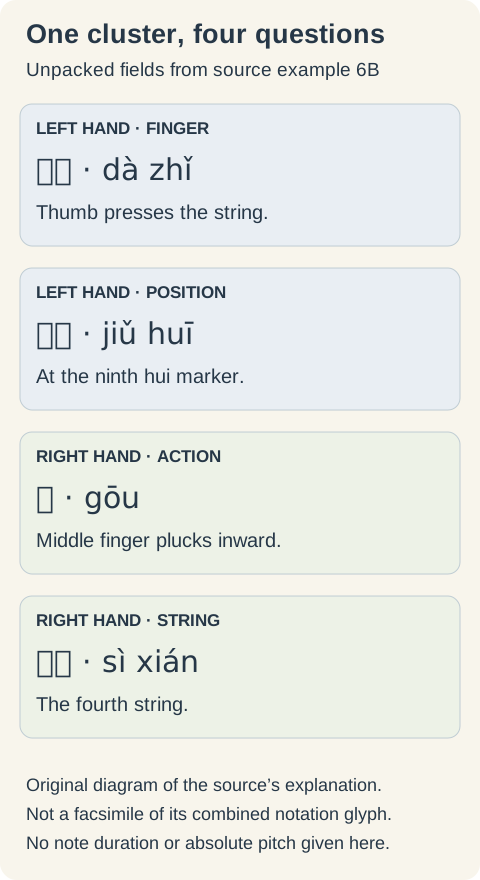
Download the component card as SVG or download the plain-text example and reading worksheet.
Do not convert “ninth hui” into nine centimetres or nine equal frets. A hui is a numbered marker on the guqin. This source names a specific marked position; other instructions can locate positions between or outside the marked points. Confirm the convention used by your own edition before interpreting a more detailed position.
Compare an open-string cluster and a teacher’s stopped example
Now look at item 6A on the same annotated page. The source expands it as 散; 挑七弦: open string, then the right index finger’s outward picking action on the seventh string. The footnote explains that a grass-like component, 艹, stands for 散, and that 乚, a component from 挑, stands for 挑. Their job is to recall the full technique term, not introduce two unrelated vocabulary words.
This comparison explains why “four fields” is a reading aid rather than a rule requiring four visible labels in every cluster. The open-string instruction does not call for the thumb’s stopped position in 6B. Other signs can give a rest, a repeated action, a harmonic instruction or a continuation. Read the instruction that is actually present and the context that goes with it.
For a second stopped example, Peiyou Chang’s general introduction displays a cluster she explains as left thumb, seventh hui, tiǎo, fifth string. Compare it with 6B: the left thumb is shared, but the hui, right-hand action and string change. Her right-hand technique page identifies 挑 as an index-finger outward action and 勾 as a middle-finger inward action. They are not interchangeable labels for plucking.
The wording “inward” and “outward” refers to the described right-hand stroke, not a direction for sliding the left hand along the instrument. Her technique page also explains that the thumb’s pluck/strum directions differ from those of the other fingers. Learn the specific action from the relevant demonstration instead of extending one directional label to every finger.
A small glossary: separate the term from its field
| Term | Job in the reading | Check before inferring more |
|---|---|---|
| 大指 · dà zhǐ | Left thumb in these examples. | It names the finger, not the right-hand stroke. |
| 徽 · huī | A numbered marker or positional reference. | Read the edition’s convention for intermediate positions. |
| 弦 · xián | String; 四弦 means fourth string. | A string number is not a numbered-notation scale degree. |
| 勾 · gōu | Right middle-finger inward pluck. | Do not substitute the index-finger action 挑. |
| 挑 · tiǎo | Right index-finger outward action. | Follow the specific stroke explanation, not a generic “pluck.” |
| 散音 · sǎn yīn | Open-string sound, without left-hand stopping. | Check whether a preceding instruction remains in effect. |
| 按音 · àn yīn | Stopped-string sound with left-hand pressure. | Position and technique matter; a separate 按 sign may be omitted. |
| 泛音 · fàn yīn | Harmonic sound associated with light left-hand contact. | Read the harmonic instruction and its beginning or ending context. |
Chang’s introduction describes the guqin’s seven strings as numbered from the farthest to the nearest in the player’s position. It describes the thirteen hui from the player’s right to left. A rotated photograph can make “top” or “left” on your screen confusing; use the instrument’s playing orientation and source explanation rather than screen direction alone.
These sound categories describe the playing relationship between hands and strings. Open-string sound and deliberately produced harmonic sound are different categories here. Do not classify every ringing open-string note as fàn yīn just because vibrating strings also contain harmonics.
What a readable cluster still leaves open
Absolute pitch needs more context. The string and position identify an operation. The sounding pitch also depends on the tuning and sound-production context. Thompson’s sample includes tuning information above the cluster explanations; removing a cluster from that setting discards information. Do not assign a pitch name from its string number alone.
Duration is a separate question. The note beneath item 6 in that sample explicitly says note values, including rhythm, are not directly indicated there. It also says the tablature describes phrasing and ornamentation. That combination does not mean the music is without rhythm; it means four decoded technique fields do not supply a quarter-note or eighth-note value by themselves.
An edition can add information. A modern teaching score may present tablature alongside staff or numbered notation. Read each system’s role and the teacher’s instructions. A rhythmic annotation in that edition is not proof that the isolated historical cluster encodes the same duration.
Recognizing a sign is not executing it. Pressure, contact, stroke and movement need appropriate demonstration and feedback. Chang’s left-hand page distinguishes finger contact for stopping and harmonic playing; knowing that 大指 means thumb does not settle the exact contact point for your lesson.
Conventions can change. Thompson notes historical differences in ornamentation, strokes and positional notation. Keep the handbook, edition and local explanation visible. An unfamiliar form should remain an identified uncertainty until you can check it; do not silently convert it into the closest modern sign.
Six component-reading exercises
Use the named source examples and their expanded terms. These exercises test a reading distinction, not your playing ability. Write a short answer, then open the explanation.
Case 1
In Thompson’s item 6B, the expanded terms include 九徽 and 四弦. Which one identifies a string, and which one identifies a left-hand position?
Show answer and explanation for case 1
四弦 is the fourth string; 九徽 is the ninth hui position.
Read each number with its function. Swapping them loses the distinction between the vibrating string and where the left hand acts on it.
Case 2
A reader treats the 四 in the same cluster as “fa,” the fourth degree of a numbered scale. What is missing from that interpretation?
Show answer and explanation for case 2
It is a string identifier here, not a scale degree.
Jianzipu is technique tablature. To derive a sounding pitch, you also need the relevant tuning and the way the string is stopped, touched or left open.
Case 3
Thompson’s item 6A combines an open-string instruction with 挑七弦. Should a reader add a left-thumb stopping position because 6B has one?
Show answer and explanation for case 3
No. Item 6A calls for an open seventh string and a right-index outward action.
The left-hand instruction is different: 散 indicates an open string. Do not force every cluster into the four occupied fields of a stopped-note example.
Case 4
Peiyou Chang’s introductory example has a thumb at the seventh hui, 挑 and the fifth string. Is it the same operation as Thompson’s 6B?
Show answer and explanation for case 4
No: the hui, right-hand action and string differ.
Both use the left thumb, but 6B has the ninth hui, 勾 and the fourth string. Matching one component does not make the whole instruction equivalent.
Case 5
You can identify the finger, position, action and string in a cluster. Can you assign a quarter-note duration from those four fields alone?
Show answer and explanation for case 5
No. Those fields do not specify a quarter-note duration.
Check the edition’s other notation, surrounding phrasing and the teacher’s demonstration. Thompson’s annotated sample explicitly says note values are not directly indicated there.
Case 6
A historical scan and a modern teacher’s handout draw a component differently. Should you silently replace the scan’s form with the modern one?
Show answer and explanation for case 6
Keep the source and consult its own explanation or a knowledgeable teacher.
Historical and modern conventions are not identical. Record the exact location and uncertainty instead of normalizing an unfamiliar component into a familiar but possibly different instruction.
Use a source record before the next lesson
Choose one cluster, record its exact location, and expand only the parts you can identify. Copy the source’s explanatory terms into the relevant fields. If a sound-type instruction begins earlier, note that context rather than treating the crop as a self-contained note.
Source / edition / page:
Cluster location:
Sound type or preceding instruction:
Left finger:
Hui or position:
Right-hand action:
String:
Adjacent instruction:
Question for my teacher:
Bring a precise question to the lesson: “In item 6A, does the preceding open-string instruction continue here?” or “Which positional convention does this edition use?” That is more useful than asking a teacher to decode an unidentified screenshot without its surrounding page.
You can practise identifying 6A and 6B without an instrument. If you want to play them, first check the relevant tuning, teacher’s demonstration and physical setup. Reading a cluster is one part of learning guqin, rather than a replacement for instruction.
For the broader first-instrument decision, see learning guqin as a beginner. For basic object identification, see the guqin identity page. The dizi, xiao and xun comparison addresses a different task: recognizing how those wind instruments produce sound, rather than reading guqin tablature.
Sources and further reading
- John Thompson: Sample tablature page with explanation, Shen Qi Mi PuActual annotated score image, items 6A and 6B; top and bottom cluster functions; note-value limitation; footnote explaining the reduced components for 散 and 挑.
- John Thompson: Qin tablature and playing techniqueLonghand and shorthand tablature, distinction from jianpu, teacher transmission and historical differences in technique and positional conventions.
- Peiyou Chang: Guqin Playing and Notation — General IntroductionActual thumb/seventh-hui/tiao/fifth-string example; strings, hui and open, stopped and harmonic categories.
- Peiyou Chang: The Playing and Notation of the Right Hand — 1The individual finger and direction of 勾 and 挑; the distinction between thumb and other-finger pluck/strum directions.
- Peiyou Chang: The Playing and Notation of the Left Hand — 1Left-finger identification and the distinction between knowing a finger term and learning the contact used in playing.