Practical guide
Written and Sounding Pitch in a Chinese Orchestra Part: An Octave-Check Guide
Identify the instrument variant and score edition before converting written pitch. Read the HKCO chart’s specific octave conventions and pipa exception, then check transparent C4 examples separately from playable range.
Identify the notation convention before correcting the player
A note’s position on the page and its sounding pitch are not always the same. First identify the instrument variant, the score’s edition and whether the part uses written or sounding pitch. Then apply the stated relationship. A tuning label, a family name and the notation convention answer different questions.
This guide reads Hong Kong Chinese Orchestra’s official one-page Instrumentation and Range Table. Its conventions apply to the instruments and score practice described by that orchestra. The page does not display a publication date; it was checked on 7 November 2026. Do not infer a revision year from the PDF filename or apply it automatically to another publisher’s parts.
The existing jianpu guide explains scale degrees, octave dots and rhythm. The seating-plan guide explains positions and staffing. Here the task is narrower: deciding which pitch a specified written note represents before comparing it with another part or a tuner.
Source: [1].
Keep five labels together
- Part: the actual instrument and variant printed on it.
- Edition: work, arranger, publisher or ensemble, and revision if supplied.
- Notation: clef, octave indications, key or reference scale, and any written/sounding instruction.
- Relation: sounds as written, sounds one octave higher, sounds one octave lower, or unresolved.
- Range: the separately identified basic, overtone or extreme range relevant to that model and player.
Copy a relationship only when its scope matches your part. “Bangdi” is more informative than “flute,” and an identified orchestra chart is more informative than a guess based on instrument size. If a heading and a footnote disagree with your expectation, retain both until the edition’s legend resolves the issue.
Range is a separate check. A correct octave conversion does not prove that the result is playable, comfortable for a beginner, or suitable at the passage’s speed and dynamic. The HKCO chart labels basic tones, overtones, extreme notes and open strings separately; a single combined number would hide those distinctions.
Source: [1].
Read these HKCO examples with their exceptions
If columns extend beyond the screen, swipe or scroll inside the table to read them.
| Instrument or group | Relationship in this chart | Scope to retain |
|---|---|---|
| Bangdi / qudi | Sound one octave higher than written. | The chart names traditional non-keyed dizi variants. |
| Xindi / dadi | Sound as written. | Xindi is membrane-free; dadi has a membrane. Sharing a row does not make their construction identical. |
| Keyed sheng | Sounds as written. | The keyed models and their labelled ranges; not every traditional sheng. |
| Zhongruan | Sounds one octave lower than written. | An exception to the plucked-section rule in this chart. |
| Other plucked-section instruments | Sound as written under the general rule. | Pipa also has the specific alternative-notation footnote below. |
| Bass gehu | Sounds one octave lower than written. | The exception to the bowed-string rule here. |
| Other bowed-string instruments | Sound as written. | The chart identifies HKCO’s own Eco-Huqins. |
| Alto guan | Sounds one octave lower than written. | Bass guan and contrabass guan sound as written in the corresponding keyed-group note. |
Do not lose the pipa footnote. HKCO also permits pipa notation on a grand staff, or on treble clef an octave above the sounding pitch, as seen in Peng Xiuwen’s works. Thus “all pipa always sounds as written” would be an incorrect expansion of the main rule. Check the actual edition before choosing the conversion.
The table is a reading aid for this source, not a complete register chart. It deliberately omits numeric range endpoints and fingering instructions. It also does not turn the sound-production grouping into a fixed seating plan.
Source: [1].
Three octave calculations, with no claim about playability
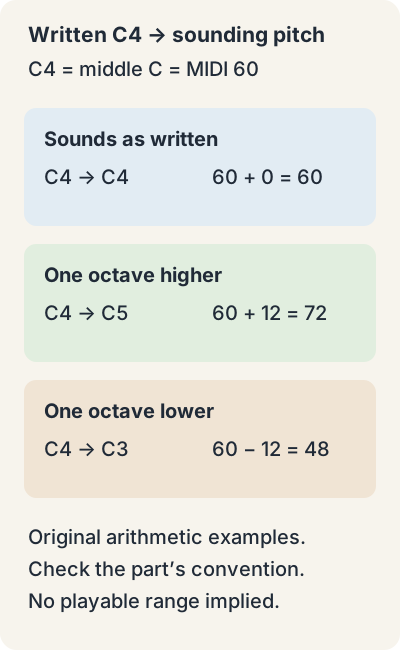
In the original arithmetic examples below, C4 means middle C. The number identifies the octave under that explicitly stated convention. Assume a hypothetical part contains written C4; do not assume that this particular note belongs to every instrument’s playable range.
If columns extend beyond the screen, swipe or scroll inside the table to read them.
| Relationship | Written pitch | Sounding result | Semitone check |
|---|---|---|---|
| Sounds as written | C4 | C4 | 60 + 0 = 60 |
| Sounds one octave higher | C4 | C5 | 60 + 12 = 72 |
| Sounds one octave lower | C4 | C3 | 60 − 12 = 48 |
The integers are an original MIDI-number calculation with C4 set to 60; they are not notes transcribed from a composition or a measured recording. Moving an octave preserves the pitch-class letter while changing register by twelve semitones. It does not change a quarter note’s duration or supply a fingering.
A tuner application may use another octave-number convention. Compare its middle-C setting or frequency reference before treating a displayed “C3” versus “C4” as a disagreement with the score. The example defines its convention explicitly so the arithmetic can be checked.
Resolve a mismatch in a useful order
Suppose an ensemble learner thinks a dizi line is an octave away from the keyboard reduction. Start with the actual part name: bangdi, qudi, xindi or another identified variant. Read the score legend and any octave marking. Check whether the reduction is in sounding pitch. Only then compare the notation relationships.
Under the HKCO bangdi/qudi convention, written C4 maps to sounding C5 in our hypothetical arithmetic. Under its xindi/dadi convention, written C4 remains C4. This difference is a reason to read the variant and edition, not proof that a particular learner played either note incorrectly.
For pipa, consult the exception before applying the general plucked-section rule. For zhongruan or bass gehu, check the lower-octave relationship. If the supplied part has no identifiable convention, write “unresolved” and ask the ensemble librarian, arranger or teacher which pitch representation it uses.
Do not transpose an entire file as a first repair. A hidden octave instruction, inconsistent octave-number labels, or a switch between written and sounding display can make a correct part appear wrong. Keep an unchanged copy and identify the exact discrepancy before editing.
Source: [1].
A tuning label and a jianpu digit still need context
With an indicated reference scale such as 1=C, a jianpu digit supplies a scale degree. Its octave dots supply another layer. Neither “1” alone nor a seller’s “C dizi” label automatically identifies the exact sounding C in the part you are holding.
TOR explains that dizi instruments are labelled by tunings and should be selected for the desired key and timbre. That observation does not provide a universal seller-label convention or a complete fingering chart. Ask how the model’s printed label relates to the lesson’s key, register and fingering.
Use the dizi buying checklist to collect the actual teacher and seller information. Use the jianpu guide to decode the written music. Use the score’s own notation instructions to connect that music to the identified instrument.
Source: [2].
Check the answer before applying it to your own part
Does written C4 always sound C4?
No. In the defined hypothetical examples it stays C4 when it sounds as written, becomes C5 when it sounds one octave higher, and becomes C3 when it sounds one octave lower. Check the actual part’s stated convention first.
Does the general HKCO plucked-section rule settle every pipa part?
No. The chart’s pipa footnote permits alternative grand-staff or octave-higher treble notation. Read the actual edition and legend.
Does a correct octave calculation establish a beginner’s playable range?
No. Model, register, passage, technique and player suitability need a separate check. The arithmetic example is not a range recommendation.
Does the PDF URL establish its publication year?
No publication date is displayed in the observed chart. Preserve its identity and the check date without inventing a revision year.
Keep the source with your next question
Use this blank record with one actual file or score. Leave unsupported dates, people and relationships unknown; a precise unresolved question is more useful than a filled-in guess.
WRITTEN AND SOUNDING PITCH NOTE

Work / edition / arranger / ensemble:
Instrument and exact variant:
Clef / octave marks / written-sounding instruction:
Written pitch under the stated octave-number convention:
Relation: as written / octave higher / octave lower / unresolved:
Resulting sounding pitch:
Separately checked model-and-passage range source:
Exact discrepancy / unanswered question:
Librarian / arranger / teacher question:

Example convention only: C4 = middle C = MIDI 60.
60+0=60 (C4); 60+12=72 (C5); 60-12=48 (C3).
These hypothetical calculations do not establish playable range or fingering.
Download the blank written and sounding pitch note (TXT). Keep any personal lesson or performer details in your own copy.
Sources and further reading
- Hong Kong Chinese Orchestra — Instrumentation and Range TableComplete one-page official chart, visually read; no publication date observed. Written/sounding conventions, variant labels, range categories and the pipa exception.
- Timbre and Orchestration Resource — Wind InstrumentsDizi tuning and variant choice, membrane-free xindi and model-specific sheng interfaces; no images/audio inspected.
- HKCO — Wind InstrumentsNamed wind variants in this orchestra; repertoire-dependent additions.