Practical guide
How to Read a Chinese Orchestra Seating Plan
Locate the audience edge and facing direction, read the section legend and distinguish zones, chairs, players and parts. Check staffing totals and doubling against the identified roster. Two original views rotate the same fictional arrangement; the official HKCO reference is a staffing table rather than a universal seating plan.
Find the audience and facing direction first
Read a Chinese orchestra seating plan by locating the audience, stage front, conductor and labelled sections before naming the instruments. Then check whether its symbols represent chairs, desks, players, instruments or simply section areas. These are different kinds of information.
Start with the document itself: which orchestra, concert or teaching example does it describe? A diagram for one piece is not automatically an institution’s standard layout. An undated image without a legend may need its original source before left, right or numbers become meaningful.
The two diagrams in this guide are original teaching examples of one invented arrangement. They have no individual seat counts and are not HKCO seating plans. The second rotates the same physical example by 180 degrees. Use them to practise keeping labels and direction together, then consult the actual ensemble’s plan.
Be explicit about who is facing where. In our first example, the audience looks towards the players and the conductor also faces the players. Their left/right orientation agrees. A performer facing the audience looks in the opposite direction, so that performer’s left corresponds to the audience’s right.
Do not assume that “conductor view” always requires mirroring an audience diagram. Follow the facing arrow and actual position. Likewise, a plan using stage-left terminology needs its own directional convention checked; this worksheet uses audience-left and performer-left with the facing direction stated.
Read section labels without inventing a fixed lineup
Modern Chinese orchestras often use bowed, plucked, wind and percussion groupings. TOR describes an evolving ensemble combining Chinese instruments and Western orchestrational principles. HKCO’s instrument guide gives its own huqin configuration and notes that additional types can depend on the repertoire.
| Section | Illustrative members | Reading limit |
|---|---|---|
| Bowed strings | Erhu, gaohu, zhonghu; lower instruments selected by the ensemble. | Bowing is a playing clue, not a permanent melody assignment. |
| Plucked-section group | Pipa, ruan and zheng; yangqin can be grouped with this orchestral section. | Yangqin is normally struck with beaters; organization and sound production differ. |
| Winds | Dizi, sheng, suona and instruments required by the programme. | A section label does not identify every variant or featured instrument. |
| Percussion | The percussion instruments and players required by the score. | One player may use several instruments; a symbol need not mean one person. |
The four-section listening guide explains how to watch and follow a part. A seating plan addresses where the labelled group is placed; a listening record addresses what a part does in a passage. Neither makes “bowed” synonymous with melody or “percussion” synonymous with loudness.
Grouping can differ from a classification by sound production. Yangqin is a particularly useful example: it is a hammered dulcimer even when an orchestra organizes it with plucked strings. A coloured zone is a practical ensemble grouping, not a new claim about how every string begins vibrating.
Use the legend supplied for the particular document. A label such as Erhu I/II may refer to divided parts or a combined group. It does not automatically describe two separate populations of the number printed beside it.
Example A: a labelled plan with the audience below
In this invented diagram the audience is at the bottom, so the lower edge is the front of the stage. The conductor is near that edge and faces towards the players. Bowed and plucked-section zones occupy the front portion; winds are farther back and percussion is near the rear.
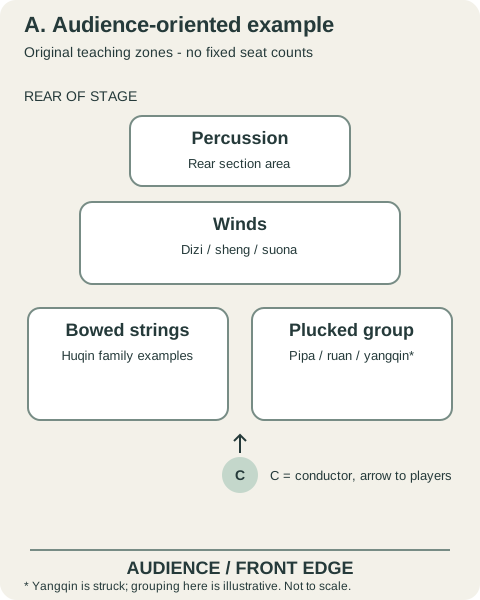
Download the audience-oriented diagram (SVG). Its labels remain readable as a vector graphic when enlarged or printed. No dimensions or scale are supplied, so it cannot allocate physical clearance, risers or equipment in a real venue.
Choose one location and describe it with a reference: “the bowed-string zone is on audience-left and nearer the front than the wind zone.” That sentence says more than “strings are left,” because it names both the viewpoint and the relation being read.
Do not use a zone’s drawn area as a proxy for the number of players. The rectangle was sized to fit its label. Real section size, instrument footprint and spacing require the specific plan and roster. This diagram intentionally does not prescribe them.
Example B: rotate the same plan and follow the arrows
Example B is a 180-degree rotation of the same invented arrangement, with the audience at the top. The conductor now appears near the top and faces down towards the players. The front string zones appear above the winds; the rear percussion zone appears below them.
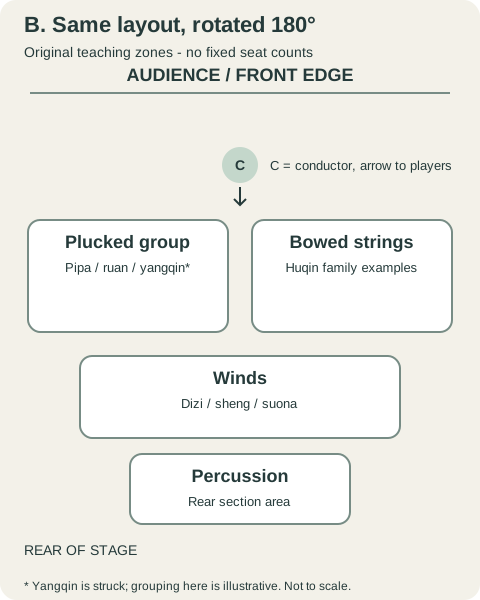
Download the rotated diagram (SVG). Compare a labelled zone in both versions before deciding that instruments have physically moved.
| Reference | Facing direction | What follows in this example |
|---|---|---|
| Audience looking towards players | Faces from the bottom towards the upper stage. | Audience-left is the left side of Example A. |
| Conductor in Example A | Also faces towards the players. | The facing direction agrees with the audience’s orientation. |
| Performer facing the audience | Faces towards the lower edge of Example A. | The performer’s left corresponds to audience-right. |
| Same plan rotated 180 degrees | Audience is now at the upper edge. | Front/back and left/right both change on the paper; identities do not. |
A horizontal mirror alone would not produce this 180-degree view: the front/rear relationship on the page must also rotate. Keep the instrument labels attached to their physical zones rather than reverse their identities with the drawing.
When a real diagram gives no audience edge, facing arrow or convention, leave the direction unresolved. Ask for the original legend or use another identified plan. A familiar-looking shape is weaker evidence than a stated reference direction.
A staffing table is not a seating plan
HKCO’s linked Configuration of the Orchestra is a table headed Instruments, Current Configuration of the Orchestra and Remarks. We read its complete displayed image. It lists numbers, doubling arrangements and an asterisk for part-time musicians, rather than drawing stage positions.

| Displayed row | What the entry says | Avoid this counting mistake |
|---|---|---|
| Xiaoruan / Liuqin | 3 in a combined labelled row. | Do not read this as three xiaoruan plus three liuqin. |
| Erhu I / II | 14 in the combined row; one player can double banhu. | Do not duplicate the 14 for each Roman numeral. |
| Timpani and percussion | 1 timpani plus 6 percussion; stated total including timpani is 7. | The total note is not seven additional players. |
| Zhongruan | 6; one player can double yueqin. | A doubling note need not add another simultaneous player. |
| Konghou / Harp and Guqin | Each has 1*; the asterisk says Part-time Musician. | The footnote changes how the staffing entry is read. |
The image does not provide an observed publication date or the exact roster for every concert. Treat these entries as an identified table checked for this guide, and consult the ensemble’s current programme or instructions for a particular performance. Do not infer a date from the image filename.
“Doubling” means a player may also play a named instrument within the applicable arrangement. It does not by itself say that both instruments sound together, that every concert requires the second instrument or that another player must be added. Read the score or programme for that performance.
A chair diagram and a personnel table can be used together only when their scope and labels agree. If a diagram has four unnumbered section boxes, the staffing table’s figures cannot be distributed into those boxes by guesswork. A discrepancy is a question to check, not an instruction to invent seats.
Distinguish a player, a part, an instrument and a desk. The real document must define its symbols. If a score shows two parts assigned to one person at different moments, counting part names may overstate staffing; if a diagram represents a shared desk, counting desk symbols may understate it.
Expect variants in instruments, programmes and layouts
HKCO’s bowed-string guide lists erhu, gaohu, zhonghu, gehu and bass gehu in its configuration, while mentioning other huqin types that may be used for particular repertoire. Another ensemble’s lower-string solution or featured instrument need not match that list.
Its Eco-Huqin account also describes a specific instrument-reform project, including PET membranes replacing python skin and redesigned soundboxes. Those are named HKCO models. A familiar family label therefore does not establish identical construction across every orchestra or period.
The orchestra’s Music of Character programme is explicitly dated 9 April 2016 and features instruments beyond a routine introductory list, including xun, rewap and sompoton. Use that as a dated programme example, not a universal current roster. The accompanying discussion also distinguishes different instrument-classification schemes.
For the broader changes, the modern-orchestra adaptation guide follows identified HKCO examples and explains their limits. A family map, staffing table, stage layout and dated concert programme each answer a different question.
For an actual event, check the work and arrangement, any soloist or additional instruments, and whether the plan belongs to that event. Do not assign a particular seat, melody role or acoustic result from one generic example. A plan can orient listening without determining everything heard.
Use a printable record for one real document
Start with one identified plan rather than collect several images with unknown origins. Copy its title and any actual date, locate the audience edge, then follow one labelled section. Keep missing information visible in the record.
ONE ORCHESTRA PLAN - IDENTIFICATION AND ORIENTATION
Orchestra / event / work / arrangement:
Original plan URL or document reference:
Document date, if actually shown:
Date I checked the document:
Audience edge and stage front:
Whose facing direction defines left/right:
Conductor position and facing arrow:
Section or instrument label being followed:
Symbol meaning: player / chair / desk / part / zone / unknown:
Related staffing number and its exact scope:
Doubling, divided-part or special-player note:
Unresolved mismatch and the document needed next:
Download the plan-reading record and answer notes (TXT). The two SVG diagrams are original printable examples; the text sheet records the actual source and unresolved details for your own plan.
On a second pass, compare a section label with the roster or programme. On a third, check one doubling or divided-part note. The useful result can be “direction clear; player count not supplied,” rather than a complete-looking arrangement built from assumptions.
If you then watch a performance, keep the camera’s viewpoint separate from the plan. A crop or changing camera angle can hide a section. Use a clearly identified recording and passage for observations; this worksheet does not provide or license an audio recording.
Six checks before treating a diagram as an exact roster
Try these original interpretation questions before opening their explanations. They use the fictional diagrams and the identified staffing examples; they are not a test of an actual orchestra’s seating requirements.
Case 1
The audience and conductor both face the players in Example A. Must conductor-left be the opposite of audience-left?
Show answer and explanation for case 1
No. Their facing directions agree in this example.
A role name alone does not determine a mirror. Check position and facing direction.
Case 2
The bowed zone appears on the opposite side of Example B. Have those players physically changed places?
Show answer and explanation for case 2
No. The same original arrangement was rotated 180 degrees on the page.
Audience edge, front/rear and both paper axes rotate together; the labelled zones retain their identity.
Case 3
HKCO’s displayed Xiaoruan / Liuqin row says 3. May you count three of each instrument?
Show answer and explanation for case 3
No. It is one combined labelled staffing row.
Its division requires the actual roster or score; duplicating the row’s number invents players.
Case 4
Timpani is 1 and percussion is 6, with a stated total of 7 including timpani. Does the total add seven more?
Show answer and explanation for case 4
No. The stated seven includes the timpani player.
Read the total’s scope before adding figures from component rows.
Case 5
One of six zhongruan players can double yueqin. Does that note automatically require a seventh person?
Show answer and explanation for case 5
No. The note describes a player’s additional instrument assignment.
Doubling does not itself establish simultaneous parts, a new player or every concert’s needs.
Case 6
A diagram has coloured section boxes without chairs, dates or scale. Can you use their areas to allocate real players and risers?
Show answer and explanation for case 6
No. Check the actual event plan, roster and symbol legend.
Original zone diagrams orient reading; they do not establish staffing, physical dimensions or a mandatory layout.
Sources and further reading
- TOR: Chinese Orchestra resourcesEnsemble organization, instrument groups and the evolving combination of Chinese instruments with orchestral principles.
- HKCO: Bowed-string InstrumentsHKCO’s huqin configuration and repertoire-dependent additional instruments.
- HKCO: Eco-HuqinsIdentified HKCO instrument-reform models; construction and dated development account, not a universal instrument specification.
- HKCO: Music of Character, 9 April 2016Dated concert programme and discussion of instrument classifications; a programme example rather than a current universal roster.
- HKCO: Configuration of the Orchestra, official imageOfficial staffing table, not a stage plan. Combined rows, doubling and part-time footnote read from the complete image; no publication date observed.
Connect the identified part to its sounding pitch
Once you know the instrument and edition, check written and sounding pitch with the chart’s exceptions. A chair, family label or staffing count does not decide the notation convention.