Practical guide
Yueqin: The Moon Lute’s High Frets and Museum Versions
Follow the short neck, nine high fret positions and four strings of Grinnell’s documented Yueqin, then compare two historical museum records without transferring one object’s tuning, materials or range to every moon lute.
On this page
A round-bodied lute with a short neck
Yueqin (月琴), also written yueh-ch’in, is the Chinese “moon lute.” The Grinnell College entry explains its name through yue, moon, and qin, stringed instrument. It describes a plucked box-lute of the Han Chinese, with a flat circular resonator joined to a short neck and pegbox. The round body and short neck give a useful starting description. [1]
The familiar ruan also has a round body, so the outline alone cannot separate every round-bodied lute. For this study, the name belongs to Grinnell’s documented Yueqin specimen and two named Metropolitan Museum of Art records. The ruan guide addresses that family’s sizes and lesson choices.
Grinnell connects Yueqin with Beijing opera and other regional instrumental and opera ensembles. Its pictured instrument was made by the Peacock factory; the authors suggest it may have been sold to tourists while describing it as functional. That qualification matters when using this one object to imagine a professional player’s setup.
Nine high fret positions, extending onto the soundboard
The Grinnell description gives the specimen a four-inch fretted fingerboard and nine raised fret positions. Three lie on the fingerboard; six continue over the upper soundboard, where each position divides into two columns. The short neck therefore does not contain the whole stopping area. The player depresses strings against these frets with the left hand and plucks with right-hand fingernails or a plectrum, according to the entry.
| Part | Documented construction | How to read this specimen |
|---|---|---|
| Resonator | Flat circular wooden body, with a shallow hoop sidewall and glued-on front and back boards | The round body supplies the moon-lute outline; the joined neck makes it a lute. |
| Neck and pegbox | Short fretted fingerboard ending at a wooden nut; pegbox carved with the neck | Keep the short fingerboard separate from the frets that continue onto the body. |
| Tuning pegs | Four friction pegs, two entering from each side | The entry describes four strings; a low-resolution photograph need not show every string clearly. |
| Fingerboard frets | Three raised fret positions on the fingerboard | These are the neck positions within the entry’s total of nine. |
| Soundboard frets | Six raised positions on the body, each divided into two columns | Count paired columns as positions as described, rather than calling them twelve additional frets. |
| Strings and attachment | Four nylon strings, secured between pegs and the wooden bridge/string fastener | This is the pictured specimen’s description; it does not establish the material of every Yueqin. |
The original diagram below follows that described arrangement. Four string lines and nine fret positions explain the layout; their spacing and the outlines are schematic. The diagram supplies neither a measured construction plan nor a pitch at each position.
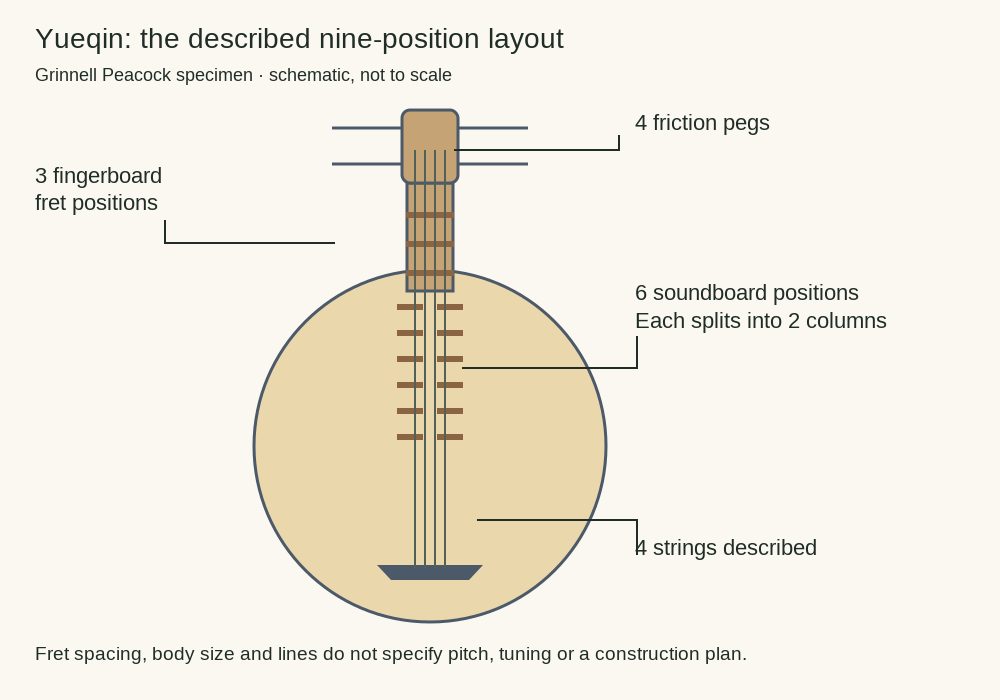
Scroll within the diagram on a narrow screen, or focus it and use the arrow keys. Open the full construction diagram to follow the labels. Grinnell’s linked photograph is the reference for the actual object; the photograph is not republished here.
Keep string courses, tuning and range attached to their source
Grinnell describes four strings arranged in two double courses and says the two strings within each course are a fifth apart. It attributes a tuning to Liang, page 273: G3 and D4 for the lower course, G4 and D5 for the upper one. These are the source’s named notes, not a default setup instruction for an unidentified Yueqin.
The same entry attributes a G3–C7 range to Liang, then explicitly questions whether that range belongs to an instrument with more frets than the pictured specimen. Preserve that qualification. Nine visible or described positions do not establish that this instrument realizes the entire quoted range.
The authors also say the literature is unclear about whether both strings in a double course are plucked together or individually. They describe parallel fifths as a consequence if both are sounded together. A useful note retains that conditional relationship instead of converting it into “every Yueqin melody uses parallel fifths.” For an actual lesson or arrangement, ask the intended player which strings, tuning and stopping positions they use.
Three records show why materials and dimensions need a matching object
The two Met records both name Yueqin (月琴) and classify the instrument as a plucked, fretted lute. Their accession numbers identify different objects: 89.4.53 and 89.4.2745. Each carries the credit “The Crosby Brown Collection of Musical Instruments, 1889.” The object dates are respectively “19th century” and “late 19th century”; the collection credit is a separate field. [2] [3]
| Identified specimen | Material description | Recorded dimensions | Reading consequence |
|---|---|---|---|
| Grinnell Peacock specimen | The written description says four nylon strings; its material tags also include silk | 25.2 inches overall height | Use the detailed description for the pictured strings; retain the difference between description and tags. |
| Met 89.4.53 | Rosewood, wu-tong (paulownia) wood, and gut | 57.5 cm height; 34.5 cm body diameter; 3.9 cm depth | Dated 19th century. The catalogue identifies a specific historical object. |
| Met 89.4.2745 | Wood, silk, nylon | 57.1 cm length; 34.2 cm body diameter; 3.9 cm depth | Dated late 19th century. The listed materials do not supply a dated restringing history. |
The first Met record expressly names gut among its materials. The second lists silk and nylon together. Grinnell’s detailed description names nylon strings while its material tags include silk. Keep those differences visible rather than replacing all three records with one claim about traditional or modern strings.
Body diameter, depth and overall height or length are different measurements. For Met 89.4.53, 34.5 cm is the body diameter and 57.5 cm is the overall height. Two museum records with similar dimensions still describe two objects; neither provides a current seller’s condition report, tuning or replacement-string specification.
Work through three Yueqin source notes
These original fictional cases use the documented specimens above. Each answer connects a conclusion to the particular source detail that supports it.
Case 1
A reader sees the six split positions on the Grinnell Yueqin’s soundboard and records twelve body frets plus three neck frets. What should the note say?
Show answer and explanation for case 1
The entry describes six body positions plus three fingerboard positions: nine raised fret positions in total.
Each body position divides into two columns. Counting every column as a separate additional position changes the construction described by the source.
Case 2
A lesson plan copies the attributed G3–C7 range and assumes Grinnell’s nine-fret specimen can play every note in it. What qualification is missing?
Show answer and explanation for case 2
Grinnell questions whether Liang’s quoted range refers to an instrument with more frets than the pictured example.
Keep the range attached to Liang and the entry’s uncertainty. Confirm the actual instrument’s usable notes and tuning with the intended player.
Case 3
A caption for Met 89.4.53 says “made in 1889, with silk strings,” using the collection credit and a general Yueqin description. How should it be corrected?
Show answer and explanation for case 3
The record dates this object to the 19th century and lists rosewood, wu-tong (paulownia) wood, and gut.
The Crosby Brown Collection, 1889 is the collection credit. The object date and material field belong to accession 89.4.53; the separate 89.4.2745 record lists wood, silk and nylon.
Sources and further reading
- Grinnell College Musical Instrument Collection: Yueqin, Roger Vetter and Toby AustinComplete entry and linked front photograph checked on 16 November 2026. Construction, double-course description and the explicit tuning/range qualifications are retained; the photo and cited books are not reproduced.
- Metropolitan Museum of Art: Yueqin, accession 89.4.53Complete official collection record, checked on 16 November 2026. Object date, materials, dimensions and collection credit; no independent inspection of its photograph.
- Metropolitan Museum of Art: Yueqin, accession 89.4.2745Complete official collection record, checked on 16 November 2026. Separate object date/material/dimension fields; no inferred restringing chronology.