Practical guide
Pipa, Liuqin and Zhongruan: A Visual Identification Worksheet
Begin with pear-shaped and round bodies, then check the matching label, instrument version and visible parts. Use original teaching and practice diagrams to distinguish a useful clue from an unsupported exact identification.
Use the body outline as a first clue, then check the label
For these three modern examples, start with the body: pipa and liuqin have pear-shaped outlines, while the ruan family has a round body. Zhongruan names the middle-sized ruan. A useful identification record keeps the visible clue and the claimed name separate until you have enough information to connect them.
The MTSU instrument gallery describes the pipa as a pear-shaped four-string lute and the ruan as a round four-string lute. It distinguishes ruan family sizes, including zhongruan. The Timbre and Orchestration Resource discusses modern changes and the use of different ruan sizes in a Chinese orchestra.
| Name | Body clue | Selected example | What remains uncertain |
|---|---|---|---|
| Pipa 琵琶 | Pear-shaped body; fretted neck | Four strings in the modern example discussed here | Outline alone does not separate it from every liuqin or historical lute |
| Liuqin 柳琴 | Smaller pear-shaped form resembling a pipa | Four strings in the modern orchestral example; other forms exist | Size needs a real reference; a small image is not a measured small instrument |
| Zhongruan 中阮 | Round-bodied member of the ruan family | Four strings in the modern ruan example | Round outline suggests a family; the exact size or label establishes the member |
The liuqin resemblance and smaller pear-shaped form are also described in the secondary Wikipedia liuqin overview. That page carries a warning about insufficient inline citations. Here it supplies a basic introductory shape comparison; its exact chronology, tuning claims and claims of equivalent playing technique are not treated as settled facts.
These are selected examples for a learning task. Historical, regional and modified instruments can differ. The table does not identify every Chinese lute, authenticate a museum object or certify a seller’s label.
Record the visible parts before using a name
Describe the outline first: round, pear-shaped or uncertain because the instrument is cropped. Then look for a neck with frets and strings running from the peg area toward the bridge. Frets are raised divisions associated with stopping strings; strings are the lengthwise lines. A decorative line or a reflection is not automatically either one.
Count only what is clearly visible. A front photograph may hide a string or peg, while a stylized drawing may omit details. “Four strings visible” is an observation. “Every instrument called this has exactly four strings” is a general claim that the picture cannot establish.
Do the same with soundholes. A selected liuqin illustration may show two prominent holes, but an outline or soundhole count should not be treated as a universal identification key. If the picture is too small, write “not clear” rather than filling the gap with the instrument you expected.
Keep the playing interface on another line. MTSU describes pipa plucking with real or artificial fingernails; the secondary liuqin overview describes a plectrum. A single picture may not show the hand clearly enough to establish the technique. Instrument, technique and a particular player’s action are related observations, not interchangeable evidence.
A catalog label, programme or maker’s model information can answer a question that the image leaves open. Record which source supplies the name and what kind of object or performance it describes. An exact-looking label still needs to match the image rather than merely appearing nearby.
Read the three original teaching diagrams
View the original shape and parts diagram. It illustrates the broad differences used in the table. The outlines, positions and annotations are independently drawn; they are not tracings of a museum photograph or measured construction plans.
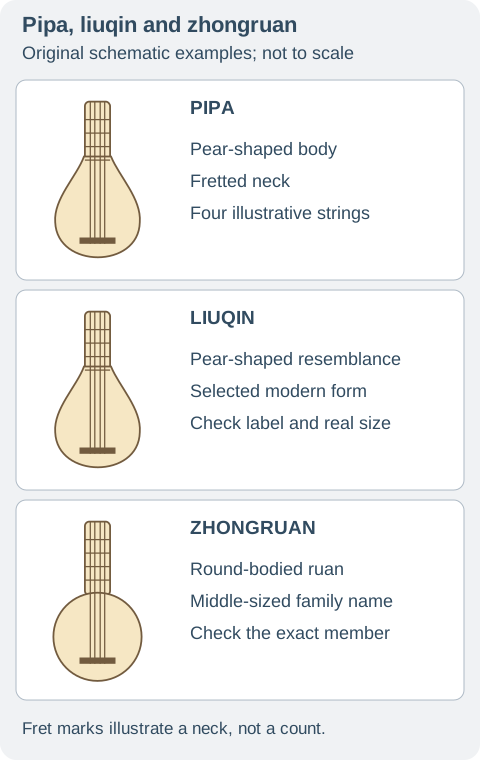
The few fret lines stand for a fretted neck, not the exact number on a particular instrument. Neither a spacing measurement nor a tuning can be read from them. The diagram also contains no materials, dates or claim that the illustrated instrument has been handled or tested.
Use it to practise a sentence such as “The body is round, a neck is visible, and the example is labeled zhongruan.” That sentence identifies the evidence you used. “All round lutes are zhongruan” would go beyond the diagram.
Compare an actual labeled reference afterward if you need a more specific result. The linked institution and orchestration descriptions support the learning task; their video links have not been opened or reused here.
Separate pipa and liuqin without guessing from image size
Pipa and liuqin are a useful pair because one strong clue is shared. Both can present a pear-shaped body and a fretted neck in the selected modern examples. Identifying a pear-shaped lute is a first step, not a complete answer between the two.
Ask what “smaller” is based on. A photograph with a reliable scale or a clear model description can support a size comparison. Two unrelated thumbnails displayed at different widths cannot. A camera angle, crop or page layout may change the apparent proportions.
Look for the named model and the playing context. A caption identifying the instrument, a programme naming its part or a collection record describing the actual object is stronger than a guess from a distant stage shot. If the context is missing, record both candidates rather than choosing the familiar name.
The TOR introduction describes a historical two-string liuqin and a changed modern four-string instrument. This is a reason to keep the version visible. A string-count clue drawn from one modern example should not erase older forms or turn an unusual object into a definite mislabeling.
A fictional observation might read: “Pear-shaped body; fretted neck; no reliable size reference; caption absent. Pipa or liuqin remains possible in this limited comparison.” That is a useful result. You have identified the missing fact to seek rather than invented certainty.
Keep ruan family recognition separate from zhongruan identification
A round body is the main contrast with the pear-shaped examples. Ruan is a family term, while zhongruan specifies a member. The TOR introduction notes different sizes and identifies zhongruan as a commonly encountered middle-sized ruan in the modern Chinese orchestra.
Within this worksheet’s three named choices, a round-bodied modern lute fits the zhongruan example. Outside that deliberately limited set, the outline alone cannot establish the exact family member or exclude every other round-bodied lute. Keep the exercise’s candidate set visible when you use its answer.
MTSU distinguishes daruan, zhongruan and xiaoruan in its account. A close crop that hides a scale reference cannot prove which size you are seeing. Seek a label, model or an appropriate comparison, and keep a tentative “ruan-family candidate” separate from an exact identification.
| Evidence | A conclusion it can support | What it does not establish |
|---|---|---|
| Clear outline but no matching label | A body-shape observation and a limited candidate group | Exact instrument, size, tuning or date |
| Label and image refer to the same identified object | A name supported by that record’s scope | Every historical or regional version |
| Programme names a player or part | Context for that performance | Permanent musical role or solo tone in every recording |
| Two unrelated thumbnails | Two images with possibly different display scales | An actual size ranking from their on-screen widths |
The Hong Kong Chinese Orchestra lists liuqin, pipa, zhongruan and daruan in its own plucked-string configuration. That list explains one ensemble’s organization. It is not proof that a particular photographed player is holding one of them, or that all ensembles use an identical lineup.
Try the unlabelled panels and observation record
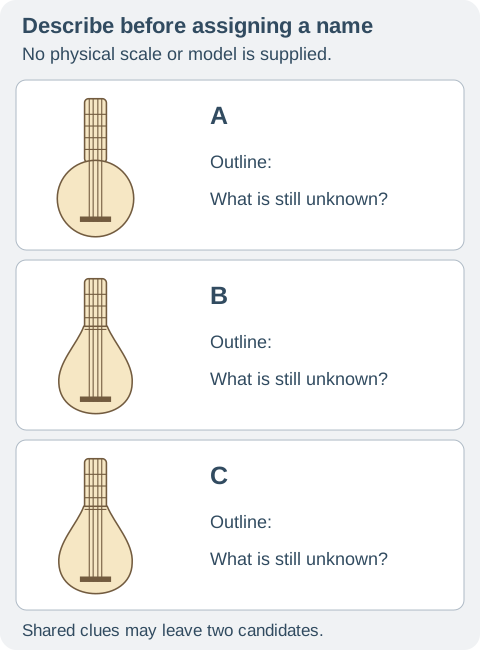
View the original A, B and C practice panels before opening the answers below. Describe the outline and the limits of the drawing. The panels intentionally do not establish measured size, tuning or a maker’s model.
REFERENCE / IMAGE / OBJECT OR PERFORMANCE:
MATCHING LABEL AND SOURCE:
BODY OUTLINE — OBSERVED OR OBSCURED:
NECK / FRETS / STRINGS ACTUALLY VISIBLE:
SOUNDHOLES OR HAND ACTION, IF CLEAR:
SIZE REFERENCE OR MODEL INFORMATION:
CANDIDATE NAME / FAMILY / EXACT MEMBER:
EVIDENCE SUPPORTING THAT CONCLUSION:
WHAT REMAINS UNKNOWN / SOURCE TO CHECK:
Open the editable identification record and answer notes if you prefer a plain-text worksheet. It includes both comparison tables and the explained cases. You do not need an account or to submit your observations.
For an actual source, write its label and what you can see before adding an interpretation. “The record calls this zhongruan” and “I see a round body” supply different parts of the identification. If the image cannot be viewed, record that limit rather than treating its alt text as visual inspection.
Nine cases with explanations
Try the original cases first. The answers test body clues, source matching and uncertainty. They are not a test of musical ability or a recommendation about which instrument to buy.
Case 1
In panel A, what is the main outline contrast with panels B and C?
Show answer and explanation for case 1
A is round-bodied; B and C are pear-shaped.
This describes the original diagrams. It is a visible comparison, not a general identification rule for every lute.
Case 2
Within the worksheet’s three selected modern names, which teaching example has a round body?
Show answer and explanation for case 2
Zhongruan, the middle-sized ruan example.
The candidate set is deliberately limited to pipa, liuqin and zhongruan. Outside that set, the round outline alone does not establish the exact instrument or family member.
Case 3
Panels B and C both have pear-shaped bodies and no reliable physical scale or matching label. Can you definitely assign pipa and liuqin?
Show answer and explanation for case 3
No. Keep the two candidates unresolved.
The shared outline is a first clue. Different diagram widths do not measure actual instruments; seek a matching label, model or reliable size reference.
Case 4
A clear source record labels a round-bodied object zhongruan. Should your note keep the label and the outline on separate lines?
Show answer and explanation for case 4
Yes. They are different pieces of evidence.
The label supplies the name within that record’s scope; your outline note records the visible clue. Check that they refer to the same object.
Case 5
A front image appears to show four strings. Does that prove all historical liuqin forms had four?
Show answer and explanation for case 5
No. Keep the selected version explicit.
TOR describes changes from an older two-string liuqin to a modern four-string instrument. A visible count in one example does not settle every version.
Case 6
Two website thumbnails are displayed at 300 and 150 pixels wide. Does this show one physical instrument is twice as wide?
Show answer and explanation for case 6
No. On-screen widths are not a physical scale.
The source images may have different crops, distances and display settings. Use a real scale or identified model information for a size comparison.
Case 7
A diagram shows only a few fret lines. Should you count them as the exact specification of a modern pipa?
Show answer and explanation for case 7
No. The lines indicate a fretted neck schematically.
The original teaching diagram is not a measured plan and does not specify an invariant fret count, spacing or tuning.
Case 8
HKCO lists pipa, liuqin and zhongruan in its configuration. Does that identify an unlabelled stage photograph?
Show answer and explanation for case 8
No. The list describes an ensemble arrangement.
Connect the actual photograph to its programme, player or model evidence. An organizational list is not an object label.
Case 9
A source image fails to load, but its description says pear-shaped pipa. Can you write “photo visually inspected”?
Show answer and explanation for case 9
No. Record the description and the missing image separately.
Text can support a descriptive claim within its source. It does not establish that you saw the object, checked its visible details or heard a linked recording.
Use identification to choose a more specific next question
Once the name is supported, you can ask about a particular performance, technique or instrument version. A photograph still cannot reveal its tuning, acoustic sound, condition or teaching suitability. Keep those as further questions rather than attaching an imagined tone to the silhouette.
For a performance, use an identified recording and name the passage you are considering. Instrument role can change within a piece. A plucked part may carry a melody, support another line or add an accent; an ensemble label does not assign one permanent role.
The orchestra-section guide explains the broader grouping, including why a struck-string yangqin can be grouped with plucked strings organizationally. The seating-plan guide separates an actual plan from a configuration list.
For a different visual and register task, the erhu, gaohu and zhonghu comparison concerns bowed instruments. Keep its open-string examples attached to the selected source instead of transferring them to these plucked lutes.
Sources and further reading
- MTSU Center for Chinese Music and Culture: Instrument GalleryPear-shaped four-string pipa and round four-string ruan descriptions; ruan family sizes. These descriptions do not specify every historical instrument or modern model.
- Timbre and Orchestration Resource: Plucked Strings — IntroductionSelected modern liuqin and ruan versions, changes from older forms and varied orchestral ruan sizes. No universal fret count, exact tuning or origin timeline adopted.
- Hong Kong Chinese Orchestra: Plucked-string InstrumentsThis orchestra’s own configuration and its organizational inclusion of struck strings; not an invariant lineup or proof about an unidentified photo.
- Wikipedia: Liuqin — secondary introductory descriptionPear-shaped resemblance, smaller form and plectrum description. The page warns about insufficient inline citations; exact chronology, tuning, guaranteed tone and claims of identical playing are not adopted.