comparison
Pipa vs Related Instruments: Shape, Strings and Playing Actions
Compare pipa with ruan, liuqin, guzheng, guqin and erhu using body shape, frets, bridges and playing actions. Work through four identification examples.
Start with three clues together
The familiar modern pipa (琵琶, pípá) is a four-string, pear-shaped Chinese plucked instrument with frets. In a clear performance view, you can inspect the body, neck and the player’s plucking action. Those combined clues are stronger than any one adjective about its sound.
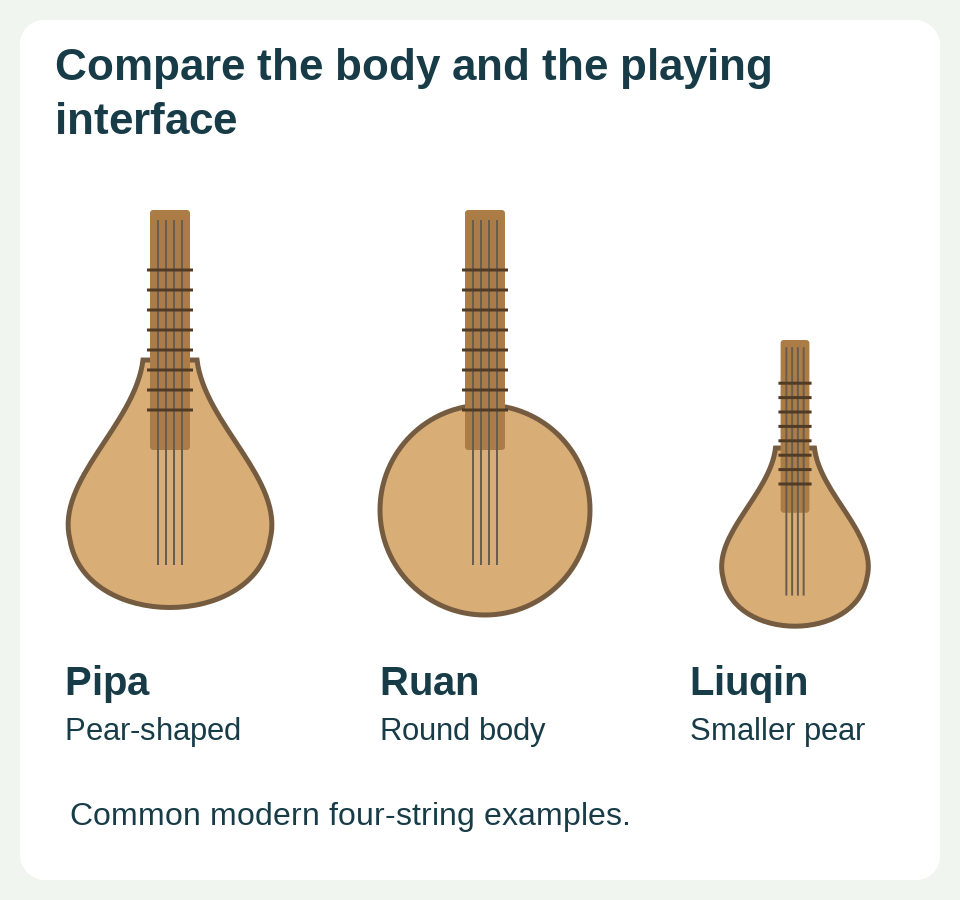
Liuqin can also have a pear-shaped body and four strings in a modern form. Ruan can also have four strings and a fretted neck. A string count alone therefore does not finish the identification. The body layout, proportions, credited name and actual playing view help resolve the remaining candidates.
The MTSU gallery and Timbre and Orchestration describe modern examples alongside historical changes. Use their construction information to interpret the demonstrated instrument, rather than imposing one modern specification on every older object.
Pipa versus ruan: pear-shaped or round-bodied
Pipa and ruan are both fretted plucked instruments, often shown in upright playing positions. The familiar pipa has a pear-shaped body; the ruan family is recognized by a round body and neck. Check the complete object, because a crop that shows only a hand and several frets can conceal the most useful difference.
Their musical roles depend on the piece, player and model. Do not reduce the comparison to pipa being lively and ruan being gentle. Both can contribute melody, accompaniment and articulated patterns. A recording’s balance may emphasize one role while hiding another.
If the question is which ruan to learn or arrange for, move to the dedicated ruan comparison. The pipa comparison solves identification; the ruan page deals with sizes, model compatibility and practical selection.
| Candidate beside pipa | Useful construction clue | Next confirmation |
|---|---|---|
| Ruan | Round body rather than the familiar pipa’s pear-shaped body | Full instrument view and credit |
| Liuqin | Smaller pear-shaped instrument in familiar modern forms | Scale/context and named model |
| Guzheng | Long zither with multiple strings and individual movable bridges | Playing view and actual model |
| Guqin | Long seven-string zither with reference markers rather than raised frets | String layout and credited name |
| Erhu | Bow hair between two strings and a small upright resonator | The continuous bowing action |
Pipa versus liuqin: a smaller pear-shaped relative
Liuqin is a particularly useful comparison because body shape can overlap. Timbre and Orchestration describes a modern four-string liuqin with more frets than older forms. Its smaller body is a visual lead, but the illustration or camera perspective may not provide a reliable scale.
Look for a full performance view, the credited name and the actual instrument specification when available. Do not call an instrument liuqin solely because a child or a distant player makes it appear small. Equally, do not decide pipa just because a thumbnail looks pear-shaped.
For a listening comparison, use clearly credited examples with a similar musical task, such as a short articulated phrase. Register, microphone and ensemble role can make unequal examples misleading. The practical pipa, liuqin and zhongruan resource provides a focused next step.
- Shape narrows the candidate list.
- Perspective can hide actual size.
- A credit resolves uncertainty better than a thumbnail.
Pipa versus guzheng and guqin: lute or zither
Guzheng and guqin have a long horizontal body with strings running along it. This differs from the pipa’s familiar body-and-neck layout. On guzheng, individual movable bridges are an important clue. On guqin, the seven-string layout and hui reference markers help identify a different playing system.
The markers on guqin are not raised frets, and guqin is not a small guzheng. Its open, harmonic and stopped-note actions need their own explanation. A score or tab for one instrument is not automatically a physical instruction for another.
If you only hear a plucked recording, construction may remain uncertain. A long decay, a slide or repeated attacks can occur under different techniques and recording conditions. Check the credited playing view before assigning the sound to a particular zither or lute.
- Use bridge and body layout.
- Guqin reference markers are not frets.
- Notation does not transfer as identical finger actions.
Pipa tremolo versus a bowed line
Repeated rapid plucks can make a pipa phrase seem continuous. This is one reason an audio-only listener may confuse a sustained plucked texture with bowed strings. The physical source of energy differs: repeated attacks renew the plucked sound, while a bow continues to drive a string.
Listen to the start and continuation separately. If the attacks are too blended to hear, use the player’s visible action or the credit. Do not force a conclusion from a heavily processed or densely orchestrated excerpt.
The linked xserra file is described as an ensemble example with dizi solo and pipa accompaniment. It is not an isolated pipa sample. Follow the accompaniment only when it is distinguishable, and keep the flute melody separate. The source description is part of the listening evidence, rather than a detail to hide below the player.
Practice situations
These are illustrative examples for working through the decision.
Four strings used as the whole identification
A viewer counts four strings and writes pipa without checking the body.
Which candidates remain?
Modern ruan and liuqin can also have four strings. Inspect the body, neck, proportions and credit.
A cropped neck hides the body
An image shows frets and plucking but cuts off the resonator.
Can pipa and ruan be separated confidently?
The view is incomplete. Find a full object view or credit; the familiar pear-shaped versus round body is a useful missing clue.
A long tremolo called a bow
A listener hears a nearly continuous line and assumes it must be erhu.
What should be checked?
Repeated attacks versus bowing, plus the credited player view. Rapid plucking can sustain a texture without a bow.
A dizi solo heard as isolated pipa
A file described as dizi solo with pipa accompaniment is labeled a pure pipa tone demonstration.
How should it be used?
As a mixed ensemble example. Follow the accompaniment where clear and do not attribute the flute melody to pipa.
Build a short identification note
Write the candidate instrument, the strongest visible clue and one confirming credit. Then note the musical action you actually observed: separate plucks, rapid repeated attacks, a slide or a bowed continuation. This ties a name to construction and performance rather than to a stereotype.
If the image is cropped, seek a full view. If the audio is an ensemble, find the credited role or a clearer solo demonstration. If two fretted lutes remain plausible, compare body shape and named model before relying on sound alone.
For learning decisions, identification is only the start. Ask a teacher to demonstrate the relevant playing interface and assess a suitable instrument. The worksheet can become a useful question list without pretending that a picture proves playability.
Download the blank worksheet (TXT)
Fill it with your own observations, source details and next question.
Questions and answers
Does a pear-shaped body prove pipa?
It is a useful clue, but liuqin can also be pear-shaped. Check the complete instrument, size context and credit.
Are pipa and ruan both fretted?
Their familiar modern forms have fretted necks, but their body shapes differ. Model and historical details still need checking.
Can pipa sustain a phrase?
Repeated plucking, including tremolo, can create a continuous texture. That differs physically from continuous bow-driven vibration.
Is guqin tablature a pipa fingering chart?
No. Guqin tablature describes guqin playing actions. Shared pitch notation does not make the physical interfaces identical.
Use written cues, then check a source
Use the sound words here as cues, then open a source-hosted route before relying on written tone descriptions.
- Open the sourceListen at the linked page and check the instrument name, setting, or collection context.
- Write one cueNote one thing you can hear: attack, sustain, volume, breath, reed edge, strike, or room setting.
- Return to the notebookCompare that cue on the sound page before choosing a learning, teaching, buying, or museum-reading path.
Additional credited recordings
Read each file’s context before comparing the sounds. These examples include ensemble, software and bowed-contrast material; they are additional to the main lesson.
Virtual guzheng played in iPad GarageBand, according to the uploader. This software example is not an acoustic instrument recording.
A credited erhu practice clip. Recording conditions do not measure your room’s practice volume; use the sound and construction guides for a focused comparison.
Uploader-described short dizi loop. It is a bounded example, not a complete regional style or concert.
Uploader-described guqin open strings. This is one tuning/example, not a demonstration of every guqin technique or tuning.
Sources and scope
References support the construction, notation, historical-object or recording details discussed above. Use the complete source description when comparing instrument models or recordings. The diagrams are original educational material, and the practice situations are illustrative examples.
- MTSU Center for Chinese Music and Culture: Instrument Gallery
- Hong Kong Chinese Orchestra: Plucked Strings
- Timbre and Orchestration: Chinese Plucked Strings
- Freesound: Pipa File and Uploader Description
Editorial revision: 4 November 2026.