orchestra role
A Practical Guide to Chinese Plucked String Instruments
Compare pipa, liuqin, ruan, guzheng and guqin by construction and playing action. Understand why hammered yangqin appears in the orchestral plucked section.
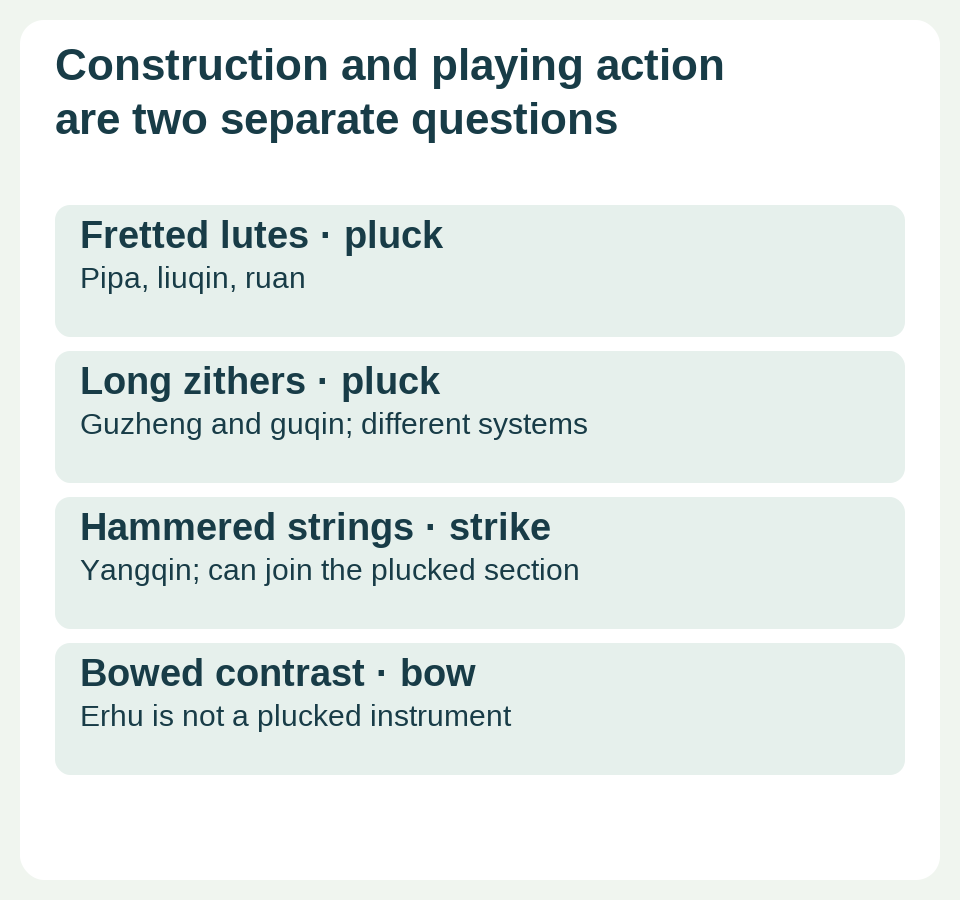
Use two questions to organize the family
First ask how the strings are arranged on the instrument. A lute such as the familiar pipa or ruan has a body and neck; a zither such as guzheng or guqin has strings running along a long body. Then ask what the player does to start or sustain the sound: pluck, strike or bow.
These questions are related but not identical. A long body does not tell you every playing technique, and membership in an orchestral section does not guarantee one sound-making action. Construction and performance together give the most useful first explanation.
The table covers familiar modern examples, with model variation noted where it matters. It is a recognition guide rather than a complete history or maker’s specification. Use the credited instrument and actual playing view when identifying a particular object.
| Instrument | Construction clue | Main action in this comparison | Important distinction |
|---|---|---|---|
| Pipa | Pear-shaped body, neck and frets | Plucking | Four strings alone do not prove pipa. |
| Liuqin | Smaller pear-shaped body and frets | Plucking | Modern and older forms differ. |
| Ruan | Round body, neck and frets | Plucking | A family with multiple sizes |
| Guzheng | Long body with individual movable bridges | Plucking | Common modern 21-string examples are not every model. |
| Guqin | Long seven-string body and hui markers | Plucking with open, harmonic and stopped-note actions | Hui are reference markers, not raised frets. |
| Yangqin | String courses on a broad body | Hammering with beaters | Orchestral plucked-section membership differs from mechanism. |
| Erhu | Two strings, small resonator and bow | Bowing | Included here only as a sound-making contrast. |
Fretted lutes: pipa, liuqin and ruan
These instruments give a listener a useful first group to compare. Look at body shape and scale context, then inspect the fretted neck and plucking action. The familiar pipa is pear-shaped, liuqin is a smaller pear-shaped example, and ruan has a round body.
Modern examples can share four strings, so counting strings is not enough. Nor does a general adjective such as bright or warm reliably distinguish them across registers, players and recording conditions. A complete credited view supplies stronger evidence.
Timbre and Orchestration discusses historical changes and modern orchestral forms, while HKCO lists pipa, liuqin, zhongruan and daruan within its section. The focused practical comparison is a better next step than trying to memorize every possible name at once.
- Compare complete bodies, not cropped necks.
- Use credits to resolve close candidates.
- Model and historical variation matter.
Zithers: guzheng and guqin are different systems
Guzheng and guqin share a long horizontal outline, but their construction and playing systems differ. The individual movable bridges on guzheng are a major clue. The common modern 21-string form is an example, not a universal count for every model described in the sources.
Guqin has seven strings and hui reference markers. Players distinguish open, harmonic and stopped-note actions. The markers are not raised frets, and the abbreviated jianzipu tablature describes guqin actions rather than simply giving pitch digits.
A guzheng score, a jianpu melody and guqin tablature therefore answer different questions. Shared musical notes do not make the physical instructions interchangeable. Use the dedicated guqin and notation resources when the question concerns technique or reading, rather than treating one zither as a smaller version of the other.
- Movable bridges help identify guzheng.
- Guqin uses a distinct action and notation system.
- Pitch notation and fingering instruction are different.
Why yangqin appears in the plucked section
Yangqin uses beaters to strike strings. By sound-making action it belongs in a hammered-string comparison. Yet the HKCO instrument overview includes it in the orchestral plucked-string section alongside pipa, ruan, zheng and other instruments.
This is a practical example of two classification systems doing different jobs. Mechanism explains how sound starts; orchestra organization explains how players and musical roles are grouped. Neither requires calling a hammering action a pluck.
For a classroom lesson, let students identify the player’s action first, then inspect the orchestra’s section list. A correct answer can say hammered strings in the plucked section. That is more precise than removing yangqin from the program or changing the physical explanation to fit the heading.
- Mechanism and section are separate labels.
- Yangqin is struck with beaters.
- An orchestra may group different actions in one section.
Listen to attack, continuation and context
A single pluck starts a vibrating string that then decays, while repeated plucks can renew the sound and create tremolo. A bow can continue to supply energy during a note. These are useful comparisons, but processing and ensemble blending may conceal the attacks.
Read the audio descriptions before treating clips as isolated examples. The linked pipa file is described as dizi solo with pipa accompaniment. The ruan file includes percussion. The guqin file describes open strings. Each answers a different listening question.
The linked guzheng file is explicitly a virtual iPad GarageBand instrument, not an acoustic guzheng recording. Keep it labeled as a software example. The erhu practice clip is a bowed-string contrast, not evidence that erhu belongs to the plucked family. Source context makes the players useful instead of misleading.
Practice situations
These are illustrative examples for working through the decision.
Yangqin removed from an orchestra section
A student sees beaters and says the orchestra must be wrong to list yangqin in its plucked section.
How can both observations be explained?
The instrument uses hammering, while the orchestra uses a practical section grouping. State both labels with their purposes.
A virtual patch called acoustic guzheng
A software-generated file is used to describe an acoustic instrument’s natural decay.
What should the label say?
Virtual iPad GarageBand guzheng example. It does not document acoustic construction or unprocessed decay.
Two long zithers treated as identical
A student calls guqin a small guzheng and uses the same fingering explanation.
Which differences matter?
Guqin’s seven-string system, hui markers and open, harmonic and stopped-note actions differ from guzheng’s movable-bridge arrangement.
An ensemble melody assigned to the wrong player
A dizi solo with pipa accompaniment is presented as isolated pipa melody.
What correction is needed?
Identify the flute solo and plucked accompaniment separately. The file’s context limits what can be attributed to pipa.
Choose a next step from the task
For identification, use construction and credits. For a lesson, ask a teacher to demonstrate one first action on the actual instrument. For a classroom, have students sort action and section separately. For arranging, ask the intended player about the practical model, tuning, range and articulation.
Avoid ranking the entire family from easiest to hardest using string counts or a polished performance. A first task can be small on any instrument, while setup, feedback and notation needs differ. A trial or demonstration supplies evidence that a generic comparison cannot.
Use the worksheet to record one instrument, one action and one question. Then choose the focused page that answers that question: pipa identification, ruan model choice, guqin construction or jianpu reading. A useful guide leads to a specific next understanding rather than another list of adjectives.
Download the blank worksheet (TXT)
Fill it with your own observations, source details and next question.
Questions and answers
Is yangqin a plucked instrument?
Its playing action is hammering with beaters. It can nevertheless be grouped in a Chinese orchestra’s plucked-string section.
Is erhu part of the plucked family?
The familiar erhu is bowed. It appears here only as a comparison of how energy continues during a note.
Are guqin and guzheng the same?
No. Their bridges, string systems, playing actions and notation needs differ, despite a broadly long horizontal outline.
Which comparison should a beginner make first?
Choose from the actual question: identification, first playing action, model compatibility or notation. A teacher’s demonstration and feedback make a learning comparison practical.
Use written cues, then check a source
Use the sound words here as cues, then open a source-hosted route before relying on written tone descriptions.
- Open the sourceListen at the linked page and check the instrument name, setting, or collection context.
- Write one cueNote one thing you can hear: attack, sustain, volume, breath, reed edge, strike, or room setting.
- Return to the notebookCompare that cue on the sound page before choosing a learning, teaching, buying, or museum-reading path.
Additional credited recordings
Read each file’s context before comparing the sounds. These examples include ensemble, software and bowed-contrast material; they are additional to the main lesson.
Uploader-described guqin open strings. This is one tuning/example, not a demonstration of every guqin technique or tuning.
Virtual guzheng played in iPad GarageBand, according to the uploader. This software example is not an acoustic instrument recording.
Uploader-described ruan practice with percussion outside a music academy in Kunming. It is a mixed contextual example, not isolated ruan tone.
A credited erhu practice clip. Recording conditions do not measure your room’s practice volume; use the sound and construction guides for a focused comparison.
Uploader-described ensemble: dizi solo with pipa accompaniment. This is not isolated pipa; distinguish the flute melody from the plucked accompaniment.
Sources and scope
References support the construction, notation, historical-object or recording details discussed above. Use the complete source description when comparing instrument models or recordings. The diagrams are original educational material, and the practice situations are illustrative examples.
- MTSU Center for Chinese Music and Culture: Instrument Gallery
- Hong Kong Chinese Orchestra: Plucked Strings
- Timbre and Orchestration: Chinese Plucked Strings
- UNESCO: Guqin and Its Music
- Freesound: Pipa File and Uploader Description
- Freesound: Ruan File and Uploader Description
- Freesound: Guqin File and Uploader Description
- Freesound: Guzheng File and Uploader Description
- Freesound: Erhu File and Uploader Description
Editorial revision: 4 November 2026.