what is
What Is a Guqin?
Understand the guqin’s seven strings, thirteen hui markers and three sound types. Compare guqin with guzheng and learn what its tablature actually describes.
A seven-string Chinese plucked zither
The guqin (古琴, gǔqín) is a Chinese plucked zither. Its seven strings run along a long wooden body placed horizontally for playing. The right hand plucks the strings; the left hand can leave them open, lightly touch them for harmonics, or press and move along them to change pitch.
Look for the combination of seven strings, a relatively low-profile body and thirteen hui markers along the surface. The markers are reference points, not frets that a string is pressed against. The instrument does not have the row of individual movable bridges that is an important visual clue on a guzheng.
“Qin” can occur in broader Chinese musical language, so read the full instrument name and inspect the object rather than identifying every long zither as guqin. A photograph can help with form and parts; it does not tell you how playable an instrument is or prove which instrument was used in an unrelated recording.
- Seven strings and thirteen hui help identify a standard guqin.
- Hui are markers rather than metal fret bars.
- Look for a clear view of the instrument, not just a music-video cover.
Open, harmonic and stopped sounds
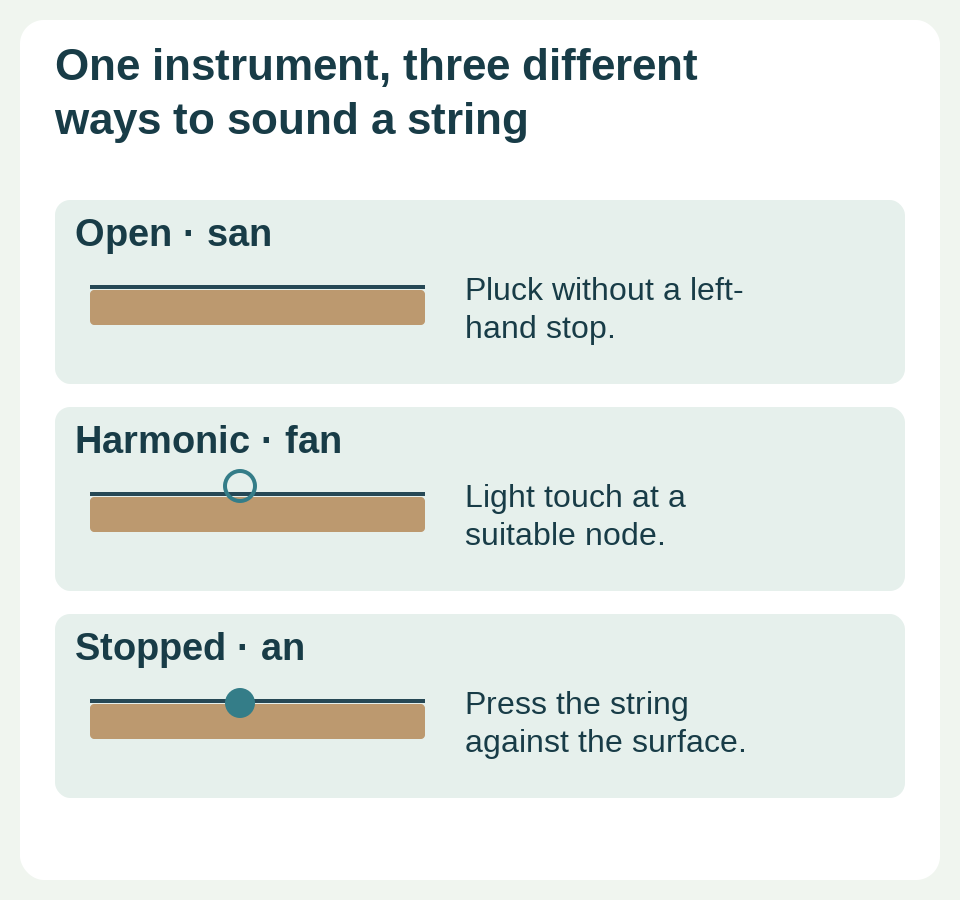
Guqin players distinguish three basic sound classes. San-yin is open-string sound: the right hand plucks without the left hand stopping the vibrating string. Fan-yin is harmonic sound: a light left-hand touch at a suitable node allows a harmonic to sound when the string is plucked. An-yin is stopped sound: the left hand presses the string to the surface while the right hand plucks it.
The difference is physical, not merely a set of poetic adjectives. A lightly touched harmonic is not made by fully pressing the string down. A stopped note can be followed by left-hand movement that changes pitch or adds ornaments. An open string lets its available vibrating length sound without that left-hand stop.
For a listening exercise, find a demonstration that shows the left hand clearly. Predict the sound class from the action, then listen. Harmonics often have a clear, floating quality; stopped notes can carry slides and other pitch gestures. Those descriptions guide attention, but the visible hand action is the better test.
- San: pluck an open string.
- Fan: pluck with an appropriate light-touch harmonic action.
- An: pluck while the left hand stops the string.
What the thirteen hui tell a player
The hui mark useful positions along the string, including harmonic reference positions. They help the player locate and describe left-hand placement. They do not divide the instrument into thirteen fixed notes in the way a beginner might imagine from a fretted guitar.
Stopped notes can be played at positions between markers. Peiyou Chang's notation introduction explains how positions between hui are described in subdivisions. This is one reason that a guqin player must learn to connect written location, hand position and the pitch actually heard.
Do not use a small schematic as a physical fingering chart. Marker positions and string lengths matter. Our diagram explains the three actions; a teacher and the instrument itself are needed to demonstrate precise stopping and harmonic locations.
- A hui number names a reference position.
- Positions between markers are part of the playing vocabulary.
- A conceptual diagram does not replace a demonstrated hand position.
Guqin and guzheng: a practical comparison
Both guqin and guzheng are plucked zithers, but their construction and playing systems are different. A common modern guzheng has twenty-one strings and a row of movable bridges, although models and historical instruments vary. A standard guqin has seven strings and no comparable row of individual movable bridges.
On guzheng, a player commonly plucks on one side of the bridges and uses the other side for pitch-shaping actions. On guqin, the left hand stops and moves along the playing length of a string, as well as using harmonic touches. The techniques and notation need their own instruction; one instrument is not simply a smaller or easier version of the other.
The sound comparison also needs a clear recording context. A close-miked guqin, an amplified concert guzheng and a software zither patch cannot settle how the physical instruments will sound in your room. Compare credited acoustic demonstrations, then compare the kind of music and learning process that interests you.
| Feature | Guqin | Guzheng |
|---|---|---|
| Strings | Standard form has seven | Twenty-one is common today; models vary |
| Visible bridge layout | No row of individual movable bridges | Individual movable bridges along the strings |
| Left-hand work | Stopping, sliding, harmonic touches | Pitch shaping and other techniques around the bridge layout |
| Notation | Guqin jianzipu; transcriptions may also be used | Jianpu or staff notation with technique marks may be used |
| First useful comparison | Hand actions and teacher access | Hand actions, instrument size and teacher access |
- Use bridges and string arrangement as identification clues.
- Learn each instrument’s hand techniques separately.
- Do not turn a loudness difference in processed clips into a universal rule.
Its cultural history is a living practice
UNESCO describes a guqin tradition extending over three thousand years and closely connected with Chinese intellectual history and the arts associated with scholars. Its heritage entry was originally proclaimed in 2003 and inscribed on the Representative List in 2008. These are recognition dates, not the invention date of every instrument now called guqin.
Historical descriptions of intimate scholarly performance help explain the tradition's associations, but they do not make modern public concerts inappropriate or prevent a new learner from beginning. Hong Kong Chinese Orchestra's plucked-string overview lists guqin among instruments that may be included according to repertoire; it is not a compulsory member of every Chinese orchestra.
Keep the tradition, the surviving object and the present performance separate. An old painting can show a cultural setting; a museum object has its own material and dating evidence; a modern demonstration shows what a particular player does today. None needs to stand in for all three.
- UNESCO recognition concerns a musical tradition.
- Historical intimate settings do not define every modern performance.
- Guqin is not required in every orchestral program.
Why jianzipu is different from jianpu
Guqin jianzipu uses abbreviated character components to describe playing actions. A cluster may identify a right-hand technique, a string, a left-hand finger and a hui position. Numbered jianpu instead describes scale degrees and rhythm. A number inside a jianzipu cluster is therefore not automatically the same musical information as a jianpu digit.
Peiyou Chang's introductory example describes a cluster in which the left thumb stops the fifth string at the seventh hui while the right index finger performs tiao on that string. The string number and position number do different jobs. This is a worked notation example, not an instruction to apply that hand action to every printed 5 or 7.
Use the linked jianzipu guide when you need to separate the components. For actual timing, phrasing and hand movement, work with a demonstration or teacher rather than treating a character diagram as a complete performance lesson.
Practice situations
These are illustrative examples for working through the decision.
Thirteen dots mistaken for thirteen frets
A guitarist sees thirteen hui and assumes the guqin offers thirteen fixed fret positions.
What does the image actually show?
Reference markers, not fret bars. A player can stop notes at positions between hui and uses hearing and demonstrated placement to control pitch.
A long zither with many separate bridges
A photograph shows many strings, each supported by a movable bridge. The caption says only “Chinese zither.”
Is that enough to label it guqin?
No. The bridge row and many-string layout point toward a guzheng or another zither form, rather than the standard seven-string guqin. Confirm with a full instrument credit or collection label.
One number, two different notation jobs
A learner sees 5 in a jianpu line and a fifth-string instruction in a guqin jianzipu example.
Do both mean scale degree 5?
No. The jianpu digit names a scale degree; the jianzipu string instruction names which string to play. Read the system and the component’s role before interpreting the number.
A museum label compared with a concert recording
A museum guqin has a historical date; a modern concert recording uses amplification.
Does one prove how the other was heard historically?
No. The object and recording document different evidence. Use the collection record for the object and a performance source for the modern sound, without treating amplification as a historical acoustic fact.
Download the blank worksheet (TXT)
Fill it with your own observations, source details and next question.
Questions and answers
Is guqin the same instrument as guzheng?
No. Both are plucked zithers, but the standard guqin has seven strings and different construction, techniques and traditional notation.
Are the thirteen hui thirteen notes?
No. They are position markers, including harmonic reference points. Stopped-note playing also uses positions between them.
Does guqin only make quiet, relaxing music?
Those descriptions capture some listening experiences, not the whole repertoire or every performance. Technique, recording and musical context change the sound.
Should I learn jianpu before guqin jianzipu?
Jianpu can help you understand musical pitch and rhythm, but it does not decode guqin action-based tablature. Learn the notation used by your teacher and lesson materials.
- A jianzipu cluster describes actions and locations.
- String numbers, hui numbers and scale degrees are distinct.
- A notation example needs a musical and teaching context.
Use the clip as one example
Uploader-described guqin open strings. This is one tuning/example, not a demonstration of every guqin technique or tuning.
Open-string guqin sample by RafaelCaro. Source, Attribution 4.0.
Sources and scope
References support the construction, notation, historical-object or recording details discussed above. Use the complete source description when comparing instrument models or recordings. The diagrams are original educational material, and the practice situations are illustrative examples.
- UNESCO: Guqin and Its Music
- Peiyou Chang: Guqin Notation 1
- Peiyou Chang: Guqin Notation 2
- Peiyou Chang: Guqin Notation 3
- Hong Kong Chinese Orchestra: Plucked Strings
- MTSU Center for Chinese Music and Culture: Instrument Gallery
Editorial revision: 4 November 2026.