culture history
Xun History and Cultural Meaning: Objects, Sound and Context
Understand the xun vessel flute, read a Tang museum object accurately, and separate early tradition, cultural interpretation and modern performance evidence.
What a xun is
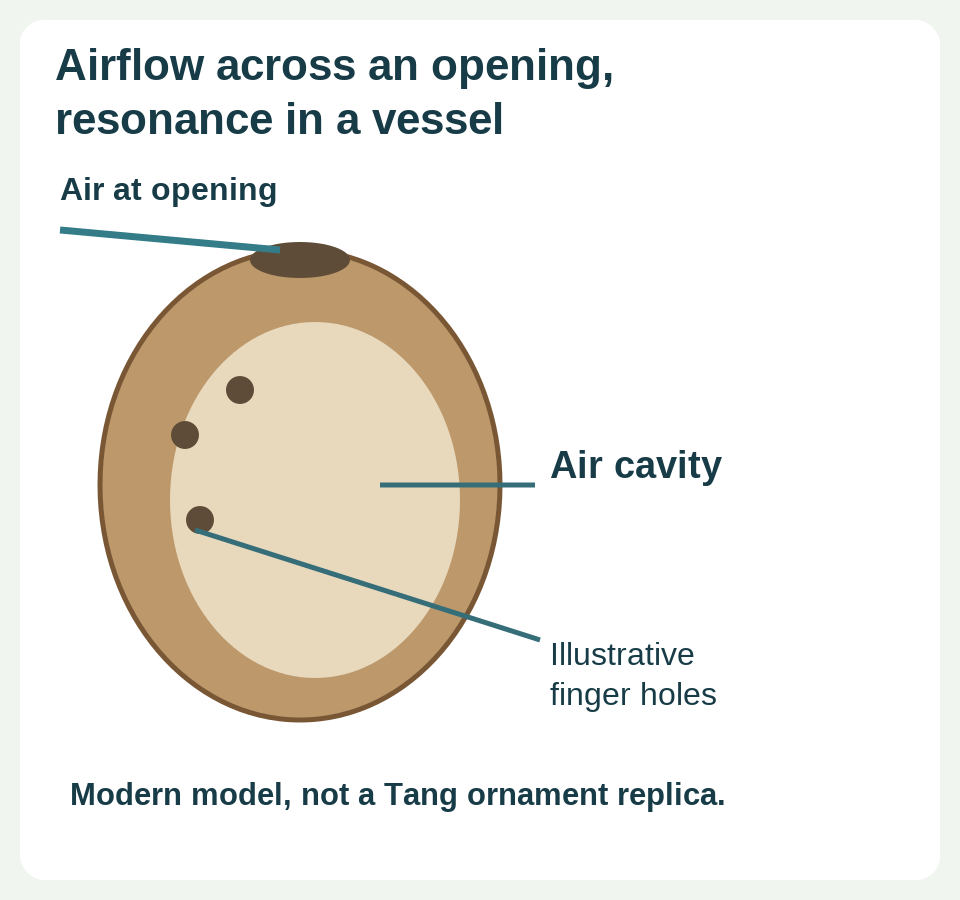
The xun (埙 or 塤, xūn) is a Chinese vessel flute, commonly associated with clay construction. Its enclosed body contains an air cavity, and the player directs air at the blowing opening. Finger holes on a playable model help control pitch.
This differs from a long tube flute such as dizi or xiao. The rounded vessel is a useful visual clue, but appearance alone does not establish a playable instrument’s range, fingering or condition. Modern models and historical objects need their own descriptions.
The MTSU gallery places xun within a long Chinese instrument tradition. The HKCO wind overview lists it among additional instruments used according to repertoire. These sources support construction and musical context without requiring the claim that every orchestra, ritual or modern composition includes it.
Early tradition and a careful timeline
The MTSU description associates xun with early Chinese history, including Neolithic roots and later ritual or court contexts. A useful article can explain that long tradition without assigning every object the same age or claiming one uninterrupted design.
Separate the broad history of a vessel-flute type from the date of a particular surviving object. A museum may date one item to a dynasty or century; that date belongs to that item. It is not automatically the invention date of all xun, nor does it prove the fingering system of a modern instrument.
The comparison below keeps those kinds of evidence apart. For a more precise historical claim, look for a specific excavation, catalog or text and check what form it describes. When that evidence is absent, a broad qualified statement is more accurate than an impressive unsupported number of years.
| Evidence | What it can establish | What remains separate |
|---|---|---|
| MTSU’s historical overview | Broad early roots and later musical contexts | Exact dates and construction of each object |
| A dated museum record | The cataloged item’s date, material and classification | Universal invention date or modern fingering |
| A current performance credit | Use in that particular musical setting | Continuity of every historical practice |
| A processed audio file | The uploaded example and its stated treatment | Natural unprocessed acoustic decay |
A Tang object: read the whole museum record
The Metropolitan Museum’s public record for object 48191 is titled Flute xun with animal face. It dates the item to the Tang dynasty, specifically the seventh to eighth century, and describes earthenware with three-color, or sancai, glaze.
The same record calls its object type Ornament and classifies it as Ceramics. Its listed height is 3.3 centimeters. Those details matter: this small historical item should not be presented as a typical full-size modern lesson instrument or as proof of playable range.
The title makes the object relevant to a discussion of xun-related material culture. The classification and dimensions limit what can be inferred from it. Without an acoustic or technical examination, the record does not establish how it was played, what notes it could produce or whether a modern beginner could use it.
- Keep title, classification and dimensions together.
- The date belongs to this cataloged object.
- Do not infer modern playability from an image or title.
Cultural meaning depends on the setting
A xun performance may be framed through an old object, a ritual association, a concert program or a modern composition. Those contexts can give listeners different ways to interpret it. They do not require one fixed emotional meaning for every piece.
Descriptions such as earthy, mournful or meditative may express a particular response to timbre. Explain who is using that description and in which program. Do not turn a personal impression into a universal historical belief or a claim about every community that has used vessel flutes.
For a classroom discussion, ask students to separate the physical mechanism, the object’s historical record and their own listening response. Each is a legitimate question, but each needs different evidence. A source about ceramics cannot by itself establish a performer’s intended emotion.
- Connect meaning to an actual text or program.
- Keep personal responses distinct from historical claims.
- A material description is not a musical interpretation.
Modern playing and recording context
A current playable xun can be explored through a credited demonstration that shows the blowing opening and finger actions. Ask for the actual model and fingering guidance if you intend to learn. Do not copy a hole count or range from a different object without checking compatibility.
The linked franeknflute audio file explicitly describes added reverb. That makes it useful for understanding a processed example, while limiting claims about natural decay or room sound. A long apparent tail in this file cannot be assigned entirely to the unprocessed vessel.
The HKCO overview treats xun as an instrument used according to repertoire rather than a required part of every wind section. If you want to attend a performance, check the current piece and player credit. An ancient association or orchestra family page is not a current event schedule.
Practice situations
These are illustrative examples for working through the decision.
A tiny ornament used as a modern setup guide
A reader uses the 3.3-centimeter Tang object to explain a beginner instrument’s hole layout and range.
What is the evidence limit?
The record describes a small ceramic ornament. It does not establish a standard modern playable model, fingering or range.
A museum date treated as an invention date
An article says xun was invented in the seventh century because one cataloged object has that date.
What does the date actually apply to?
That particular museum item. The instrument tradition has a separate broader history.
Reverb assigned to natural tone
A listener hears a long tail in a file described as having added reverb and calls it the xun’s natural decay.
How should the observation be qualified?
It is a processed recording. The file does not isolate the unprocessed instrument’s acoustic decay.
One emotional label applied to all uses
A student says every xun piece is mournful because one soundtrack sounds that way.
What should be examined?
That piece’s actual program and recording context. A personal response does not establish a universal cultural meaning.
A practical object-and-performance note
Choose one object or recording and write down its complete source. For an object, include title, classification, material, date and dimensions. For a recording, include the performer or uploader credit, model if stated, ensemble context and processing information.
Then write two sentences: what the evidence establishes and what remains unknown. This prevents a compelling image or sound from doing more historical work than it can support. It also gives you a precise next question for a museum, teacher or program note.
Use the flute comparison resource when the construction is unclear. Use the xiao history article to compare name confusion with object interpretation. The worksheet below keeps a dated artifact, a playable instrument and a cultural response from being blended into one unsupported claim.
Download the blank worksheet (TXT)
Fill it with your own observations, source details and next question.
Questions and answers
Is xun a flute even though it is rounded?
Yes. It is a vessel flute rather than a long tube flute. Airflow at its opening excites the cavity of a playable model.
Does the Tang museum object prove a modern xun’s range?
No. The record identifies a small ornament and provides material, date and dimensions. It does not give a playable modern range.
Can a processed recording show natural decay?
Not by itself. Added reverb changes the tail, so an unprocessed comparison or suitable acoustic demonstration is needed.
Does xun always have the same cultural meaning?
No universal meaning follows from the sources used here. Interpret a particular object, text or performance in its context.
Use the clip as one example
The uploader describes added reverb. The recording does not isolate the xun’s natural unprocessed decay.
Xun sample by franeknflute. Source, Attribution 4.0.
Sources and scope
References support the construction, notation, historical-object or recording details discussed above. Use the complete source description when comparing instrument models or recordings. The diagrams are original educational material, and the practice situations are illustrative examples.
- MTSU Center for Chinese Music and Culture: Instrument Gallery
- Hong Kong Chinese Orchestra: Winds
- The Metropolitan Museum of Art: Object 48191, Flute Xun Ornament
- Freesound: Xun File and Uploader Description
Editorial revision: 4 November 2026.