culture history
Xiao History and Cultural Meaning: Read the Evidence Carefully
Understand the xiao as an end-blown flute, distinguish it from paixiao and Xiao Luo, and separate cultural stories, guqin associations and historical evidence.
Start with the modern instrument
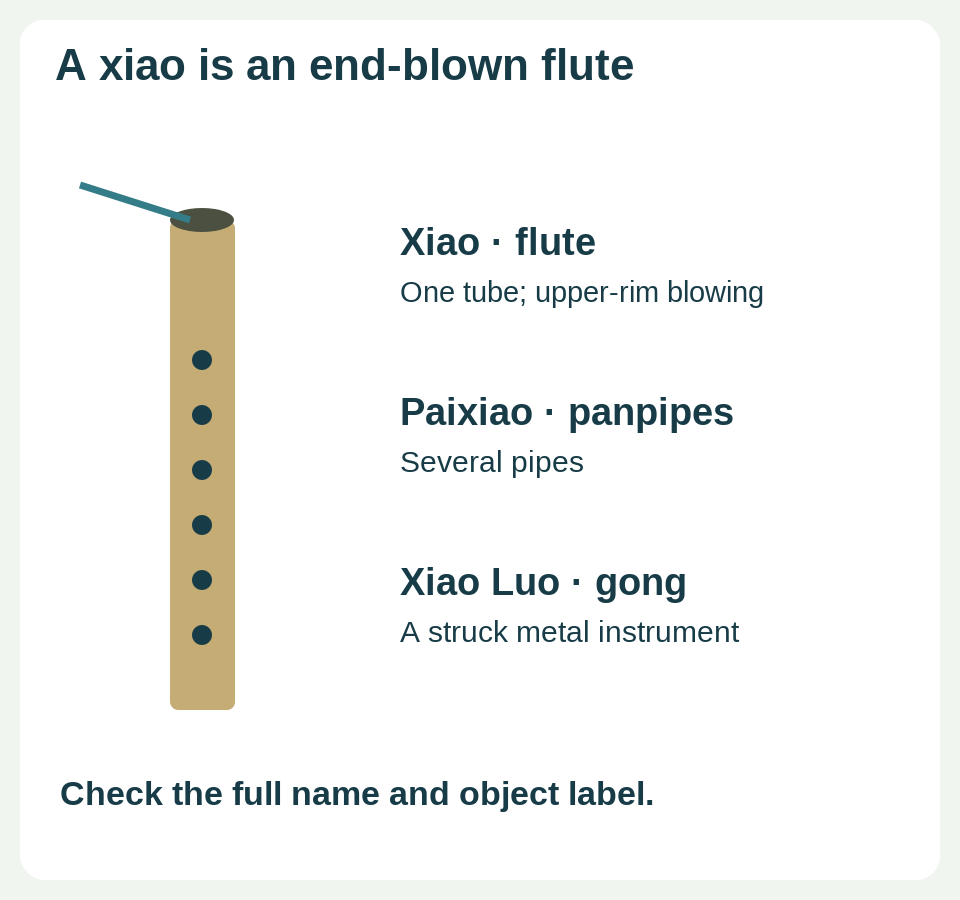
The xiao (箫 or 簫, xiāo) is a Chinese vertical end-blown flute, commonly made of bamboo. The player directs air across the blowing edge at its upper end. Finger holes help control pitch, while breath and articulation shape the phrase.
Timbre and Orchestration describes northern and southern forms, and the HKCO wind overview includes xiao as an instrument used according to repertoire. That gives a useful modern construction and ensemble context. It does not establish one fixed size, tuning, hole count or place in every Chinese orchestra.
Begin a historical explanation with this clear object definition. Otherwise, a name, painting or story can be attached to the wrong instrument. The diagram here is an original recognition aid, rather than a museum photograph or a reconstruction of a particular ancient flute.
Three similar names that need different explanations
Xiao, paixiao and Xiao Luo should not be treated as interchangeable labels. Paixiao refers to a panpipe instrument with multiple pipes. Xiao Luo is a small gong. The modern xiao discussed here is a single-tube end-blown flute.
The Metropolitan Museum’s public record for object 500585 names it Xiao Luo and classifies it as an idiophone-struck gong. Read that complete label when choosing an illustration: this particular object is a gong, rather than an end-blown flute. The shared word xiao in a romanized label does not make the objects interchangeable.
Historical instrument terminology also needs care. The secondary xiao overview notes that the word has had broader uses in earlier naming contexts. When reading an old reference, ask what construction the author describes rather than assuming every occurrence names the present-day dongxiao.
| Name | Construction or evidence | What the label cannot prove |
|---|---|---|
| Xiao / 箫 / 簫 | A modern single-tube end-blown flute | One universal historical form or invention date |
| Paixiao / 排箫 | A panpipe instrument with multiple pipes | That it is the same object as a modern xiao |
| Xiao Luo / 小锣 | The Met object 500585 is a struck gong | Any claim about xiao-flute sound or construction |
| A historical use of xiao | The described object and source context must be examined | That modern terminology maps exactly onto the old text |
An old tradition without an invented birthday
The wind resource associates xiao’s development with earlier end-blown flutes and traditions in southwest China. The secondary overview also discusses this ancestry. These are broad historical descriptions, not a securely documented day, year or single inventor for the modern instrument.
A dated artifact can establish that a particular object existed in a particular period if its identification and dating are reliable. It cannot, by itself, establish the complete origin of every later flute sharing a name. An image of a performer is evidence of the depicted form and context, not automatically a continuous construction lineage.
For a careful timeline, distinguish an object date, a written reference, a later performance tradition and a modern maker’s design. When the sources do not resolve the connection between them, state that limit. A precise unsupported age makes an article look confident while giving the reader less reliable history.
- Separate object dates from origin dates.
- Check the construction behind a historical name.
- Avoid assigning one inventor without evidence.
Phoenix stories: cultural meaning, not archaeological proof
The secondary overview summarizes a story associated with Xiao Shi, whose flute playing imitates the phoenix and whose tale involves transformation and flight. Such material belongs to the history of stories and cultural associations. It is not a physical explanation of how a flute vibrates or a dated record of invention.
Read a story as a story: who tells it, which characters and images it uses, and what a particular text says. Avoid turning the phoenix association into a rule that every xiao piece represents the same belief or emotion. A modern performer may choose a different program or interpretation.
The same distinction helps with words such as meditative, natural or spiritual in recording descriptions. They may express a listener’s response or a program’s theme. They do not prove that every historical player shared one philosophy or that a sound has a universal meaning.
- Name a legend as a legend.
- Treat a program interpretation as specific to that program.
- Do not infer a universal belief from a timbre adjective.
Guqin association and varieties
The secondary overview describes qin xiao as a form used to accompany guqin and discusses northern and southern varieties. This helps a reader understand why xiao may appear in a quiet chamber pairing rather than only in a large orchestra. The actual model and arrangement still matter.
An association does not make xiao and guqin the same instrument or give them the same notation. Guqin’s abbreviated tablature describes playing actions on strings; a flute score and fingering instruction use a different physical interface. A duet program can unite them musically while preserving those differences.
If you are choosing a recording, check the credits for both instruments and follow how they exchange or support a phrase. If you are choosing an instrument for a lesson or duet, ask the teacher or player about the actual model, tuning and intended use. Do not derive purchasing specifications from a general cultural description.
Practice situations
These are illustrative examples for working through the decision.
Xiao Luo mistaken for xiao
A museum image labeled Xiao Luo is used to illustrate an end-blown flute.
Which record resolves the error?
The complete object label and classification. Met object 500585 is an idiophone-struck gong, not a xiao flute.
A legend used as an invention date
A reader dates the instrument’s creation from a story about Xiao Shi and a phoenix.
What does the story actually support?
A cultural-story association. It does not establish a physical invention date or an archaeological lineage.
One model treated as all xiao
A seller’s flute has a particular hole count and the buyer assumes every historical xiao was identical.
What is missing?
Model-specific and historical evidence. Varieties and naming contexts differ; one modern specification is not a universal history.
A learner recording treated as a style standard
A novice improvisation is used to define expert xiao performance.
How should it be described?
As that learner’s uploaded example, with its stated experience and source context. Seek credited expert performances for broader stylistic study.
Read a recording with the same care as an object label
The linked JamieWilson1112 file is described by its uploader as an improvisation after roughly four weeks of learning. That context makes it an example of one learner’s playing, rather than a definitive account of expert xiao style. A file page can document a title, uploader description and displayed license without establishing the history of a whole tradition.
Write a short note containing the Chinese name, source, credited construction and type of claim. Mark whether the claim is a modern observation, a legend, a dated object record or a broad historical association. This makes uncertainty visible without preventing you from enjoying the music.
For construction comparisons, use the dizi, xiao and xun resource. For the guqin pairing, read the guqin identity article before assuming its notation or playing actions transfer to flute. The worksheet below keeps names, evidence and interpretation apart.
Download the blank worksheet (TXT)
Fill it with your own observations, source details and next question.
Questions and answers
Is xiao the same as paixiao?
No. Modern xiao is a single-tube end-blown flute; paixiao is a panpipe instrument with multiple pipes. Historical terminology should be checked in context.
Is Xiao Luo a kind of flute?
No. The Met record used here identifies Xiao Luo as a struck gong. A similar romanized word does not establish the same instrument.
Can I give xiao one exact invention date?
The sources used here do not establish one. Distinguish dated objects, written references, traditions and modern designs instead.
Does xiao always symbolize meditation?
That may be a particular listener’s or program’s interpretation. It is not a universal meaning for every player, tradition or piece.
Use the clip as one example
Uploader-described improvisation after about four weeks of learning. Treat it as one learner’s example, not an expert style standard.
Xiao practice sample by JamieWilson1112. Source, Creative Commons 0.
Sources and scope
References support the construction, notation, historical-object or recording details discussed above. Use the complete source description when comparing instrument models or recordings. The diagrams are original educational material, and the practice situations are illustrative examples.
- Hong Kong Chinese Orchestra: Winds
- Timbre and Orchestration: Chinese Winds
- Wikipedia: Xiao (Flute)
- The Metropolitan Museum of Art: Object 500585, Xiao Luo Gong
- Freesound: Xiao File and Uploader Description
Editorial revision: 4 November 2026.