Practical guide
Guqin Hui Positions: Thirteen Markers, Uneven Gaps and Harmonics
The guqin’s thirteen hui mark selected harmonic nodes at unequal fractions of the sounding string. Several markers give the same harmonic pitch on one string. Use the relative map below to understand the pattern; it is not a measured instrument or a fretted fingering chart.
Start with the playing orientation
In Peiyou Chang’s introduction, the thirteen hui are numbered from the player’s right to left. The seven strings run from the farthest to the nearest in the playing position. A rotated photograph can reverse what “left” appears to mean on your screen.
Here, let L mean the whole available sounding string length, not the wooden body length. Distances are measured from its right end, on the side where the right hand normally plucks. Hui 1 is at L/8, hui 7 at L/2, and hui 13 at 7 L/8. State that origin before using a fraction.
Read the thirteen fractions, not thirteen equal divisions
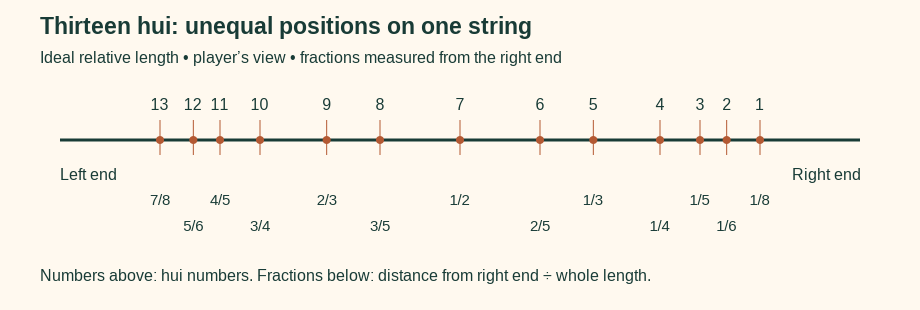
John Thompson’s Table 2 lists the marker positions and their harmonic relationships. The table below rewrites that map in hui-number order. Its 120 cm length and 80 Hz open-string frequency are explicit hypothetical values for arithmetic; they are not measurements or recommended tuning.
| Hui | Fraction from right | Distance in example | Harmonic multiplier | Frequency in example |
|---|---|---|---|---|
| 1 | 1/8 | 15 cm | 8 × open | 640 Hz |
| 2 | 1/6 | 20 cm | 6 × open | 480 Hz |
| 3 | 1/5 | 24 cm | 5 × open | 400 Hz |
| 4 | 1/4 | 30 cm | 4 × open | 320 Hz |
| 5 | 1/3 | 40 cm | 3 × open | 240 Hz |
| 6 | 2/5 | 48 cm | 5 × open | 400 Hz |
| 7 | 1/2 | 60 cm | 2 × open | 160 Hz |
| 8 | 3/5 | 72 cm | 5 × open | 400 Hz |
| 9 | 2/3 | 80 cm | 3 × open | 240 Hz |
| 10 | 3/4 | 90 cm | 4 × open | 320 Hz |
| 11 | 4/5 | 96 cm | 5 × open | 400 Hz |
| 12 | 5/6 | 100 cm | 6 × open | 480 Hz |
| 13 | 7/8 | 105 cm | 8 × open | 640 Hz |
On a phone, scroll inside the table. Keyboard users can focus the table region and use the arrow keys.
Sources: [1].
Why the gaps are unequal
The positions come from selected simple fractions: halves, thirds, quarters, fifths, sixths and eighths, including reflected positions. They are not thirteen equal steps. For example, hui 1→2 covers 1/6−1/8=1/24 of L, while hui 6→7 covers 1/2−2/5=1/10 of L.
On the hypothetical 120 cm length those gaps are 5 cm and 12 cm. Copying the same physical spacing thirteen times would erase the relationships the markers are meant to show. Thompson notes that 3/8 and 5/8 are omitted from this thirteen-marker arrangement. Thirteen therefore describes this selected map, not all possible nodes or all playable pitches.
Sources: [1].
Why different markers can give the same harmonic pitch
For the ideal light-touch harmonic described here, the whole string vibrates in equal segments. Touching at 1/3 or 2/3 selects the same three-segment relationship, so both can produce three times the open-string frequency on that same string. Hui 5 and 9 are that pair.
At 1/5, 2/5, 3/5 or 4/5, the lowest compatible relationship has five segments. Hui 3, 6, 8 and 11 therefore share the five-times multiplier. Do not calculate the harmonic at 2/5 as 1÷(2/5)=2.5 times: that inverse-length shortcut describes a different physical assumption.
Within these thirteen marked positions, the indicated lowest harmonic multipliers are 2, 3, 4, 5, 6 and 8. Their absolute frequencies change with the open pitch of the selected string. A multiplier is not an absolute note name or proof of identical tone colour at every contact point.
Sources: [1].
A harmonic touch and a stopped note are different checks
A fan-yin harmonic uses light contact at a suitable node. An an-yin stopped sound uses pressure to stop the string against the surface. UNESCO’s description and Chang’s introduction distinguish those actions; a hui marker is not a metal fret bar.
Do not replace the harmonic map with a stopped-note chart. For stopped notes the effective length, pressing action and instrument setup matter. Thompson discusses why a stopped sound at the same visually marked position can be slightly sharper than the corresponding harmonic. That is a reason to listen with instruction, not a universal prescription to shift every finger by the same amount.
Check two complete hypothetical examples
These examples test the stated relationships; no instrument was played or measured.
Case 1
An ideal string has an 80 Hz open pitch. Compare a light-touch harmonic at hui 5 with one at hui 9. Do they differ by an octave?
Show answer and explanation for case 1
No. Both indicated harmonics are 240 Hz.
Hui 5 is at 1/3 and hui 9 at 2/3. Both use the three-segment relationship:3×80=240. Distinct positions do not necessarily imply distinct harmonic pitches.
Case 2
A diagram labels hui 6 as 2/5 of a 120 cm sounding length from the right. A learner calculates its harmonic as 80÷0.4=200 Hz. What should the stated ideal map give?
Show answer and explanation for case 2
48 cm from the right, but a 400 Hz harmonic.
The position is 120×2/5=48 cm. The harmonic relationship uses five segments, so 5×80=400 Hz. 200 Hz would result from treating 0.4 L as a stopped vibrating length; that is not the light-touch harmonic model.
Move from the map to your own lesson
Use this map to explain the marker pattern, then ask a teacher to show harmonic contact on the actual instrument. Do not move inlays, alter the bridge or retune strings to make a schematic fit.
For locations between markers, read modern positions 7.6 and 7.9. To interpret which string, finger and action a written cluster names, use the worked jianzipu component guide. The guqin identity guide covers the broader three-sound distinction.
Sources and further reading
- John Thompson: Qin Tunings, Some Theoretical ConceptsTable 2 gives the thirteen relative fractions and the hypothetical 120 cm/80 Hz values. Footnote 11 explains paired nodes and harmonic multipliers; sections 4–5 discuss stopped-position limits.
- Peiyou Chang: Guqin Playing and Notation — General IntroductionPlayer-facing string/hui numbering and distinctions among open, harmonic and stopped actions.
- UNESCO: Guqin and its musicSeven strings, thirteen marked positions and the light-touch harmonic/pressed stopped distinction; historical population statements are not used as current data.