Practical guide
Read Guqin Positions 7.6 and 7.9: Subdivisions, Not Equal Frets
In the modern positional convention described here, 7.6 means six tenths of the distance from the seventh hui towards the eighth; 7.9 means nine tenths. Read the numbered interval before estimating a place. Neither number supplies a string, a sound type or an absolute pitch.
Read the two parts of the position
The number before the decimal identifies the hui at the start of the described interval. The decimal part identifies tenths along that interval towards the next hui. John Thompson explicitly explains 7.6 and 7.9 as 6/10 and 9/10 of the 7→8 distance; Chang’s introduction describes ten subdivisions between consecutive hui.
Because hui numbers increase from the player’s right to left, 7.6 lies towards the left from 7 in the playing orientation. It is farther towards 8 than 7.5 and not as far as 7.9. Screen direction alone is unreliable in a rotated image.
Calculate within one interval
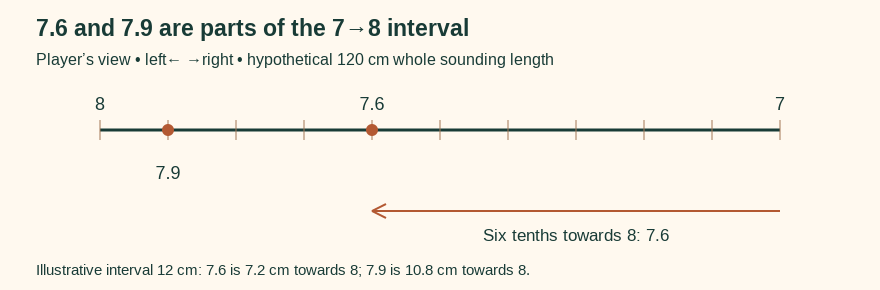
In Thompson’s relative node map, hui 7 is 1/2 of L from the right and hui 8 is 3/5 of L. On a hypothetical 120 cm sounding length their positions are 60 cm and 72 cm, so this interval is 12 cm.
For a fraction t of that interval, the coordinate is 60+t×12 cm from the right. Thus 7.6 gives 60+0.6×12=67.2 cm; 7.9 gives 60+0.9×12=70.8 cm. The gap between those two positions is 3.6 cm.
That formula belongs to this explicitly defined interval. The next interval has a different physical length: a decimal fraction is not a fixed number of centimetres across the instrument.
| Instruction | Fraction of interval | From hui 7 towards 8 | Coordinate from right |
|---|---|---|---|
| 7.0 | 0/10 | 0 cm | 60 cm |
| 7.5 | 5/10 | 6 cm | 66 cm |
| 7.6 | 6/10 | 7.2 cm | 67.2 cm |
| 7.9 | 9/10 | 10.8 cm | 70.8 cm |
| 8.0 | 10/10, the next marker | 12 cm | 72 cm |
On a phone, scroll inside the table. Keyboard users can focus the table region and use the arrow keys.
Sources: [1].
Position does not supply the whole note
Keep four questions separate: which string, where the left hand acts, which sound-producing technique applies, and how the passage is timed. A 7.6 position does not mean sixth string, scale degree 6, 7.6 cm or a duration.
The absolute sound depends on the string’s tuning and the way it is touched or stopped. The ideal relative node map in the thirteen-hui guide describes harmonic relationships, not a universal stopped-note pitch chart.
Thompson explains that pressing a string can sharpen a stopped sound relative to the corresponding lightly touched harmonic. Bridge height, tension and the instrument affect the discrepancy. Use the position as an instruction to interpret with hearing and demonstration; do not promise an exact pitch from the printed decimal alone.
Sources: [1].
Keep historical positions with their source
Historical “between,” “above,” “below” and ban (half) labels cannot all be replaced by one decimal rule. Thompson’s discussion of Shen Qi Mi Pu and Zheyin Shizi Qinpu gives examples where the conventions differ and can vary within a copied source.
In his Table 5, modern 7.6 is associated with the Old row’s 7–8; his discussion also describes 7 ban being used for that location in sliding instructions. Reading the word “half” as the modern mathematical midpoint 7.5 would therefore silently change the source’s convention.
This is a named analytical comparison, not a conversion dictionary for every historical handbook. Preserve the exact sign, edition, page and context. Check the source’s own explanation or a knowledgeable teacher before modernizing it.
Sources: [1].
Try two complete reading cases
These are original hypothetical reading cases based on the stated convention, not played passages.
Case 1
Within the hypothetical 12 cm 7→8 interval, a learner treats 7.6 as the midpoint and places it 6 cm from 7. What does the modern decimal convention require?
Show answer and explanation for case 1
7.2 cm from 7 towards 8, which is 1.2 cm beyond that midpoint.
Six tenths means 0.6×12=7.2 cm. The midpoint is 0.5×12=6 cm. These distances illustrate one interval and should not be transferred to a different instrument as measured instructions.
Case 2
A historical explanation calls a sliding location 7 ban, and the identified source associates it with modern 7.6. Should an editor replace it with 7.5 because ban means half?
Show answer and explanation for case 2
No. Retain the source’s convention and exact sign.
The historical term is not automatically a modern decimal midpoint. A substitution would change the specified comparison. Record the edition and local explanation; do not extend that mapping to every handbook.
Bring the exact positional question to a lesson
Open the whole instruction rather than an isolated number. Confirm the string, sound class, finger, position, following movement and notation convention. For a historical crop, retain adjacent instructions and the handbook/page.
A useful question is “Does this edition use the modern 7→8 subdivision here, and how should I check the stopped pitch?” Use the jianzipu component guide when a string or action is unclear, and the slide-and-return comparison when the left hand is meant to move.
Sources and further reading
- John Thompson: Qin Tunings, Some Theoretical ConceptsSection 4 explicitly defines 7.6/7.9. Table 2 provides the relative 7/8 nodes; Table 5 and sections 4–5 discuss named historical variants and the limits of visual stopping precision.
- Peiyou Chang: Guqin Playing and Notation — General IntroductionHui numbering, ten interval subdivisions and the distinct fields and sound classes in tablature.