Jianpu and score reading
Hold a Jianpu Note Across a Bar Line: Read the Tie Before Repeating
Add durations of notes tied at the same pitch, keep both bars complete, and distinguish a held continuation from a new attack. Three original examples show the checks.
A tie joins written notes at the same pitch into one sustained duration. When it crosses a bar line, keep counting both written note values but do not make a new attack at the second tied note. The bar line remains in place; it does not restart the held sound.
Check pitch, octave marks and the score’s notation legend. Two matching digits alone do not prove that the notes represent the same pitch or are tied.
Identify the tie before deciding to repeat the note
The official Dots and Ties lesson states that ties merge notes of the same pitch and let their duration cross a measure line. Its displayed example ties a note at the end of one 4/4 measure to a note at the beginning of the next.
For jianpu, compare the scale degree, octave dots and any applicable accidental or key change. A 5 with an upper octave dot and a plain 5 are not the same register. A curve over different pitches cannot be interpreted as this same-pitch tie without other explanation.
Instrument-specific phrasing or bowing marks need the score’s legend or teacher. This tutorial does not assign a bow, breath or fingering from a curved line.
On a narrow screen, scroll inside the table to read all columns.
| Check | What it establishes | What it does not establish alone |
|---|---|---|
| Same pitch | Matching interpreted scale degree, octave and alteration | That a tie is printed |
| Actual tie | The indicated same-pitch continuity | A new attack on the next symbol |
| Written durations | How long each tied portion occupies its bar | The player’s fingering or breath |
| Bar total | Whether each regular measure has its required capacity | That every printed note is attacked separately |
Keep duration, bar totals and note attacks separate
Read a tie in two passes. First add each measure’s written durations as usual, counting rests and tied portions. Then mark where each new sound begins. Tied continuation symbols contribute duration but do not add new attacks to the held note.
On a narrow screen, scroll inside the diagram to read the full count grid.
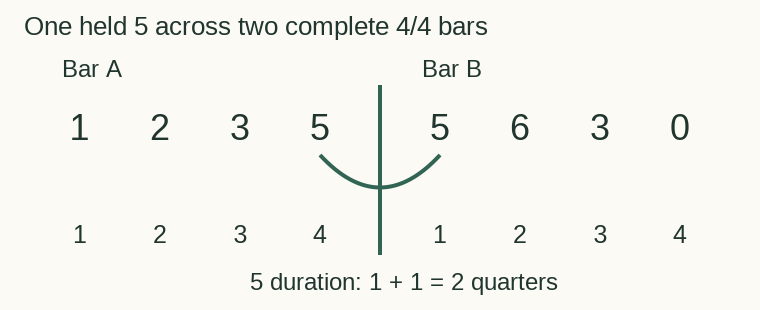
The basic jianpu guide explains duration dashes within a bar. A dash extends the preceding note by a quarter-note value in that convention. A cross-bar tie instead connects the specified note values on both sides of the bar line. Do not erase the bar line and replace a tie with unlabelled text dashes.
Three complete original held-note examples
These invented examples use unchanged 1=C and the same reference octave unless explicitly stated. Both bars are complete regular 4/4 measures.
1. A quarter tied to a quarter across the bar line
Bar A contains plain 1, 2, 3, 5. Bar B contains plain 5, 6, 3, 0. A tie joins bar A’s last 5 to bar B’s first 5. Each bar totals 1+1+1+1=4 quarter-note units. The joined 5 lasts 1+1=2 quarter-note units: attack it on bar A’s beat 4, hold through bar B’s beat 1, then attack 6 on bar B’s beat 2. The rest 0 occupies bar B’s beat 4. There are six sounded attacks across the two bars: 1, 2, 3, the held 5, 6 and 3. The tied continuation adds time, and the rest adds silence.
2. An eighth tied to a quarter
Bar A contains plain 1, 2, 3, then underlined 6 and underlined 5. Bar B contains plain 5, 6, 3, 0. A tie connects only the last underlined 5 to the first plain 5. Bar A adds 1+1+1+½+½=4 quarters; bar B adds 4 quarters. The tied 5 lasts ½+1=1½ quarter-note units. Attack 6 on beat 4, attack 5 on 4-and, hold 5 through the next beat 1, then attack 6 on beat 2. The different written note values still join because the interpreted pitch is the same.
3. Repeated digit, different octave
Copy the first example but give bar B’s first 5 one upper octave dot while bar A’s last 5 has none. The two notes still occupy one quarter each, so the bar totals remain correct. They no longer identify the same pitch under the stated unchanged reference scale. Do not apply the previous held-note answer just because both show 5. Check the original for a copying error or another kind of mark, and ask about the intended notation before changing the score.
When the count or attack does not fit
- Confirm the meter and each note’s duration marks.
- Check that the curve actually connects the two notes you are reading.
- Resolve pitch identity, including octave dots and relevant alterations.
- Add the tied durations in one unit.
- Check the bar totals independently of the held sound.
- Mark the next genuinely new attack after the tie ends.
Repeated same-pitch notes without an indicated tie are not automatically one long note. Likewise, a printed rest is silence, not a same-pitch continuation. If the source image hides the curve’s endpoint or an octave dot, use a clearer original rather than infer it from the sound you expected.
Save one held-note record
Score / edition / page and bars:
Meter and reference key:
First tied note: degree / octave / alteration / duration:
Next tied note: degree / octave / alteration / duration:
Evidence that both represent the same pitch:
Tie endpoints as printed:
Sum of tied durations in one unit:
Each bar’s separate duration total:
Held sound begins on:
Next new attack occurs on:
Unclear legend, copying issue or teacher question:
For a short opening, see the pickup-counting guide. A pickup changes where a phrase begins in the meter; a tie changes continuity across written note values. These are separate checks.
Sources and scope
Sources checked on 10 November 2026. The official Dots and Ties lesson supports same-pitch continuity and ties across a measure line. The selected numbered-notation reference supports the note-value and rest conventions. The count grid and examples are original; they do not assign an instrument-specific playing technique.
The exercises, count grids and blank records are original explanatory material. No named work is transcribed, no audio performance was evaluated, and no music teacher review is claimed.