Jianpu and score reading
A Short First Jianpu Bar: Count the Pickup Before Beat One
Count a stated pickup in 4/4, 3/4 or 6/8, then enter the first full bar. Three original exercises show the start position and how to read a complementary ending.
A stated pickup begins before the first full bar’s beat one. Count the note values in the short opening, locate them at the end of the established meter, then enter the first complete bar on one. Do not automatically add rests or make the first printed note beat one.
First confirm that the score actually has a pickup. A cropped image, a missing symbol or a free-time introduction needs a different explanation.
Identify the opening before filling a supposed gap
The anacrusis reference describes a pickup as a note or group of notes preceding the first downbeat. The existing jianpu primer distinguishes deliberately incomplete openings from complete regular bars. Here the extra task is deciding where to begin your count.
Use the actual time signature and the opening’s written duration marks. A plain digit is a quarter-note value in our convention; an underline halves it. A pitch digit such as 5 does not say “beat five.” Check the score’s beginning and legend, not only the fragment visible on a phone.
On a narrow screen, scroll inside the table to read all columns.
| Check | Useful evidence | Do not substitute |
|---|---|---|
| Opening context | Full score beginning and any pickup indication | A cropped line with unknown preceding notes |
| Meter | Actual time signature and established pulse | Number of printed pitch digits |
| Pickup duration | All note values and rests in that opening | The duration of only the first note |
| Entry point | First complete bar’s downbeat | An automatic added rest |
Place the pickup at the end of a regular-bar grid
For the simple stated pickups below, subtract the pickup duration from one complete bar’s duration. The result tells you how far through the imagined bar the pickup begins. This is a counting aid; it does not add an actual empty bar to the score.
On a narrow screen, scroll inside the diagram to read the full count grid.
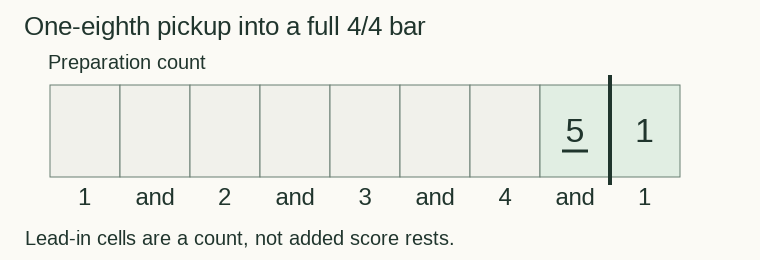
In 4/4, a complete bar contains 4 quarter-note units or 8 eighths. A one-eighth pickup begins after 7 eighths of the preparation grid: 4-and is its position. The next full bar begins on 1. If you call that pickup 1, you move the entire following bar’s beat labels.
Three complete original starting examples
The following phrases are invented. Their meters and pickup status are explicit, so no missing score details are inferred.
1. One eighth before a full 4/4 bar
The pickup is underlined 5, lasting 1 eighth. The next bar has four plain digits 1, 2, 3, 5, each lasting 1 quarter. Prepare 1-and 2-and 3-and 4, sound the pickup on the final “and,” then start the next bar’s 1 on the next downbeat. Pickup capacity is 1 eighth; the next bar is 2+2+2+2=8 eighths. Keep those two lengths separate rather than forcing the opening to total 8.
2. One quarter before a full 3/4 bar
The pickup is plain 5, lasting 1 quarter. The next bar has plain 1, 2, 3, totaling 3 quarters. Prepare counts 1, 2, sound the pickup on 3, and sound the next bar’s 1 on the following downbeat. The preparation offset is 3−1=2 quarter-note units. The pitch 5 is not a fifth beat.
3. One eighth before a full 6/8 bar
The pickup is underlined 6. The next complete bar contains a right-dotted plain 1 followed by three underlined digits 2, 3, 5. Use 1-and-a 2-and-a for the two dotted-quarter pulses. Prepare 1-and-a 2-and, sound the pickup on the last “a,” then hold 1 through the next 1-and-a. Sound 2, 3, 5 on 2-and-a. The pickup lasts 1 eighth; the complete bar totals 3+1+1+1=6 eighths.
Read a complementary ending without inventing one
A common notation pattern pairs a pickup with a shorter ending so their durations add to one complete bar. The anacrusis reference describes that recommendation, including endings before repeats. It does not establish that every edition must show it.
In an original 4/4 example with a one-eighth pickup and a written seven-eighth ending, 1+7=8 eighths. In 3/4 with a one-quarter pickup and a written two-quarter ending, 1+2=3 quarters. These sums explain the supplied notation; they are not instructions to shorten an existing full ending.
Read the actual repeat signs, alternative endings and any pickup instruction. Do not add the opening again at every line break, omit a written note to force a complement, or invent a rest where the edition supplies none. If the repeat route is unclear, retain an unchanged copy and ask how that edition returns to the pickup.
Check the transition and keep a brief record
- Confirm the score beginning and stated meter.
- Add the opening’s complete duration in one unit.
- Choose a consistent count grid for that meter.
- Place the pickup at the grid’s end and enter the first full bar on one.
- Read the closing and repeat route as actually written.
Score / edition / original page:
Evidence that the opening is a pickup:
Time signature and pulse unit:
Opening symbols and durations:
Pickup total in a chosen unit:
Full regular-bar capacity in that unit:
Starting count syllable:
First full-bar entry:
Written ending and any repeat route:
Unclear score detail / teacher question:
A correctly counted pickup does not determine fingering, breathing or bow direction. Follow the lesson’s separate playing instructions. For the difference between 3/4 and 6/8 pulse groups, use the meter comparison.
Sources and scope
- Wikipedia — Anacrusis
- musictheory.net — Simple and Compound Meter
- Wikipedia — Numbered musical notation
Sources checked on 10 November 2026. The anacrusis reference supports the pickup definition and the common complementary-ending discussion; it is a secondary reference, and its cited books were not independently consulted. The official meter lesson and selected numbered-notation definitions support the units used in the original counted examples. Read the actual edition rather than assume that every score must have the same ending pattern.
The exercises, count grids and blank records are original explanatory material. No named work is transcribed, no audio performance was evaluated, and no music teacher review is claimed.