Jianpu and score reading
6/8 vs 3/4 in Jianpu: Count the Groups, Not Just Six Notes
Read six eighth notes as two groups of three or three groups of two. Original numbered-note examples separate durations, pulse and scale-degree digits.
Six eighth-note values can fill either a 3/4 bar or a 6/8 bar, but their conventional pulse groups differ. In 3/4, count three quarter-note beats, each divided into two eighths. In 6/8, count two dotted-quarter beats, each divided into three eighths. The jianpu digits still identify scale degrees; they are not the numbers in your spoken beat count.
This lesson uses conventional simple-triple and compound-duple grouping. It does not transcribe a particular performance or decide an unusual score’s phrasing.
Read the meter and the duration marks first
The official simple-and-compound-meter lesson compares grouping six eighths into three beats or two beats. Its 3/4 example is simple triple; its 6/8 example is compound duple, with a dotted quarter as the beat.
In the numbered-note convention used here, a plain digit has a quarter-note value, one underline makes it an eighth, and a right dot adds half of that value. Those symbols determine duration before you choose the spoken count. A bare 1 in 6/8 is still a quarter-note value; it is not automatically one whole dotted-quarter pulse.
On a narrow screen, scroll inside the table to read all columns.
| Check | 3/4 | 6/8 |
|---|---|---|
| Normal pulse groups | Three quarter-note beats | Two dotted-quarter beats |
| Eighth-note subdivisions | 2+2+2 | 3+3 |
| Complete bar in eighth-note units | 6 | 6 |
| Complete bar in quarter-note units | 3 | 3 |
Keep scale-degree numbers separate from count syllables
The original six-note phrase below uses scale degrees 1, 2, 3, 4, 5, 6, each with one underline. All six are eighth notes. With 1=C and the stated reference octave they name C, D, E, F, G, A. That pitch sequence is separate from how the six equal durations are grouped.
On a narrow screen, scroll inside the diagram to read the full count grid.
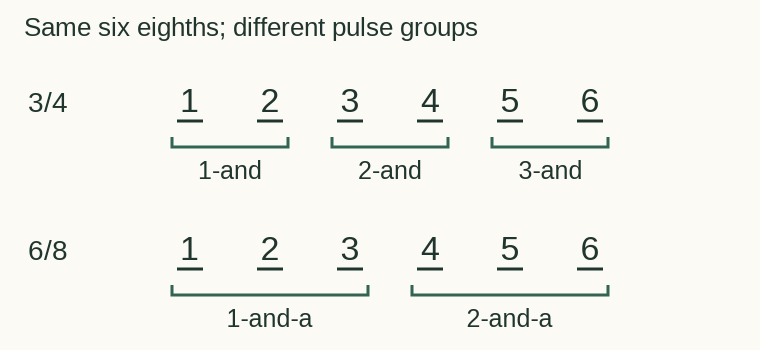
For 3/4, say 1-and 2-and 3-and. For 6/8, this lesson uses 1-and-a 2-and-a. The syllables are a teaching choice; use your teacher’s consistent alternative if supplied. Tap only 1, 2, 3 in the first version, and 1, 2 in the second, while speaking all six subdivisions.
The new pulse begins at the third eighth in 3/4, but at the fourth eighth in 6/8. Equal total duration therefore does not make the internal grouping interchangeable.
Three complete original counting examples
These exercises are invented for this explanation. Each uses a complete regular bar, with no pickup or tuplet.
1. Six eighths, two possible groupings
Use the six underlined digits 1, 2, 3, 4, 5, 6. In 3/4, group them (1, 2), (3, 4), (5, 6): each pair is 1 quarter-note beat. In 6/8, group them (1, 2, 3), (4, 5, 6): each triple is 1 dotted-quarter beat. Both totals are 6 eighths, but you tap three pulses in one version and two in the other. Do not use the pitch digit 3 as evidence that the third sound is always beat 3.
2. One dotted plain digit followed by three eighths in 6/8
Sound a plain 5 with a right dot, followed by three underlined digits 6, 3, 2. The dotted 5 occupies 3 eighth-note units, or the whole first dotted-quarter beat. The three eighths fill the second beat: 3+1+1+1=6 eighths. Hold 5 through “1-and-a,” then place 6, 3, 2 on “2-and-a.” This is one sustained note plus three new notes, not four equal pulse attacks.
3. Keep the pulse through an eighth rest
Use underlined 1, underlined 0, underlined 3, followed by a right-dotted plain 5. The first three symbols have durations 1+1+1 eighths; the last has 3. Together they fill 6/8. Count 1 on the first sound, “and” during the rest, “a” on 3, then hold 5 through 2-and-a. The rest changes what sounds, not the subdivision grid.
Check the score before changing its meter
- Read the actual time signature and note-value marks.
- Add durations in one common unit, such as eighths.
- Locate pulse groups from the meter and the score’s beaming or instructions.
- Clap or speak rhythm in one pass; name pitches in a separate pass.
- If a complete bar does not add up, check a clearer original, a pickup, tie or tuplet instruction before adding notes.
A correct duration sum does not settle every accent or phrase. A passage can deliberately cross the usual group boundaries. This simple comparison does not identify such a passage by itself.
Meter also does not state a tempo. Read the actual tempo indication rather than assuming two exercises with different beat units run at the same speed. No performance speed is measured here.
Record one bar and its count
Score / edition / page:
Time signature:
Reference key and octave context:
Each symbol with underline, right dot or rest:
Duration of each symbol in eighth-note units:
Complete-bar duration or stated pickup:
Pulse groups:
Chosen spoken subdivisions:
Any tie, tuplet or unclear mark:
One precise question for the teacher:
For basic symbol recognition, return to the jianpu primer. For an octave disagreement between parts, use the written-and-sounding-pitch guide; changing the meter does not resolve an octave convention.
Sources and scope
- musictheory.net — Simple and Compound Meter
- Wikipedia — Numbered musical notation
- musictheory.net — Dots and Ties
Sources checked on 10 November 2026. The official musictheory.net lessons support simple/compound beat grouping, dotted-quarter values and their relation to eighths. The numbered-notation reference supports the stated note-value and rest conventions. This tutorial applies those facts to original jianpu grids; it does not transcribe a published composition.
The exercises, count grids and blank records are original explanatory material. No named work is transcribed, no audio performance was evaluated, and no music teacher review is claimed.