Practical guide
Sanxian vs Ruan: Frets, Soundboards and Playing Actions
Distinguish a fretless, membrane-covered sanxian from a fretted ruan, and use playing action to avoid confusing either with bowed huqin.
Compare the neck, soundboard and action together
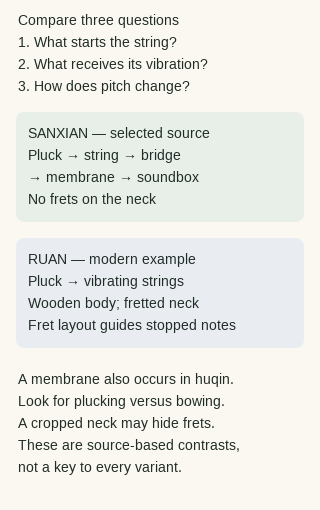
Sanxian and ruan can both be plucked, but they do not offer the same playing interface. In the Timbre and Orchestration Resource (TOR), sanxian has a membrane-covered soundbox and no frets. Its strings transmit vibration through a bridge to that membrane. The modern ruan is described with a round body, long neck and frets. These differences explain more than a label such as bright or warm.
Begin with three questions: is the player plucking or bowing, does the neck have frets, and what is the resonating surface? A membrane by itself is insufficient: bowed huqin can also have a membrane. A pick by itself is insufficient too: more than one plucked instrument can use a plectrum.
On a narrow screen, swipe the table sideways or focus it and use the right-arrow key.
| Question | Sanxian in TOR | Modern ruan in TOR | Bowed huqin contrast |
|---|---|---|---|
| Main action in this task | Plucking or strumming | Plucking | Bowing |
| Neck clue | No frets | Fretted neck | The bowing action remains essential |
| Resonator clue | Membrane over soundbox | Round wooden body | A membrane can also occur |
| What confirms a name? | Matched credit plus clear action and parts | Matched model/family label and clear parts | Matched variant and visible bowing |
The erhu-family guide explains the bowed contrast. Keep this comparison limited to the named sources and visible evidence; it does not identify every regional lute or modified huqin.
What the membrane and bridge actually tell you
The bridge transfers string vibration to the resonating surface. TOR describes a membrane, usually snakeskin, over the sanxian soundbox. That is a construction explanation for the selected instrument, rather than a claim about the material of an unidentified object.
Look for the bridge and the surface receiving its vibration in a clear view or labeled description. A patterned surface in a low-resolution image may be a clue, but a photograph does not certify species, authenticity, legal import status or current condition. Seek the actual maker or collection record for those questions.
A membrane-supported plucked instrument also differs from a drum: the performer’s plucking starts a string, whose vibration reaches the membrane. Do not classify the instrument only by the final surface that radiates sound. Conversely, seeing a membrane does not mean you have observed bowing.
Why the absence of frets changes the comparison
Frets supply positions associated with stopping a string on a fretted instrument. Sanxian’s fretless neck gives a different interface: the player controls where the string is stopped without those raised divisions. TOR connects that absence of frets with smooth glissandi and with its pitch-changing and vibrato techniques.
This explains why familiar ruan fingerings cannot simply be copied as identical sanxian instructions. A melody may name the same pitches while the instrument’s tuning, positions and hand actions differ. A first lesson should demonstrate the actual instrument’s stopping and plucking, with feedback on the resulting pitch.
Do not turn fretless into an automatic difficulty ranking. Frets do not remove setup or technique requirements, and no string count supplies a reliable prediction of a learner’s progress. For a lesson choice, ask what model the teacher uses and how the first stopped-note exercise is checked.
A pick and an orchestra label do different jobs
TOR describes sanxian being played with a pick or with finger plectrums. The visible accessory is therefore a playing clue rather than an exclusive identification mark. A player wearing finger plectrums is not necessarily holding a pipa.
Watch the start of a phrase in a clearly credited view. Plucking or strumming supplies an attack; a slide describes pitch changing after or during the action. A smooth line does not by itself prove a bow is driving the strings. When a distant view hides the right hand, leave that action unresolved instead of choosing from sound alone.
The Hong Kong Chinese Orchestra includes sanxian, zhongruan and daruan in its plucked-string configuration. TOR distinguishes small and large sanxian contexts and describes the large instrument in the Chinese orchestra. Neither source establishes the dimensions, tuning or permanent musical job of every sanxian.
Use the name on the actual programme, instrument or collection record together with its context. For a recording, keep the performer and passage attached. This guide explains written construction and technique descriptions; it does not report an independent audition of the sources’ linked recordings.
Three identification cases with explained answers
These fictional cases test the reasoning, not a claim that any pictured instrument has been inspected.
Case 1
A cropped image shows a membrane-covered soundbox. The neck and right hand are hidden. Is “definitely sanxian” justified?
Show answer and explanation for case 1
No. The image leaves decisive evidence missing.
Bowed huqin can also have a membrane. Seek a complete neck and playing view, then match the credit; the resonating surface alone does not establish sanxian.
Case 2
A matching teaching record names sanxian. It shows a fretless neck and the performer plucking with finger plectrums. Must the plectrums make it pipa?
Show answer and explanation for case 2
No. Those features are consistent with the described sanxian.
TOR includes finger plectrums among sanxian options. Combine the matched name, fretless neck and plucking action instead of treating an accessory as an exclusive pipa marker.
Case 3
A learner recognizes a ruan melody and copies its fretted positions onto a sanxian without checking tuning. Is the shared melody enough?
Show answer and explanation for case 3
No. Shared pitch content does not supply identical physical instructions.
The fretless interface, actual tuning and stopping positions need their own instruction. Ask the teacher to demonstrate a short phrase on the intended sanxian and explain the correction.
Choose the next question after recognition
Once the identification is supported, make the next task specific. A listener needs a credited passage and a clear musical role. A learner needs the teacher’s model and first action. A buyer needs actual dimensions, setup, materials and condition information. None of those follows from a generic family name.
If the remaining candidates are pipa, liuqin and zhongruan, use the focused visual comparison. If you know the instrument is ruan and are choosing a model, use the ruan size and lesson guide. Keep the evidence gap small enough that one next source or demonstration can resolve it.
Sources and further reading
- Timbre and Orchestration Resource: Plucked Strings — In-depthConstruction descriptions of sanxian membrane transfer, modern ruan body/frets, yangqin multiple strings and bridge divisions. Selected instruments; exact maker layouts are not specified.
- Timbre and Orchestration Resource: Plucked Strings — PracticalitiesSanxian fretless playing, pick/finger-plectrum options and yangqin mallet techniques. Model and extreme-register qualifications; linked recordings and score images are not reproduced.
- Timbre and Orchestration Resource: Plucked Strings — IntroductionSmall/large sanxian context and changes in modern orchestral instruments; no universal model specification or fixed ancient origin adopted.
- Hong Kong Chinese Orchestra: Plucked-string InstrumentsThis orchestra lists sanxian, ruan sizes and yangqin in its plucked section; mechanism and section membership remain separate questions.