comparison
Suona vs Related Instruments: Check the Sound-Making Action
Compare suona with guan, sheng, dizi, xiao and trumpet using reeds, bores, pipe layout and airflow. Follow a practical identification sequence with worked cases.
The fastest useful comparison
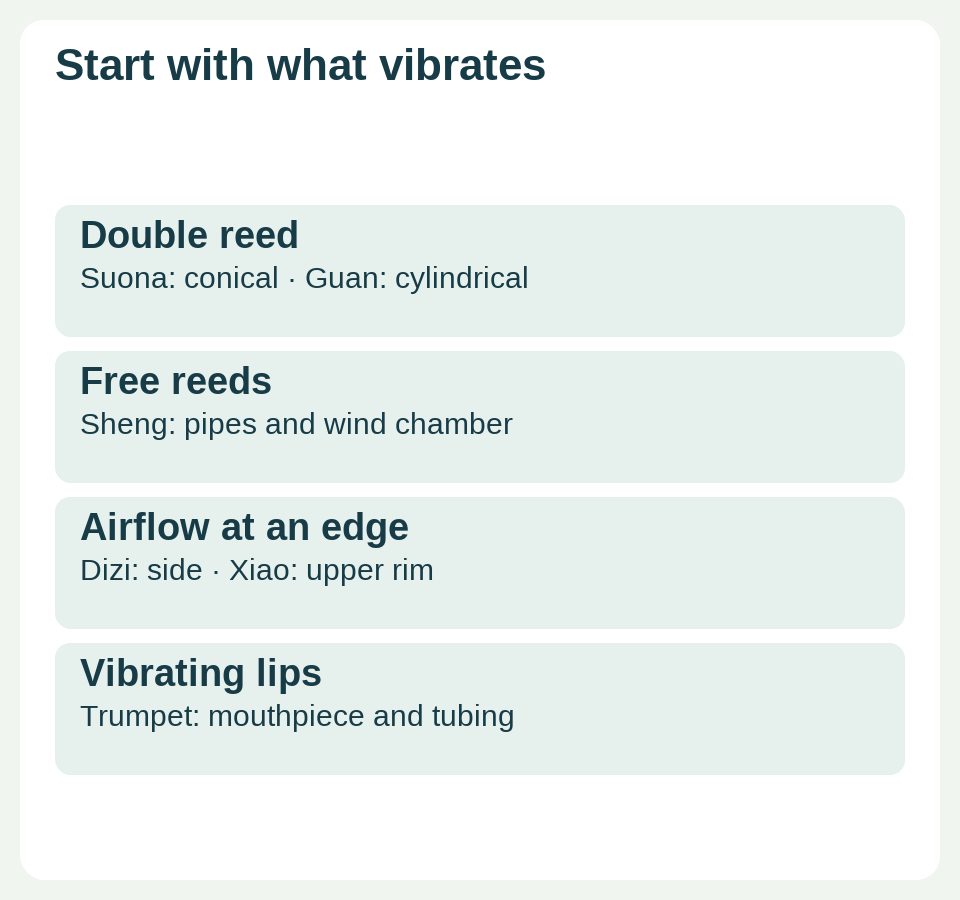
Suona and guan are the closest comparison here because both are double-reed winds. In the familiar forms described by the sources, suona has a conical bore and flared bell, while guan has a cylindrical bore. That construction distinction is stronger than calling one bright and the other warm.
Sheng uses free reeds associated with a bundle of pipes. Dizi and xiao are flutes: airflow interacts with an edge rather than a reed. Trumpet uses the player’s vibrating lips. These mechanisms explain why instruments with similar materials, outdoor uses or striking tones can still belong to different construction groups.
Use the table to select a candidate, then look for a credited performance or a clear view. A diagram is a recognition aid, not a universal maker’s specification. Modern keys, instrument sizes and regional variants can change the visible details.
| Instrument | What starts the vibration | Useful visible clue | What still needs checking |
|---|---|---|---|
| Suona | Double reed | Conical bore and flared bell | Actual model and credit |
| Guan | Double reed | Generally cylindrical bore | Size, keys and local form |
| Sheng | Free reeds | Bundle of pipes connected to a wind chamber | Pipe layout and model |
| Dizi | Airflow at a blowing edge | Transverse playing; many forms have a membrane hole | Membrane-bearing form or xindi |
| Xiao | Airflow at the upper rim | Vertical end-blown flute | Mouthpiece form and credit |
| Trumpet | Player’s vibrating lips | Brass-style mouthpiece and tubing | Instrument view and credit |
Suona versus guan: do not stop at the reed
Finding a double reed narrows the question but does not finish it. Check the instrument’s body, bore description and bell, and see whether the program names suona or guan. BCCMA discusses the two on the same instrument page, while HKCO places both in its wind family.
Do not infer an exact range or pitch from a photograph. The sources describe sizes and modern keyed instruments. A keyed bass model and a smaller traditional model may share a family name while requiring different practical information for arranging or lessons.
For an audio-only excerpt, describe what you can actually hear and retain both candidates if necessary. A nasal or penetrating tone can occur under different playing and recording conditions. A reliable label or visible construction is often the missing evidence, rather than a stronger adjective.
- Double reed is a shared feature.
- Bore and bell help separate the familiar forms.
- Keep the result provisional when the model is hidden.
Suona versus sheng: one reed system or a pipe bundle
The sheng’s bundle of pipes and wind chamber is a major visible clue. BCCMA describes free brass reeds associated with the pipes and the ability to produce chords. It also describes variation among traditional and modern instruments; not every model has the same pipe count, keys or available notes.
Hearing several notes at once can be a useful prompt to inspect the sheng candidate. It is not proof: an ensemble can contain several suonas, a recording can layer tracks and another instrument can double the line. Conversely, a sheng can play a single-line passage, so the absence of a chord does not rule it out.
Watch the credited player and follow that player’s role through one phrase. The practical sheng-versus-suona resource provides a focused comparison. Keep ensemble texture separate from what one physical instrument can do.
- A pipe bundle is stronger evidence than a mood word.
- Chord capability does not mean every passage is chordal.
- Layered audio can imitate simultaneous playing.
Suona versus dizi and xiao: reed or blowing edge
Dizi is usually held transversely, while xiao is played as a vertical end-blown flute. Their sound begins with airflow at an edge. Many familiar dizi forms include a membrane that adds a characteristic component to the sound; the HKCO description also includes xindi, a form without that membrane arrangement.
Look at where the player blows. A top-rim blowing position supports the xiao candidate, while a side blowing hole supports dizi. A suona mouthpiece has a reed. These visible actions remain useful when microphone treatment or ensemble blending makes timbre uncertain.
Do not use softness as the definition of xiao or brightness as the definition of dizi. Players can vary articulation and intensity, and different flute models serve different roles. Confirm the instrument name before attaching a regional tradition or repertoire claim to the clip.
- Inspect the blowing position.
- Account for dizi-family variation.
- Separate observed sound from assumed cultural setting.
Why a metal bell does not make suona a trumpet
Materials do not determine the sound-making family. Suona can have a metal bell while relying on a reed; trumpet can have a metal bell while relying on the player’s lips. A distant stage photograph that shows only a flare is therefore incomplete evidence.
Try to find the mouthpiece, tubing and credited instrument name in the same performance. If the relevant view is obscured, write a candidate rather than a certainty. A soundtrack attached to an unrelated image provides even less evidence because the visible object and recorded sound may not match.
This is also a useful classroom exercise. Ask students to explain which component starts the vibration before asking them to classify by appearance. Their explanation can then be checked against the performance view and source description.
Practice situations
These are illustrative examples for working through the decision.
A chord mistaken for proof of sheng
A clip has several pitches at once but no performer view or credits.
Can the listener conclude sheng?
No. Chords make sheng a candidate, but an ensemble or layered recording can produce the same texture. Check the physical pipe bundle or credit.
A vertical flute called suona
A video shows a player blowing across the upper rim of a long bamboo tube.
Which mechanism should be considered?
An end-blown flute such as xiao. A suona would use a reed mouthpiece; confirm the credit and actual form.
Two double-reed candidates
A program mentions guan and suona, but a close-up is brief.
What should the viewer inspect?
The body, bell and credited model. Both use double reeds; conical versus generally cylindrical bore helps distinguish the familiar forms.
A single-line sheng passage
A credited sheng player plays a melody with no obvious chord.
Does that contradict the instrument label?
No. Chord capability does not require chords in every phrase. Use the credited instrument and visible pipe construction.
A repeatable identification sequence
First establish whether the source is a solo demonstration, ensemble excerpt, processed loop or layered track. Next inspect the sound-making interface: double reed, free-reed pipe bundle, blowing edge or lips. Then check the body layout and the performer or program credit.
Listen again with a specific question. Is the line sustained, articulated, doubled or chordal? Which observation belongs to one player, and which belongs to the whole ensemble? If the source does not let you decide, preserve the uncertainty and seek a better credited example.
Write your conclusion as candidate, evidence and missing check. That three-part note is more useful than memorizing a list of timbre adjectives, and it transfers to other instrument families. The worksheet below provides the same sequence for a classroom or concert note.
Download the blank worksheet (TXT)
Fill it with your own observations, source details and next question.
Questions and answers
Can I identify suona by its sound alone?
Sometimes a clear familiar recording supports a strong candidate, but timbre is affected by register, player and recording. Credits and construction provide better confirmation.
Are guan and suona both double-reed instruments?
Yes, in the familiar forms described here. Their bore and body construction distinguish them; sizes and modern keyed forms also vary.
Does sheng always play chords?
No. It can play a single line. Chord capability is a mechanism clue, rather than a requirement in every passage.
Is every transverse Chinese flute a membrane dizi?
The dizi family includes variation. HKCO also describes xindi without the usual membrane arrangement, so inspect the actual instrument.
Use written cues, then check a source
Use the sound words here as cues, then open a source-hosted route before relying on written tone descriptions.
- Open the sourceListen at the linked page and check the instrument name, setting, or collection context.
- Write one cueNote one thing you can hear: attack, sustain, volume, breath, reed edge, strike, or room setting.
- Return to the notebookCompare that cue on the sound page before choosing a learning, teaching, buying, or museum-reading path.
Additional credited recordings
Read each file’s context before comparing the sounds. These examples include ensemble, software and bowed-contrast material; they are additional to the main lesson.
Virtual guzheng played in iPad GarageBand, according to the uploader. This software example is not an acoustic instrument recording.
A credited erhu practice clip. Recording conditions do not measure your room’s practice volume; use the sound and construction guides for a focused comparison.
Uploader-described ensemble: dizi solo with pipa accompaniment. This is not isolated pipa; distinguish the flute melody from the plucked accompaniment.
Uploader-described short dizi loop. It is a bounded example, not a complete regional style or concert.
Sources and scope
References support the construction, notation, historical-object or recording details discussed above. Use the complete source description when comparing instrument models or recordings. The diagrams are original educational material, and the practice situations are illustrative examples.
- Hong Kong Chinese Orchestra: Winds
- Timbre and Orchestration: Chinese Winds
- British Columbia Chinese Music Association: Suona and Guan
- British Columbia Chinese Music Association: Sheng
Editorial revision: 4 November 2026.