travel context
Where You Might Hear Sheng in China
Find sheng in credited Chinese-orchestra and chamber programs. Understand its free-reed pipe bundle, model variation and chordal roles without assuming an event lineup.
Begin with a program, not a promise about a place
The most useful way to find sheng is to look for a current performance credit. Search an orchestra or venue’s program for sheng, 笙, a named player or a described wind section. Check the event date, location and lineup together before making travel plans.
The Hong Kong Chinese Orchestra provides a concrete institutional example. Its instrument description includes soprano keyed sheng, alto paisheng and bass baosheng in the wind section. This establishes the orchestra’s described instrument family; it does not establish that every concert uses every member or that a particular concert has seats available.
A concert hall, a conservatory recital or a chamber event can be a promising lead when its program names the instrument. A general festival description or a decorative photograph is weaker evidence. If the listing is unclear, ask the venue about the actual lineup rather than assuming the instrument will be present.
- Verify date, venue and lineup.
- Look for an instrument or performer credit.
- An orchestra’s instrument page is not a current ticket listing.
What you are looking for on stage
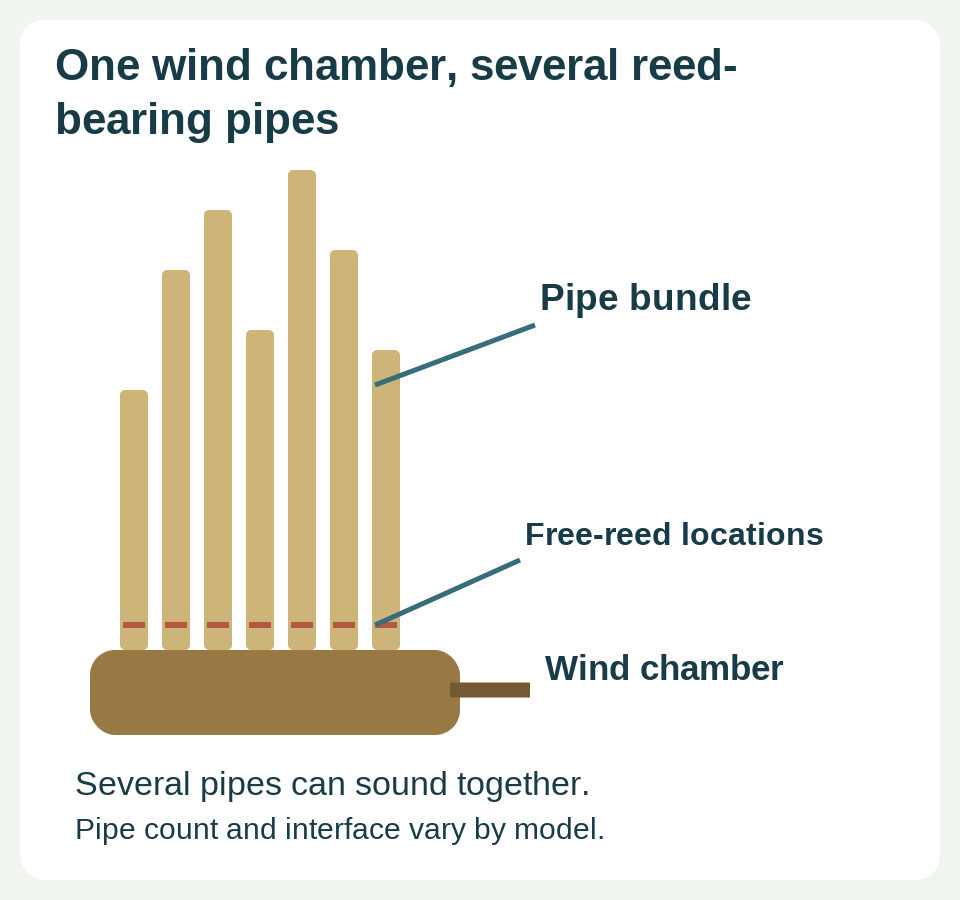
Sheng is a free-reed wind instrument with a bundle of pipes connected to a wind chamber. BCCMA describes brass reeds associated with the pipes and sound production during inhalation as well as exhalation. Its ability to sound multiple notes helps explain its chordal and ensemble roles.
Traditional and modern instruments vary. The BCCMA description includes differences in pipe counts, reed-bearing pipes and keyed or other modern arrangements. Avoid defining every sheng by a single number of pipes, a single layout or universal chromatic capability.
On stage, look for the pipe bundle and playing interface, then connect that view with the program credit. A smaller hand-held form and a larger keyed model may look quite different. Knowing that variation prevents you from overlooking an alto or bass member of the same family.
Chinese-orchestra performances
An orchestra offers a chance to hear sheng in relation to flutes, double reeds, strings and percussion. Follow its role through one phrase: does it support a melody, contribute harmony, blend with another wind or become prominent in a passage? You do not need to identify every note to learn from the arrangement.
Timbre and Orchestration provides wind-family explanations and source-hosted examples. Use the named instrument and musical context to frame your listening question. A blended chord is an orchestral result; it should not automatically be credited to sheng alone.
For a concert you intend to attend, check the piece-specific lineup. If the program gives only a broad orchestra description, a venue inquiry may be useful. Write the answer down with the event details so an interesting possibility does not become an unsupported travel claim.
| Lead | Useful confirmation | Remaining limitation |
|---|---|---|
| Orchestra instrument page | It describes sheng in that orchestra’s wind family. | It does not prove a particular concert uses it. |
| Current concert program | The piece or lineup names sheng or a player. | Check changes, venue and date. |
| Chamber or recital listing | A specific performer and instrument are credited. | Confirm acoustic or other format if that matters. |
| Festival or attraction description | The actual performance schedule names sheng. | A broad cultural label is insufficient. |
Recitals, chamber events and demonstrations
A credited recital or chamber event may make the sheng’s individual sound-making actions easier to follow than a dense orchestral passage. A demonstration can also reveal the relationship between pipe selection and simultaneous notes. Choose an event because its actual description fits that interest.
If you are looking online first, BCCMA’s sheng page includes a source-hosted video link. It is a starting point for a credited instrument context, rather than evidence of a future event in China. BCCMA is based in British Columbia; its educational instrument description should not be mistaken for a Chinese venue schedule.
For a classroom visit, check whether the presenter will explain the instrument, perform it or merely display it. Those are different experiences. Ask one focused question, such as how a chord is selected on the demonstrated model, instead of assuming that every form works like the photograph you first saw.
- Match the event format to your goal.
- Educational links are not travel schedules.
- Ask about the actual model being demonstrated.
A three-pass listening plan
In the first pass, confirm the instrument credit and follow one visible player or identified part. In the second, notice whether the passage uses a single line, simultaneous notes or changing textures. In the third, listen for interaction with a flute, reed or string part.
Do not rule out sheng just because the phrase is melodic rather than chordal. Capability and musical choice are different. Likewise, do not identify sheng solely because a recording has chords: multiple players or layered tracks can create them.
Record one observation and one unanswered question. For example, you might notice sustained support under a flute melody and still be unsure which keyed sheng model is playing. The program, score excerpt or a presenter can help answer the remaining question more effectively than repeated guesses about brightness.
Practice situations
These are illustrative examples for working through the decision.
An orchestra page treated as a ticket confirmation
A traveler sees sheng on an orchestra’s instrument page and assumes it appears in next week’s concert.
What needs another check?
The specific current program and lineup. The instrument page describes the orchestra’s family, not every event.
A Canadian educational page used as a China venue
A student lists BCCMA’s sheng video page as a place to attend in China.
How should the source be used?
As an educational mechanism and video lead. BCCMA is in British Columbia; find a separate current Chinese event listing.
No chord in a credited performance
A chamber program credits sheng, but one passage sounds like a single melody.
Is the credit contradicted?
No. The instrument can choose a single line. Follow the model and performer rather than requiring chords.
An unconfirmed festival visit
A festival advertises traditional music without naming instruments.
What is the practical next action?
Look for the actual schedule or ask the organizer whether a sheng player is in that performance. Do not guarantee the lineup from the broad label.
Make a realistic short list
Choose two or three leads with the strongest current evidence. Record the event page, instrument credit, date, location and the detail you still need to confirm. If no event currently names sheng, keep an educational recording or a future venue program as a research lead without describing it as a booked performance.
Use the sheng-versus-suona resource if identification remains uncertain. Use the orchestra seating-plan guide if your question is how the wind family fits into the ensemble. The next step should answer a specific gap: lineup, model, musical role or event format.
This keeps the search useful whether you are traveling, planning a class or exploring from home. A verified small recital can answer your question better than a large event whose publicity never identifies the instrument.
Download the blank worksheet (TXT)
Fill it with your own observations, source details and next question.
Questions and answers
Will every Chinese-orchestra concert include sheng?
No such guarantee follows from an instrument-family description. Check the specific program and lineup.
Does every sheng have seventeen pipes?
No. Traditional and modern designs vary in pipe counts, reed-bearing pipes and playing interfaces.
Can sheng play a single melody?
Yes. Its ability to produce chords does not require simultaneous notes in every passage.
What should I ask a venue?
Ask whether the dated event includes a credited sheng performer or part, and confirm the location and format relevant to your visit.
Use written cues, then check a source
Use the sound words here as cues, then open a source-hosted route before relying on written tone descriptions.
- Open the sourceListen at the linked page and check the instrument name, setting, or collection context.
- Write one cueNote one thing you can hear: attack, sustain, volume, breath, reed edge, strike, or room setting.
- Return to the notebookCompare that cue on the sound page before choosing a learning, teaching, buying, or museum-reading path.
Sources and scope
References support the construction, notation, historical-object or recording details discussed above. Use the complete source description when comparing instrument models or recordings. The diagrams are original educational material, and the practice situations are illustrative examples.
- Hong Kong Chinese Orchestra: Winds
- Timbre and Orchestration: Chinese Winds
- British Columbia Chinese Music Association: Sheng
Editorial revision: 4 November 2026.