what is
What Is the Suona Instrument?
Identify the suona by its double reed, conical bore and flared bell. Understand ceremonial and orchestral uses, recording limits and questions for a first lesson.
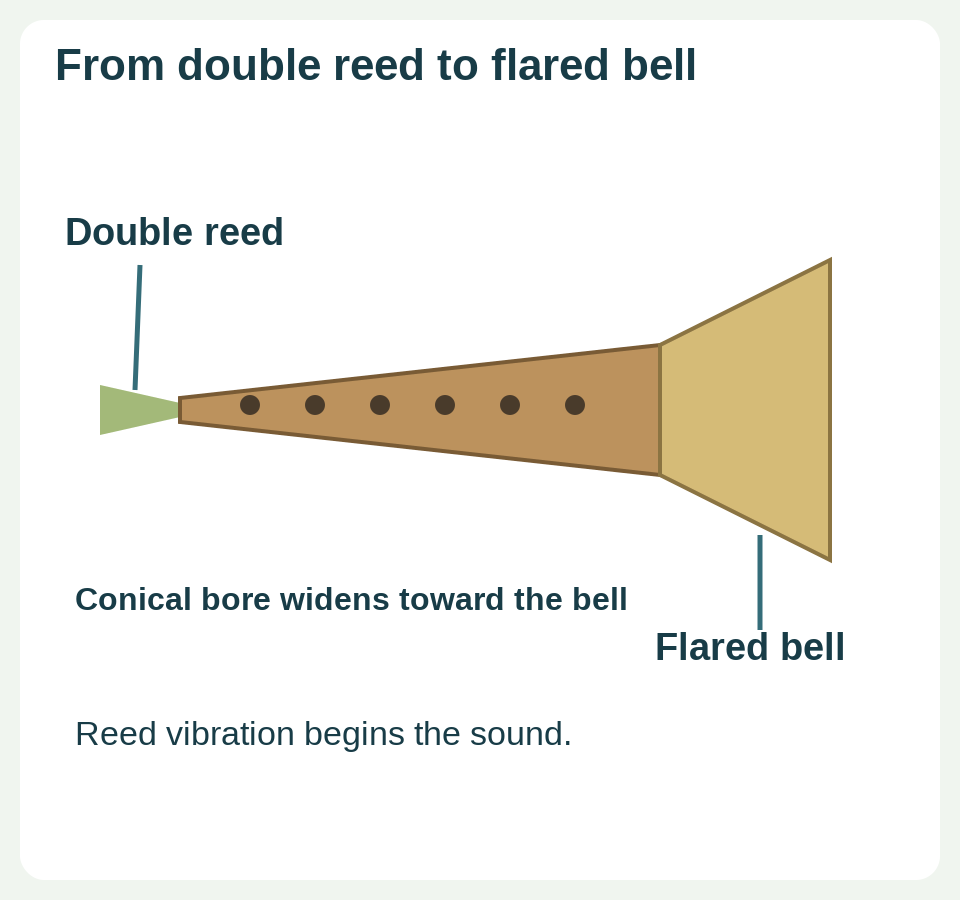
A reed instrument with a recognizable construction
The suona (唢呐, suǒnà) is a Chinese double-reed wind instrument. Its familiar acoustic form has a reed at the mouthpiece, a conical bore and a flared bell, often metal. The player supplies air, the reed vibrates and the instrument’s air column responds. Finger holes or keys, depending on the model, help control pitch.
A bell can make the instrument look superficially like a small brass instrument. The sound-making interface is different: a trumpet begins with the player’s vibrating lips, while the suona uses a reed. Start with that distinction when explaining it to a child or identifying an unfamiliar stage instrument.
The Hong Kong Chinese Orchestra and the British Columbia Chinese Music Association both describe a family with different sizes and uses. One picture is a useful construction example, rather than a complete catalog of every suona design.
- Check the reed as well as the bell.
- Describe the actual model shown.
- A conical bore distinguishes it from the usual cylindrical-bore guan.
What its sound can tell you
Suona is often described as penetrating, bright or nasal. Those words can help point a listener toward a comparison, but they are not exclusive identifiers. Register, articulation, player, reed, room and recording treatment affect the result. A short high phrase may conceal more than a clear credited performance view reveals.
Listen first to the beginning of a note and then to the way a phrase continues. Notice repeated articulation, pitch movement and how the line interacts with percussion or other winds. If several instruments double the melody, do not assign the entire blended tone to suona.
The short audio excerpt linked here is described by its uploader as material from Hundred Birds Paying Homage to the Phoenix. It is a few seconds of an uploaded excerpt, not the whole work or a documented model comparison. The file description and displayed license help explain its context; they do not prove who originally performed it or how loud it would be beside you.
- Treat a sound description as a clue.
- Use credits or a visible instrument to confirm a name.
- Do not turn an excerpt into a loudness measurement.
Ceremonial uses and the concert stage
BCCMA describes folk and ceremonial uses, including weddings and funerals. That is evidence of a range of settings, not a rule that suona always expresses celebration or always expresses mourning. Repertoire, local custom, ensemble and the occasion give a performance its meaning.
Suona also appears in modern Chinese orchestras. The HKCO wind-section description includes suona and guan families alongside flutes and sheng. Timbre and Orchestration explains how different wind instruments contribute to a larger orchestral texture. A concert arrangement can place suona in a foreground solo or integrate it into a section.
When choosing an event, read the current program rather than assuming every festival, temple or outdoor performance will include it. Look for an instrument credit, performer name or ensemble description. If you are learning about a ceremony, ask the host or program what that music does in that particular setting.
- Read the occasion and program together.
- Concert use and ceremonial use can coexist.
- A cultural association does not guarantee a local performance.
Traditional forms, sizes and keyed instruments
The sources describe multiple sizes and modern keyed forms. A larger or keyed instrument should not be treated as an unrelated instrument simply because it differs from a familiar small suona photograph. Equally, a label such as high, middle or low does not establish a universal tuning or range across all makers and traditions.
For a useful comparison, ask for the specific model, tuning and intended role. If you are arranging music, confirm the practical range and notation convention with the player. If you are shopping, ask what reed and fingering approach the teacher expects. An attractive listing with no demonstrated match to the lesson is missing important information.
The comparison table gives a next question for each purpose. It does not substitute for a maker’s specification or a player’s demonstration.
| Your purpose | Information to request | Why it matters |
|---|---|---|
| Identify a video | A clear instrument view and performance credit | Timbre alone can be ambiguous. |
| Choose a lesson | Model, reed, tuning and teacher’s approach | The instrument must fit the instruction. |
| Arrange a part | Usable range, transposition and articulation advice | Family names do not define every model. |
| Plan home practice | An actual room-level demonstration and practical arrangements | Recording gain cannot predict practice conditions. |
Before a first lesson or purchase
Ask a teacher to demonstrate the playing interface and explain what a workable first task looks like. Reed condition and instrument setup matter, so a beginner should not judge a listing solely by its appearance or change unfamiliar parts without guidance. Confirm what is supplied and what must match the model.
Discuss where practice can happen before setting a daily quota. An instrument known for projecting in some settings still needs a practical assessment in your own room and circumstances. A digital recording, a phone’s volume slider and a seller’s adjective do not answer that question.
A trial lesson can reveal whether you enjoy the breath-and-reed process and can obtain useful feedback. You can also study performances without owning an instrument. The right next action depends on whether your unresolved question concerns identification, technique, setup or practice arrangements.
Practice situations
These are illustrative examples for working through the decision.
A bell mistaken for a trumpet
A student sees a flared metal bell and writes trumpet under the photograph.
Which detail should be checked next?
Look at the mouthpiece and credit. Suona uses a double reed; trumpet uses vibrating lips. The bell alone does not decide.
A ceremony assigned one universal meaning
A viewer assumes every suona performance must be a wedding celebration.
What context would correct the assumption?
Read the actual occasion, repertoire and local description. The sources also describe funerary and other ceremonial uses.
A several-second excerpt treated as a complete work
A listener recognizes a file described as Hundred Birds Paying Homage to the Phoenix and writes a review of the whole piece.
What can the file support?
An observation about that excerpt and its uploader description. It cannot support a claim to have heard the whole performance.
A purchase before checking the lesson model
A beginner buys a keyed instrument without asking what the teacher uses.
What should have been checked?
Model, tuning, reed approach and instruction compatibility. A family name does not guarantee the same first-lesson interface.
- Arrange feedback on a demonstrated first task.
- Check model-specific reed and setup support.
- Consider a trial before committing to ownership.
Build a small evidence-based listening note
Choose one performance and record its source, performer credit, visible construction and musical setting. Then write one sentence about the role you heard: melody, response, doubling, punctuation or another clearly observed action. Leave an unclear detail blank rather than completing it from a stereotype.
Compare suona with guan if you are identifying two double-reed instruments. Compare it with sheng if you are distinguishing a reed melody from a pipe-bundle instrument that can produce chords. Use the linked practical resource when the broad sound category remains uncertain.
This approach gives you something specific to ask a teacher or concert host. It also makes the next listening session more productive: you know which evidence is missing and which part of the phrase deserves another pass.
Download the blank worksheet (TXT)
Fill it with your own observations, source details and next question.
Questions and answers
Is suona a brass instrument?
Its bell may be metal, but its sound begins with a double reed. Classifying it by sound production places it with reed winds, rather than lip-vibrated brass.
Is suona the same as guan?
They are both double-reed winds, but the familiar suona has a conical bore and flared bell while guan generally has a cylindrical bore. Check the actual model and credit.
Is suona only used at weddings?
No. The sources describe multiple folk and ceremonial settings, including funerals, as well as modern orchestral uses.
Can a recording tell me whether suona suits my home?
It cannot reliably measure your practice conditions. Discuss an actual demonstration, room and practical arrangements with a teacher.
Use the clip as one example
Uploader-described short excerpt associated with Hundred Birds Paying Homage to the Phoenix. This is not the complete work or a room-volume measurement.
Short suona segment by jiemojiemo. Source, Creative Commons 0.
Sources and scope
References support the construction, notation, historical-object or recording details discussed above. Use the complete source description when comparing instrument models or recordings. The diagrams are original educational material, and the practice situations are illustrative examples.
- Hong Kong Chinese Orchestra: Winds
- Timbre and Orchestration: Chinese Winds
- British Columbia Chinese Music Association: Suona and Guan
- Freesound: Suona File and Uploader Description
Editorial revision: 4 November 2026.