beginner learning
Is Guqin a Good First Instrument?
Choose guqin by teacher access, a playable instrument and practice fit. Use a trial-lesson checklist, a realistic first-month plan and beginner decision examples.
Yes, you can begin; choose the learning process
Guqin can be a first instrument. The useful question is whether you want its way of making music and can obtain feedback on the hand actions. You do not need to achieve advanced technique before taking a first lesson, and you do not need to read every guqin character before trying a demonstrated beginner action.
Expect more than pressing a key to get a fixed note. The right hand has distinct plucking and outward-playing techniques. The left hand eventually controls stopped pitches, harmonic touches, slides and ornaments. Some early open-string work is approachable, while accurate stopping and expressive phrasing develop with instruction and practice.
Listen to the instrument, but also watch a beginner demonstration. If you enjoy careful repetition, close listening and slowly connecting movement with sound, the process may suit you. If your main goal is an immediate fixed-pitch accompaniment or a familiar fretted interface, compare another instrument before assuming that a quiet guqin will be the easiest option.
- A first lesson is different from mastery.
- Choose the hand actions and learning process, not only the sound.
- Quietness does not establish ease.
Find feedback before choosing a particular instrument
Ask a prospective teacher how they introduce right-hand technique, stopped notes, harmonics and notation. Request a trial lesson or demonstration of the beginner sequence. Peiyou Chang's teaching pages show how specific the hand actions are: different fingers and directions have names and physical requirements.
For online lessons, ask what the teacher needs to see and hear. A camera should make the relevant hand position visible; test whether both hands, the instrument surface and the sound can be checked without constantly moving the camera. A short test of your actual equipment is more informative than a general promise that online lessons always work.
If no suitable feedback is available yet, begin with listening, notation orientation and a teacher search. You can also ask whether a school, teacher or community group offers access to an instrument for a trial. Owning a guqin before the first lesson is not the only route into learning.
- Ask how the teacher corrects basic hand actions.
- Test your actual camera and sound if lessons are online.
- A trial or shared lesson instrument can precede ownership.
Check a playable setup and a stable practice place
A beginner needs a guqin that can be played for the intended lesson, not simply a beautiful object. Ask a teacher or knowledgeable repairer about its condition, strings, string height, unwanted buzzing and suitability for the beginner's current work. An attractive wood description does not answer those questions.
Ask whether setup has been checked, which strings are fitted, what accessories are included, how the instrument is protected during transport and what the return terms cover. Avoid adjusting unfamiliar parts to solve a problem you cannot yet identify. A teacher's setup check before a return period ends can be more useful than trying to rank instruments by price alone.
Arrange a stable support and sitting position that the teacher can assess. Measure the space with the intended table or supports, rather than assuming that a long instrument will fit wherever a small keyboard fits. Plan for case storage too. The room should let you hear the instrument clearly during short practice without forcing a cramped posture.
- Check playability with someone who understands guqin setup.
- Include support, storage and transport in the decision.
- Ask for a demonstrated sitting and hand position.
A first-month plan with observable checkpoints
Treat the following sequence as a discussion plan for your teacher, not a timetable that every learner must meet. A teacher may change the order to suit the instrument, lesson materials and your starting point.
Start with handling, a demonstrated position and a small right-hand action on open strings. Next, repeat a short pattern slowly enough that you can compare the movements and sound. Add a stopped-note or harmonic action when it has been demonstrated and corrected. Then connect a small passage with the notation and phrasing your teacher uses.
Keep the goal narrow. “Repeat this demonstrated action comfortably and hear whether the intended string sounds” is a clearer first checkpoint than “play a famous piece this month.” If a movement becomes uncomfortable, stop that movement and ask for correction rather than forcing it to complete a practice quota.
| Stage | Small focus | Useful checkpoint |
|---|---|---|
| Early sessions | Handling, support and one open-string action | You can reproduce the demonstrated setup and name the string played |
| Next sessions | A short right-hand pattern | You can repeat slowly and describe one issue to correct |
| When demonstrated | A harmonic or stopped-note action | You can distinguish the intended action from pressing or touching incorrectly |
| A short passage | Notation, timing and phrase shape | You can connect the written instructions to the demonstrated movement |
- Use checkpoints rather than a guaranteed completion date.
- Add new actions after demonstration and feedback.
- Stop an uncomfortable movement and ask for correction.
How to use a short regular practice period
You can divide a short session into three jobs: check the setup, repeat one demonstrated action and note one question. For example, a twenty-minute slot might give a few minutes to settling the support and tuning check agreed with the teacher, most of the time to a short pattern, and the final minutes to recording what needs feedback.
That is an example of session structure, not a promise that twenty minutes guarantees progress at a particular speed. The quality of feedback, the difficulty of the task and your ability to repeat it comfortably matter. A shorter focused session may answer more than a long session that rehearses an uncorrected movement.
Keep a small log: action practiced, issue noticed, correction given and next task. A recording can help if your teacher agrees on the angle and sound needed. It does not replace the teacher's view of the hands or make every audible noise a setup fault.
Download the blank worksheet (TXT)
Fill it with your own observations, source details and next question.
- Repeat one agreed task rather than adding many new techniques.
- End with one precise question or observation.
- Use recordings in a format the teacher can assess.
Understand the notation without postponing the first lesson
Guqin jianzipu describes playing actions through character components. A beginner can learn a small set of components alongside the actions they name. Peiyou Chang's introductory example separates a left-hand finger, a hui position, a string and a right-hand technique; John Thompson's sample tablature explanation also emphasizes clusters of abbreviated elements.
You do not need to memorize the whole system in advance. Ask your teacher which components occur in the current exercise and how the timing is taught. A numbered or staff transcription can help with pitch and rhythm, but it does not automatically carry all the same hand-action information.
Keep the lessons connected: see the action, name it, find the relevant notation component and repeat the action. Reading a symbol and performing its technique are related skills, not interchangeable achievements.
- Learn the current exercise’s components with the corresponding actions.
- Ask how timing and phrasing are taught.
- A pitch transcription is not a complete replacement for jianzipu.
Choose the next step for your own constraints
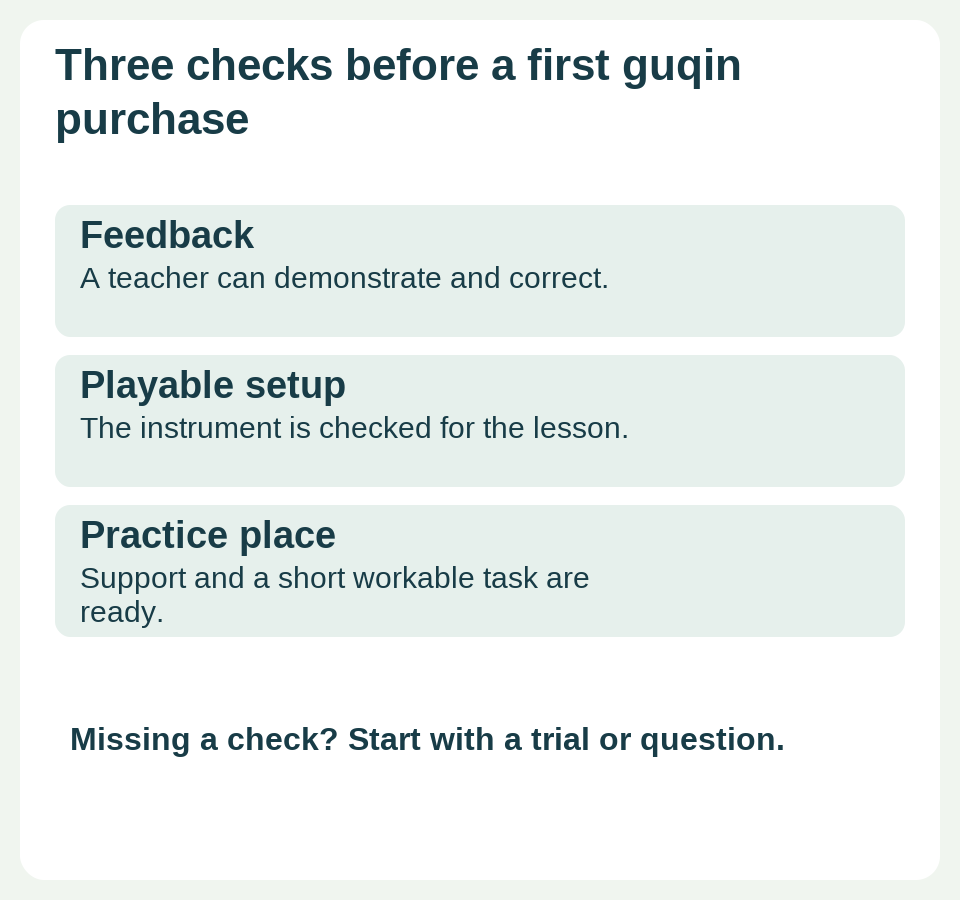
Continue toward a trial when you have a teacher or feedback route, access to a suitable instrument and a workable practice place. If one of these is missing, make that your next question rather than choosing a listing first.
Compare guzheng, pipa or ruan when their music and playing interface interest you, but compare them on their own terms. A guitar background may help with musical habits without transferring every motion to pipa or ruan; the frets and movable bridges of other instruments do not make guqin's stopping system disappear.
Historical statements about decades of training concern proficiency and tradition, not a requirement to wait before beginning. UNESCO's heritage description should not become a stopwatch for a modern novice. Use the scenarios below to choose a trial, a setup check, a teacher search or another comparison.
Practice situations
These are illustrative examples for working through the decision.
A learner with short regular sessions
An adult can practice in short slots and has found a teacher who offers feedback on the first right-hand actions.
What is a reasonable next step?
Arrange a trial using a suitable lesson instrument if possible. Ask the teacher for one repeatable action and a checkpoint, rather than promising a full repertoire goal for the first month.
A low-price decorative listing
A seller provides beautiful photographs but no information about playability, strings, setup checks or return terms.
Should a beginner buy it to begin sooner?
First ask for the missing information and a teacher or setup assessment. Appearance and price do not establish that it can support the intended first lesson.
An online lesson with an incomplete camera view
A learner’s video shows the right hand clearly but hides the left hand and part of the instrument.
What should be tested before relying on this setup?
Ask the teacher to assess the actual view and sound for the planned exercise. Change the camera position or lesson setup if the actions being corrected cannot be seen.
A listener who mainly wants relaxation audio
Someone enjoys guqin recordings but has not tried or watched the basic hand actions and is unsure about learning an instrument.
Is a purchase necessary to explore the interest?
No. Start with credited listening and a demonstration or trial. The attraction to recordings can lead to learning, but it does not oblige you to own an instrument or prove that the practice process fits.
Questions and answers
Must I already read Chinese to start?
Not every teacher requires it for a first lesson. Ask which notation and language the lessons use, and learn the terms and components in your current exercises with their demonstrated actions.
Can I learn only from a printed notation chart?
A chart helps with symbols, but basic hand actions, posture, timing and setup need a demonstration and a way to receive feedback.
Does a short open-string sample show the whole instrument?
No. It demonstrates open-string sound in one recording context. Harmonics, stopped notes, pitch movements and repertoire require other demonstrations.
How soon will I be able to play a famous piece?
There is no dependable timetable from the instrument name alone. Choose a suitable short passage with your teacher and use technique and musical checkpoints rather than a promised deadline.
- Choose the next action from the missing practical check.
- Compare other instruments by their own hand actions and music.
- Beginning and advanced proficiency are different decisions.
Use the clip as one example
Uploader-described guqin open strings. This is one tuning/example, not a demonstration of every guqin technique or tuning.
Open-string guqin sample by RafaelCaro. Source, Attribution 4.0.
Sources and scope
References support the construction, notation, historical-object or recording details discussed above. Use the complete source description when comparing instrument models or recordings. The diagrams are original educational material, and the practice situations are illustrative examples.
- UNESCO: Guqin and Its Music
- Peiyou Chang: Guqin Notation 1
- Peiyou Chang: Guqin Notation 2
- Peiyou Chang: Guqin Notation 3
- Silkqin: Sample Tablature
- Freesound: Guqin File and Uploader Description
Editorial revision: 4 November 2026.