Practical guide
Sheng vs Suona: Reeds, Airflow and Sound Production
A sheng selects separate free-reed pipes from a shared wind chamber; a suona uses a double reed at the top of a conical body. Check the mechanism before assigning a tone or ensemble chord to one instrument.
Start with the reed system, then check the instrument
A sheng (笙) is a free-reed mouth organ: several pipes connect to a wind chamber, with a reed associated with each sounding pipe. A suona (唢呐) is a double-reed instrument: the reed sits at the top of a body that opens into a bell. They both use breath, but they do not start or select sound in the same way.
If you are looking at a photograph, start with the assembly of pipes versus a single body with an end bell. Then check the label and the reed arrangement. If you are listening without a view, keep an identification provisional: register, articulation, the room, amplification and the other players all affect the sound.
| Question | Sheng | Suona |
|---|---|---|
| What starts the sound? | Free reeds associated with its sounding pipes. | A double reed at the top of the instrument. |
| What is the visible body? | A group of pipes connected to a common wind chamber. | A slightly conical body ending in a bell. |
| How are notes selected? | Fingers or keys select sounding pipes. | Finger holes or keys select notes on the body. |
| Can ordinary playing combine notes? | Several selected pipes can sound together; melodies are also possible. | Ordinary playing follows a melodic line; it is not a set of independently selected reed-pipes. |
| What can change with the model? | Pipe count, register, layout and keyed interface. | Register, size, keyed interface and playing options. |
This table compares ordinary sound-production principles. It is not a fingering chart, a price guide or a claim that every instrument with these names has the same range. For the larger ensemble setting, use the Chinese orchestra section guide.
Sheng: separate reeds and a shared wind chamber
The pipes are not simply a row of flutes that the player blows across one at a time. In the sheng, a mouthpiece supplies the common wind chamber. Britannica's sheng description identifies a free reed in each pipe and explains that covering a finger hole makes that pipe sound. Its description distinguishes the bamboo pipes from the reeds, which are metal in the described modern construction; earlier reed materials also existed.
That distinction matters when reading a label. “Bamboo wind instrument” may describe a visible pipe material; it does not mean that the player makes sound by blowing across the pipe's rim, or that every reed must be bamboo. Nor does a common wind chamber mean there is just one reed supplying all the notes.
On a traditional finger-hole instrument, the player selects pipes with the fingers. On a keyed sheng, a key mechanism provides a different interface. Several selected pipes can sound together, which helps explain chordal textures and accompaniment. The same player can also play a melody. Hearing a single line is therefore not evidence against a sheng identification.
The Timbre and Orchestration Resource describes sound produced by blowing out or drawing breath in. This is a useful mechanism distinction, not an invitation to copy a breathing exercise from a diagram. The learner still needs model-specific instruction on holding, fingering, articulation and maintenance.
Do not turn the familiar “17 pipes” description into a test that excludes all other shengs. Britannica describes several traditional and modern pipe sets; the orchestration resource also discusses keyed developments and different registers. For an exact instrument, use its own description or the performer and maker's information. Counting visible pipes in a partly obscured image does not establish its complete musical range.
Suona: a double reed at the start of a conical body
The Timbre and Orchestration wind-instrument guide describes the suona as a double-reed instrument with a slightly conical body and an end bell. The reed connects to a bocal, the short connection at the top. A circular support disc may be visible in that assembly. It is a different part from the bell at the far end.
Double reed refers to the paired blades of the vibrating reed. It does not mean two separate reed-pipes are selected to make a chord. In ordinary playing, the player blows toward the reed, and the reed and body form the sounding system. Holes and, on suitable models, keys change the available notes. The bell is the opening at the end; it is not the reed that begins the vibration.
A metal bell does not make the suona a lip-vibrated brass instrument. The useful classification question is what vibrates to initiate the sound. Hong Kong Chinese Orchestra explicitly places suona and guan among double-reed winds. The material of a visible accessory and the sound-production category answer different questions.
Keyed suonas appear in modern orchestras in different sizes. Keys can change the playing interface and access to notes, but they do not turn a suona into a sheng. Likewise, the possibility of expressive pitch changes does not supply a universal fingering pattern. The orchestration guide describes effects made through combinations of lip, breath and finger control; those are techniques for instruction with a suitable instrument.
The resource also discusses circular breathing on suona. This maintains a sounding phrase while the player replenishes air. It should not be confused with the sheng's ability to sound through both outward and inward breath. An uninterrupted phrase alone cannot tell you which mechanism is in use, and a written comparison is not a circular-breathing tutorial.
Trace two paths without turning the picture into a playing instruction
The original diagrams below separate the common air supply and selectable reed-pipes of a sheng from the reed-to-body path of a suona. Read each one from top to bottom as a sequence of questions. The arrows show the relationship between parts; they do not specify pressure, speed, dimensions or a safe practice routine.
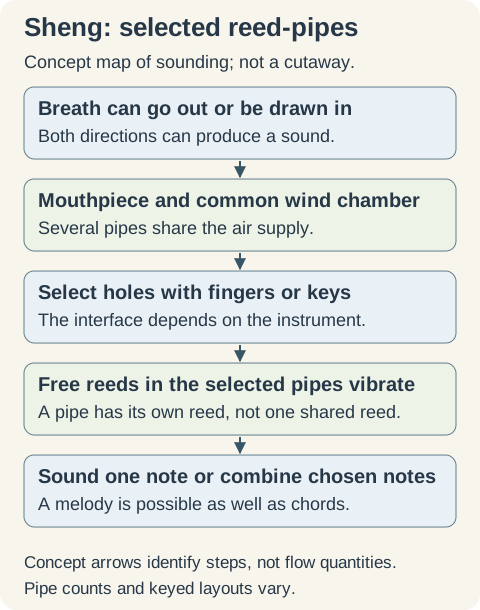
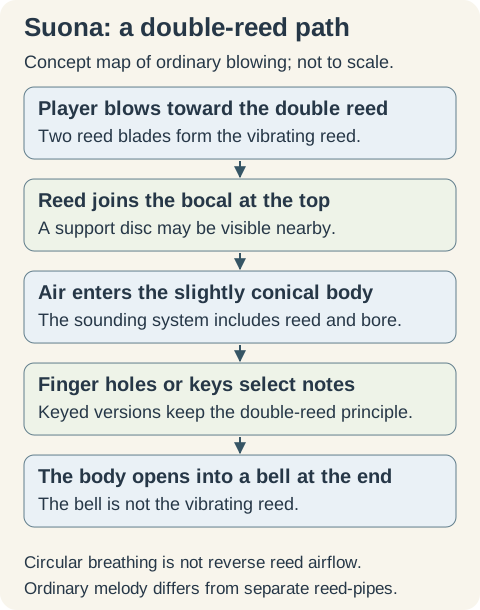
When looking at an actual object, add “not visible” wherever the photograph hides a part. You do not need to take an instrument apart to complete this comparison. A labeled description or a teacher's demonstration can answer the reed question without treating an unclear picture as proof.
Listen for note patterns and attacks, then verify the source
Sound words such as bright, mellow, piercing or organ-like can point your attention somewhere, but none is a reliable instrument detector. A high sheng register can sound bright; a suona's articulation and projection depend on the player and setting. Loudness in a recording also depends on microphone placement and playback level.
| Observation | What it may help you notice | What it cannot establish |
|---|---|---|
| Several notes begin or continue together | A sheng can combine selected pipes in ordinary playing. | An ensemble chord could be several players or an added layer. |
| One flowing melodic line | Follow articulation, pitch changes and phrase shape. | Both instruments can carry a melody. |
| A sustained phrase without an audible pause | Notice continuity before deciding how breath was managed. | It does not distinguish inward sheng sounding from circular breathing. |
| A bright or penetrating attack | Compare attacks within the same recording context. | A tone adjective alone does not identify the reed system. |
| A captioned performer with a visible instrument | Connect the sound to the actual player's action. | A distant camera view may hide the reed, keys or complete pipe set. |
| A chord changes while one visible sheng player selects notes | Relate the changing texture to that identified instrument. | It does not establish a universal chord layout or the model's full range. |
For a labeled starting example, the Britannica sheng article includes “Wuzikaimen,” identified there as a Chinese folk song played on a sheng. Use the source's own player and caption. Choose a separately labeled suona performance from a performer, orchestra or teaching institution for the second observation. Record its identity rather than treating an anonymous search clip as a match.
Compare a short passage in which you can follow the relevant performer, at a comfortable playback level. First record what you hear without an instrument guess. Then check the name and visible action. Finally ask whether the note pattern fits the described mechanism. You do not need two clips in the same key or to judge which player sounds better; this is an observation of structure and texture.
Three fictional observations show how to correct a first guess
These invented examples illustrate a checking method. They are not reports of recordings we tested, actual pupils' results or claims that a listener can identify every instrument by ear.
1. A bundle of pipes, with one line in the passage
Mina sees a caption naming a keyed sheng, but the musician plays only a melody in the selected passage. She initially writes “cannot be sheng because there are no chords.”
Better note: “The caption and visible pipe assembly identify the sheng. It can combine notes, but this passage uses a melody. The absence of a chord is a musical choice, not a different reed system.”
Mina separates the instrument's capacity from what this passage asks it to do. She leaves the exact pipe count and range blank until the model information is available.
2. A flared metal end, with the reed hidden
Arun sees a photograph of a suona with the upper connection partly behind the player's hand. The bell reminds him of a small trumpet, so he labels it “brass: lips make the sound.”
Better note: “The bell is visible, but the sound-source identification needs the caption or top assembly. The labeled suona uses a double reed. A metal bell alone does not establish lip vibration.”
Arun checks the instrument description rather than inferring a reed from the part he cannot see. He does not claim that every bell-shaped object is a suona either.
3. A strong chord in a full ensemble
Leah hears several simultaneous pitches while the camera shows an orchestral wind section. A suona player is prominent in the frame, so she assigns the complete chord to that one instrument.
Better note: “This is a combined texture. The frame does not isolate every sounding player. I can describe the chord, but I need a solo view, a score or a clear identification to attribute all its notes.”
Leah keeps the audible observation and the instrument attribution in separate fields. Turning down an uncertain label does not erase the useful observation of the musical texture.
Use two short records to keep parts and listening separate
Complete the structure record from a labeled photograph or instrument description. Complete the listening record from one identified passage. Keeping them separate prevents an attractive sound word from filling in a part that you have not actually seen or verified.
SHENG AND SUONA — STRUCTURE RECORD
Instrument name and the source that identifies it:
Traditional or keyed model; what is actually visible:
Mouthpiece, reed position, body and end opening:
One double reed, or separate free reeds in pipes:
Finger holes or keys; what the description says they select:
Which parts are hidden in this photograph:
Do not infer exact range or pipe count from a distant image.
LISTENING RECORD — OBSERVATION BEFORE IDENTIFICATION
Recording title, performer/ensemble and source:
Instrument caption and time in the recording:
Is one performer isolated or is this an ensemble texture:
One line, several notes together, attack and sustain:
Visible playing motion that supports the identification:
What could another player, microphone or effect explain:
One next check; leave uncertain identity unresolved:
Download both blank records, diagram notes and the six answered checks. For a class, you can compare two descriptions first and make the listening step optional if a suitable labeled example is unavailable. A student should be able to write “uncertain” and explain what would resolve it.
This worksheet ends when you can explain the different reed systems and identify one useful observation with its limit. It does not rank learning difficulty, set a buying budget or establish a practice-room noise allowance. If you want to learn either instrument, ask a teacher about the actual model and the first lesson before buying reeds or copying a performance technique.
Six checks for a mechanism-first comparison
Try the original cases before opening the explanations. Each asks you to separate a structural fact, a playing option or an audible observation from a stronger claim it cannot support.
Case 1
A labeled sheng plays only one melodic line in the passage. Does that rule out a sheng?
Show answer and explanation for case 1
No. The sheng can play a melody as well as combined notes.
A musical passage need not use every capability of the instrument. Use the identified pipe-and-reed arrangement rather than requiring a chord in every phrase.
Case 2
A suona has a metal bell. Is that enough to classify its sound source as lip vibration?
Show answer and explanation for case 2
No. The suona uses a double reed.
The material and shape of the end bell do not tell you what initiates vibration. Check the reed at the top or a reliable instrument description.
Case 3
A sheng player draws breath inward while sounding. Is this necessarily the same method as a suona player maintaining a phrase with circular breathing?
Show answer and explanation for case 3
No. They are different explanations of sound and breath management.
The sheng can sound with outward or inward breath. Circular breathing on suona maintains the outward sounding phrase while air is replenished; an unbroken phrase alone does not identify the mechanism.
Case 4
One sheng has keys and another has exposed finger holes. Does that mean one must have a suona-type double reed?
Show answer and explanation for case 4
No. A keyed interface does not change the sheng into a double-reed suona.
Keys and fingers are alternative note-selection interfaces on different models. Read the reed and body description separately from the presence of keys.
Case 5
You hear a chord while a suona player appears in a full-orchestra shot. Can you attribute every pitch to that performer?
Show answer and explanation for case 5
No. The recording may combine several sounding players.
Record the chord as an audible texture, then check a solo view, score or clear source identification before assigning all its notes to one instrument.
Case 6
An unclear picture seems to show 17 pipes. Does this establish the instrument's exact range or exclude other sheng models?
Show answer and explanation for case 6
No. Pipe counts and models vary, and the picture may be incomplete.
A familiar pipe-count description is not a universal range chart. Use a model-specific source; do not convert a partly hidden photograph into an exact musical specification.
Sources and further reading
- Britannica: ShengPer-pipe free reeds, material distinctions and varied pipe sets. The labeled audio remains at its source; this guide does not reuse the recording or photograph.
- Timbre and Orchestration Resource: Wind Instruments — Chinese OrchestraPipe selection, outward/inward sheng sounding, suona double reed and conical body, model interfaces and the difference from circular breathing. No exact range is reproduced.
- Hong Kong Chinese Orchestra: Wind InstrumentsIndependent sound-source categories and examples from this orchestra's own instrument lineup, not a universal configuration.