Instrument guide
Dizi: Membrane Variants, Score Pitch and Recording Context
Distinguish bangdi, qudi, xindi and dadi; read the membrane and octave conventions; and keep a short dizi loop separate from model, range and buying evidence.
Winds and reeds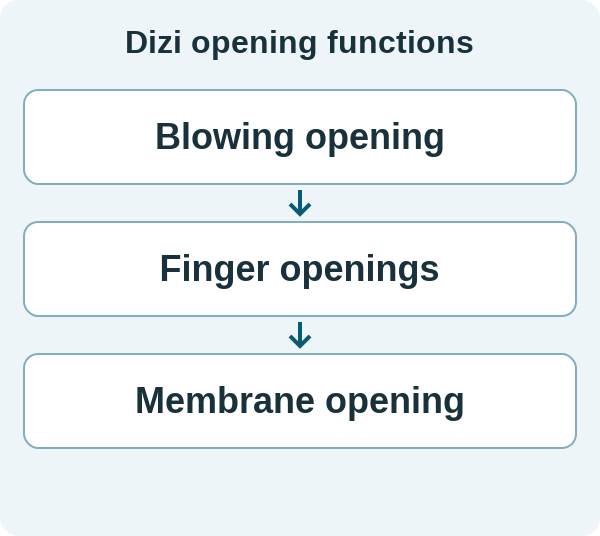
Dizi is a family name; the variant changes the next question
Dizi is a transverse flute, usually made from bamboo, but the broad name does not specify one membrane, tuning or register. Identify the variant and actual instrument before reading a range chart, matching a lesson score or interpreting a recording.
The Timbre and Orchestration Resource describes traditional dizi with six finger holes, a blowing hole and a separate membrane hole. Its modern-orchestra account distinguishes bangdi, qudi and xindi. HKCO’s own wind list also names dadi. These are useful variant labels, not interchangeable spellings for one identical instrument.
A description can support the instrument’s construction without proving how a particular unidentified clip was played. A phrase may sound bright or mellow, but a tone adjective does not establish the membrane hole, model or key.
Three openings have three different jobs
| Opening | Function | Reading mistake to avoid |
|---|---|---|
| Blowing hole | The player directs the air across the side opening. | Do not confuse it with a hole covered by dimo. |
| Finger holes | The playing interface used to select notes. | Six finger holes does not mean six openings of every kind. |
| Membrane hole | A separate opening covered by the vibrating dimo sheet on common membrane variants. | A membrane is not the reed of a sheng or suona. |
The comparison is a description of the common membrane construction. Xindi is explicitly membrane-free in TOR and the HKCO chart. The latter distinguishes non-membrane xindi from membrane dadi even though they share a range-chart row.
When the camera or a hand hides the relevant opening, record “not visible.” That does not prove absence. Conversely, an identified xindi without a membrane is not a wrongly built bangdi merely because both are called dizi.
Read variant descriptions without promising one fixed tone
TOR describes bangdi as smaller than the other dizi types it discusses, with a bright, resonant and clear quality. It describes qudi as thicker and mellower and xindi as membrane-free. Those are qualified descriptions of named types in that resource, not measurements of every maker’s instrument or a test that identifies every recording.
The resource also explains that instruments are labelled by tuning and selected for the desired key and timbre. For your own instrument, retain the exact maker and model label, teacher’s requested key and the notation convention used by the lesson.
Do not use a downloaded loop’s filename to determine which dizi to buy. A title such as Dm may describe musical material rather than the maker’s tuning stamp. The record may not supply the variant or a fingering chart.
The score’s octave convention is another layer
HKCO’s official chart says bangdi and qudi sound an octave higher than written in the convention it describes. Xindi and dadi sound as written. It labels basic tones, overtones and extreme notes separately.
That means a copied range number without its variant and written/sounding convention can be misleading. So can a claim that an extreme printed note is automatically comfortable for a first lesson. Match the source’s scope and ask a teacher about the actual passage.
Our written-and-sounding pitch guide shows the original arithmetic of one-octave changes. It does not provide a fingering chart or guarantee that its hypothetical written C4 belongs to your instrument’s playable range. Use the actual part and its legend to resolve an octave disagreement.
Take an instrument-specific question to the teacher
For a first lesson, ask which variant and tuning the course uses, how the label relates to the lesson notation, and whether the fingering and register match the supplied book. Record the teacher’s actual answer rather than select a universal “beginner key” from a generic article.
For a seller, ask for the exact model, label photograph, a model-specific fingering or pitch reference, and what comes with it. If a membrane is required, identify the supplied membrane and maintenance instructions. If the model is membrane-free, do not buy a dimo accessory to repair an absence that is part of its design.
Hand fit needs the actual hole spacing or a supervised trial. Recording playback volume does not establish suitability for an apartment. The buying checklist turns these questions into a documented order decision without inventing price, quality or a tested brand recommendation.
The current Carty source is a short loop
The linked CarlosCarty file is titled Dizi_Loop_Carlos Carty_6_Dm_100BPM.wav. Its uploader describes a loop recycled from recordings; the page shows 20 December 2018 and a duration of 0:04.799. It displays Attribution 4.0.
Label it as an uploader-described dizi loop. The file title’s Dm and 100BPM are not independently measured here. The description does not supply a specific bangdi, qudi or xindi model, a complete piece, or a whole regional style. This entry did not audition or test the file.
Use the source-record worksheet before treating a clip as evidence for a model, isolated tone or performer. The source’s licence governs any reuse; an appropriate credit does not fill missing instrument information.
Choose the route that answers the missing fact
If the uncertainty is the blowing interface, use Dizi, Xiao and Xun. If it is a scale degree or duration mark, use the jianpu reading guide. If it is a printed octave, use the score’s legend and the chart-reading guide.
Do not diagnose a membrane buzz, weak note or tuning problem solely from this entry. Record the model, what changed, the relevant note or visible part, and the maker or teacher instruction you need. Keep membrane work and breathing exercises attached to actual instruction rather than copy an unsupported adjustment from a generic comparison.
A complete first record has five fields: named model; variant and tuning; source of the range and fingering; lesson requirement; unresolved fit or setup question. Each missing field points to a concrete next check.
A source-linked loop
Uploader-described dizi loop recycled from recordings; displayed CC BY 4.0. The filename is not a verified model, tuning stamp or full instrument range. This revision did not audition the audio.
Short dizi loop by CarlosCarty. Source · Attribution 4.0
Sources and further reading
- Timbre and Orchestration Resource — Wind Instruments
Dizi opening functions and named variant descriptions in the resource’s Chinese-orchestra context. Checked 7 November 2026.
- HKCO — Wind Instruments
Dizi variant names used by this orchestra. Checked 7 November 2026.
- Hong Kong Chinese Orchestra — Instrumentation and Range Table
Written and sounding conventions for bangdi, qudi, xindi and dadi, with separately labelled range categories. Checked 7 November 2026.
- Freesound — Dizi_Loop_Carlos Carty_6_Dm_100BPM.wav
Uploader’s file title, loop description, displayed upload date, duration and attribution licence. Checked 7 November 2026.
- Creative Commons — Attribution 4.0 deed
Credit, licence links and marking changes in the human-readable Attribution 4.0 summary. Checked 7 November 2026.